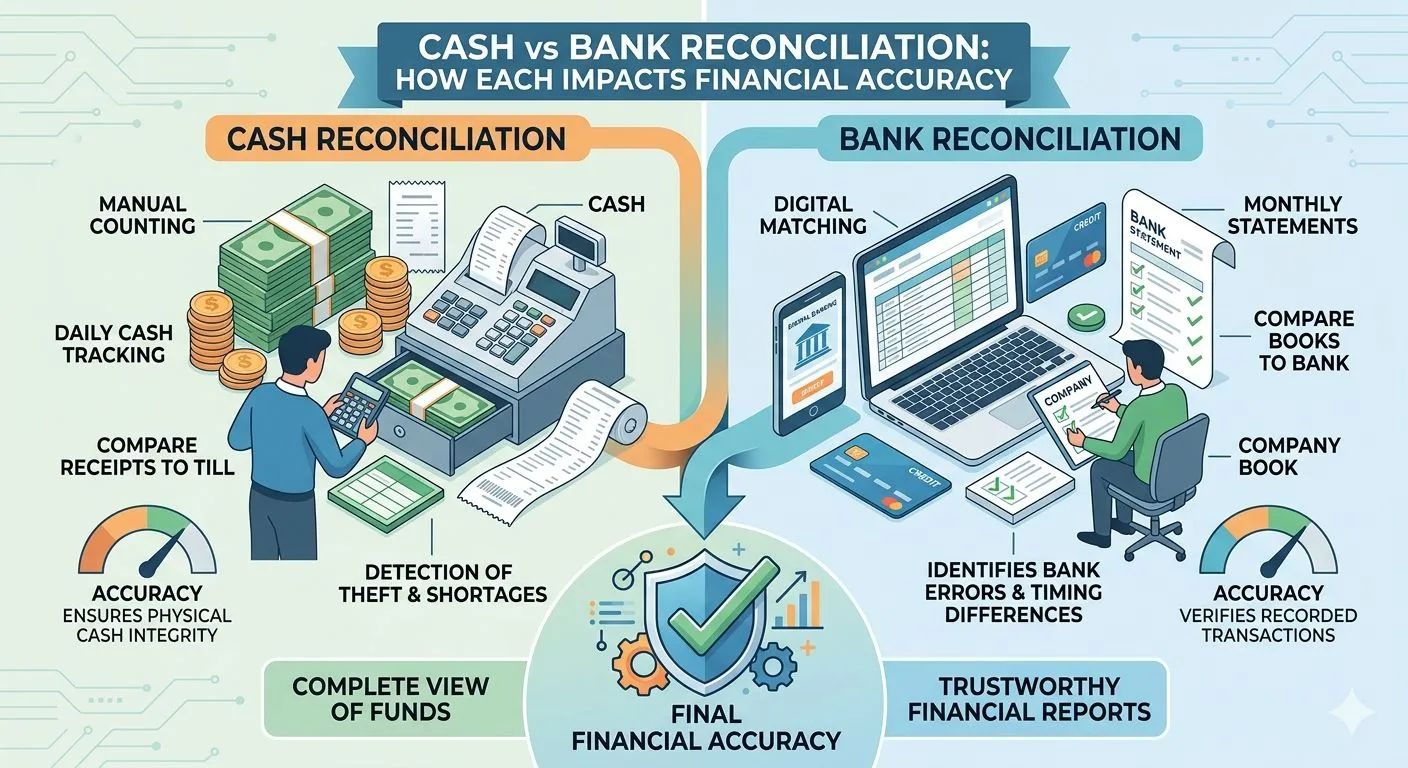

Finance teams often use the terms cash reconciliation and bank reconciliation interchangeably, even though both processes serve different operational purposes. This confusion creates reporting gaps because organizations may validate bank balances without fully reviewing treasury activity across receipts, settlements, transfers, and ledger postings. As transaction volumes increase across ERPs, treasury systems, payment platforms, and banking environments, finance teams need broader transaction-level validation to maintain accurate liquidity visibility and financial reporting. Without clear reconciliation ownership and structured validation workflows, unsupported entries, delayed settlements, and posting inconsistencies continue spreading across reporting periods.
Cash reconciliation and bank reconciliation both support financial accuracy, but each process validates different operational risks. This article explains the differences between both reconciliation approaches, the records finance teams should review, the most common discrepancies organizations encounter, and how structured reconciliation improves treasury visibility and reporting confidence.
Why Finance Teams Often Confuse Cash and Bank Reconciliation
Finance teams frequently confuse these reconciliation processes because both involve validating balances and treasury activity.
Despite similar objectives, their operational scope differs significantly.
Similar objectives but different operational scope
Both reconciliation processes support financial accuracy and discrepancy detection, but cash reconciliation reviews broader treasury activity while bank reconciliation focuses primarily on bank-recorded transactions.
Why balance matching alone creates reporting gaps
Matching balances alone does not confirm that all receipts, settlements, transfers, and treasury entries were recorded accurately.
Impact of misunderstanding reconciliation responsibilities
Unclear reconciliation responsibilities increase the risk of unresolved discrepancies, unsupported adjustments, and delayed financial close cycles.
Organizations therefore need a clearer understanding of what bank reconciliation actually covers.
What Bank Reconciliation Actually Covers
Bank reconciliation validates whether transactions recorded by banks align with internal ledger balances and treasury records.
The focus remains on external transaction validation.
Definition of bank reconciliation in finance operations
Bank reconciliation compares bank statements against internal ledger balances to identify discrepancies caused by timing differences, posting errors, or missing transactions.
Organizations often improve their Cash and Bank Reconciliation processes to reduce treasury discrepancies and improve financial reporting accuracy.
Comparison between bank statements and ledger balances
Finance teams compare deposits, withdrawals, outstanding checks, fees, and settlements against internal accounting records.
Why bank reconciliation focuses on external transaction validation
The process validates whether banking activity recorded externally matches internal treasury records accurately.
Cash reconciliation extends beyond these banking comparisons.
What Cash Reconciliation Actually Covers
Cash reconciliation reviews treasury activity across finance systems, banking environments, settlements, and cash ledgers.
The objective is broader treasury visibility and liquidity accuracy.
Definition of cash reconciliation in treasury operations
Cash reconciliation validates cash movement across banking systems, ERPs, treasury applications, receipts, transfers, and settlements.
Relationship between cash reconciliation and liquidity visibility
Cash reconciliation directly affects liquidity reporting and working capital visibility across finance operations.
Why cash reconciliation extends beyond bank balances
Treasury balances may appear correct while underlying receipts, transfers, or adjustments remain unresolved.
Finance teams therefore require a clearer understanding of how these reconciliation processes differ operationally.
Cash Reconciliation vs Bank Reconciliation: Core Differences
Although both processes support treasury accuracy, they validate different operational areas across finance operations.
Understanding these differences improves reconciliation effectiveness significantly.
Scope of records reviewed during reconciliation
Bank reconciliation mainly reviews banking activity, while cash reconciliation reviews broader treasury transactions across multiple systems.
Difference between transaction-level and balance-level validation
Bank reconciliation often validates balances, while cash reconciliation validates transaction-level treasury movement continuously.
Internal treasury visibility versus external banking validation
Cash reconciliation improves internal treasury visibility, while bank reconciliation validates externally recorded banking activity.
Role of timing differences in each reconciliation process
Timing gaps affect both reconciliation processes differently depending on settlement timing and ledger updates.
Both reconciliation processes therefore support financial accuracy in different ways.
How Bank Reconciliation Supports Financial Accuracy
Bank reconciliation helps finance teams validate external banking activity and identify unsupported banking transactions.
It strengthens balance-level treasury accuracy.
Validation of bank-recorded transaction activity
Bank reconciliation confirms whether deposits, payments, and settlements recorded by banks align with internal ledgers.
Detection of unauthorized transactions and posting errors
The process helps finance teams identify unusual banking activity, missing transactions, and posting inconsistencies.
Importance of reconciling outstanding checks and deposits
Outstanding items frequently create temporary discrepancies that require continuous monitoring.
Cash reconciliation provides broader treasury validation across finance systems.
How Cash Reconciliation Supports Financial Accuracy
Cash reconciliation improves treasury visibility by validating broader transaction activity across systems.
It helps finance teams maintain more accurate liquidity reporting.
Validation of treasury balances across finance systems
Treasury balances are validated continuously across ERPs, banking systems, and treasury applications.
Identification of unsupported cash entries and adjustments
Cash reconciliation identifies unsupported treasury entries before reporting deadlines are affected.
Impact on liquidity reporting and working capital visibility
Accurate treasury reconciliation improves confidence in liquidity reporting and working capital visibility.
Both reconciliation approaches depend heavily on validating specific operational records.
Core Records Reviewed During Bank Reconciliation
Bank reconciliation focuses heavily on validating external banking activity against ledger balances.
These records support accurate balance validation.
Bank statements against general ledger balances
Bank statements should align with general ledger cash balances across all accounts.
Outstanding checks and pending deposits
Pending settlements and outstanding checks should remain visible until processed successfully.
Bank fees, charges, and interest entries
Banking fees and interest adjustments should align with internal accounting records.
Settlement confirmations and rejected transactions
Rejected payments and settlement confirmations should be validated continuously.
Cash reconciliation requires broader operational validation across treasury systems.
Core Records Reviewed During Cash Reconciliation
Cash reconciliation reviews treasury activity across finance systems and operational workflows.
This process supports broader liquidity visibility.
Treasury balances across ERPs and finance systems
Treasury balances should align consistently across ERPs and treasury applications.
Payment records versus settlement activity
Outgoing payments should match settlement confirmations and treasury records accurately.
Receipts and deposits against recorded cash movement
Receipts and deposits should align with recorded treasury activity continuously.
Intercompany transfers and treasury adjustments
Treasury adjustments and intercompany transfers require continuous reconciliation monitoring.
Despite structured reconciliation workflows, organizations still encounter discrepancies frequently.
Most Common Bank Reconciliation Discrepancies
Bank reconciliation discrepancies usually originate from delayed banking updates, posting errors, or missing transactions.
These mismatches affect external transaction validation directly.
Missing bank transactions and delayed settlements
Transactions may fail to appear immediately because of delayed banking updates or settlement issues.
Duplicate banking entries and posting mismatches
Repeated transaction postings create direct treasury inconsistencies.
Incorrect transaction references and dates
Incorrect references frequently create matching inconsistencies across banking records and ledgers.
Bank fee and charge discrepancies
Unrecorded fees and banking adjustments frequently remain unresolved during reconciliation reviews.
Cash reconciliation discrepancies often involve broader treasury activity.
Most Common Cash Reconciliation Discrepancies
Cash reconciliation discrepancies usually originate from unsupported treasury activity and delayed system updates.
These issues affect liquidity visibility significantly.
Unsupported treasury adjustments and manual entries
Manual treasury adjustments frequently create unsupported reconciliation balances.
Duplicate receipts and duplicate payment postings
Repeated treasury entries distort cash balances across systems.
Currency conversion inconsistencies across accounts
Exchange-rate differences frequently create treasury discrepancies across global operations.
Incorrect cut-off treatment during financial close
Incorrect reporting-period treatment creates inaccurate treasury balances during close cycles.
Timing differences affect both reconciliation processes significantly.
Why Timing Differences Affect Both Reconciliation Processes
Settlement timing and posting delays frequently create temporary treasury discrepancies across systems.
These timing gaps affect reporting confidence directly.
Delayed bank updates versus internal ledger postings
Bank activity and ledger postings often occur at different times across finance systems.
Settlement timing gaps across treasury systems
Treasury settlements may remain pending across multiple operational platforms simultaneously.
Period-end cut-off mismatches during financial close
Incorrect cut-off treatment frequently creates temporary reporting inconsistencies before close validation.
Weak reconciliation controls therefore affect broader financial reporting accuracy.
How Weak Reconciliation Affects Financial Reporting Accuracy
Poor reconciliation affects liquidity visibility, treasury reporting, and financial statement accuracy.
These risks gradually spread across finance operations.
Impact on liquidity and cash flow reporting
Incomplete reconciliation weakens liquidity reporting and treasury forecasting visibility.
Risk of inaccurate treasury balances in financial statements
Unsupported balances create inaccurate cash reporting across financial statements.
Delayed financial close caused by unresolved discrepancies
Unresolved discrepancies delay treasury validation during financial close cycles.
Audit exposure from unsupported balances and adjustments
Auditors frequently request additional evidence for unresolved treasury discrepancies.
These reconciliation challenges become more complex across global operations.
Cash and Bank Reconciliation Across Multi-Entity Operations
Global organizations manage treasury activity across subsidiaries, currencies, and banking environments simultaneously.
This creates additional reconciliation dependencies.
Challenges with multiple banking relationships and accounts
Different banking structures create inconsistent reconciliation workflows across entities.
Cross-border transactions and currency differences
Cross-border settlements frequently create exchange-rate discrepancies across treasury operations.
Shared treasury structures across subsidiaries
Centralized treasury functions often process transactions across multiple subsidiaries simultaneously.
Intercompany settlement tracking across entities
Intercompany settlements create additional reconciliation complexity across business units.
Many organizations still depend heavily on spreadsheets despite these reconciliation challenges.
Why Spreadsheet-Based Reconciliation Creates Operational Risk
Spreadsheet-heavy reconciliation creates governance, visibility, and validation issues across treasury operations.
These problems increase significantly at scale.
Version-control problems across finance teams
Multiple spreadsheet versions frequently create inconsistent balances and duplicated reconciliation effort.
Formula inconsistencies and unsupported adjustments
Broken formulas and unsupported manual entries reduce reconciliation accuracy.
Delayed identification of unresolved discrepancies
Spreadsheet workflows limit real-time visibility into unresolved treasury mismatches.
Difficulty maintaining audit-ready reconciliation records
Audit evidence becomes difficult to maintain across disconnected spreadsheets and approval chains.
Modern reconciliation processes therefore depend heavily on stronger matching logic.
Matching Logic Used in Modern Reconciliation Processes
Matching logic determines how treasury activity and banking records are validated across systems.
Strong matching structures reduce unresolved discrepancies significantly.
Transaction-to-bank statement matching
Transactions are matched directly against bank statement activity using settlement references and identifiers.
Reference-number and transaction-date validation
Matching logic compares transaction IDs, dates, and banking references across systems.
Amount-based and tolerance-based matching
Tolerance thresholds allow acceptable differences caused by settlement timing or treasury adjustments.
Matching grouped transactions and batch settlements
Grouped settlements and batch transactions require flexible reconciliation matching structures.
Handling partial settlements and failed transfers
Partial settlements and failed transfers require continuous monitoring during reconciliation reviews.
Organizations also require structured exception management across reconciliation workflows.
Exception Management Across Cash and Bank Reconciliation
Exception management determines how efficiently finance teams resolve treasury discrepancies before reporting deadlines.
Without escalation workflows, unresolved balances accumulate rapidly.
Classification of high-risk discrepancies
Finance teams should prioritize discrepancies based on treasury exposure and reporting impact.
Escalation workflows for unresolved balances
Defined escalation paths reduce aging discrepancies across treasury operations.
Aging visibility for unmatched transactions
Aging reports improve visibility into unresolved treasury mismatches.
Root-cause analysis for recurring reconciliation failures
Recurring discrepancies should be reviewed continuously to identify operational weaknesses.
Organizations also require stronger reconciliation controls across treasury operations.
Reconciliation Controls That Improve Financial Accuracy
Control frameworks improve reconciliation consistency and reduce treasury inaccuracies.
Strong governance reduces operational risk significantly.
Segregation of duties across treasury and finance workflows
Different individuals should manage settlements, approvals, and reconciliation reviews.
Validation checkpoints before ledger postings
Treasury postings should move through validation checkpoints before ledger updates occur.
Approval structures for treasury adjustments and write-offs
Structured approvals reduce unsupported treasury adjustments and reporting inconsistencies.
Audit-ready documentation for reconciliation evidence
Organizations should maintain traceable reconciliation evidence across treasury operations and reporting periods.
Finance teams also require measurable indicators to evaluate reconciliation performance.
Metrics That Reveal Reconciliation Accuracy Problems
Reconciliation metrics help organizations monitor treasury accuracy and operational efficiency consistently.
These indicators reveal where reconciliation processes require improvement.
Number of unresolved discrepancies
A growing backlog of unresolved discrepancies usually signals operational inefficiencies.
Percentage of unmatched transactions
High unmatched percentages often indicate weak matching logic or delayed settlement processing.
Aging of unresolved treasury adjustments
Aging metrics track how long treasury discrepancies remain unresolved.
Frequency of duplicate postings and corrections
Recurring duplicate postings indicate weaknesses in reconciliation controls.
Financial close delays linked to reconciliation issues
Delayed treasury reconciliations directly affect financial close timelines.
Automation increasingly helps organizations improve reconciliation visibility and treasury accuracy.
How Automation Improves Cash and Bank Reconciliation
Automation reduces repetitive manual effort across treasury reconciliation workflows.
It also improves discrepancy visibility significantly.
Automated matching across bank statements and ledgers
Automation compares bank statements and treasury balances using predefined matching logic.
Real-time visibility into unresolved discrepancies
Finance teams gain centralized visibility into unresolved treasury mismatches across accounts.
Continuous validation of treasury transactions
Continuous validation identifies reconciliation mismatches earlier before reporting deadlines are affected.
Reduction in repetitive manual reconciliation effort
Automation reduces spreadsheet reviews, repetitive transaction matching, and manual treasury validation.
High-performing finance teams already operate with these principles consistently.
What High-Performing Finance Teams Do Differently
High-performing finance teams focus heavily on continuous validation, centralized visibility, and standardized workflows.
Their reconciliation operations are generally more scalable and predictable.
Continuous reconciliation instead of period-end dependency
Frequent reconciliation reduces unresolved discrepancies before financial close begins.
Standardized workflows across treasury and banking operations
Consistent workflows improve treasury visibility across finance operations.
Centralized dashboards for reconciliation visibility
Centralized dashboards improve monitoring across treasury balances and reconciliation status.
Ongoing monitoring of recurring discrepancies
Recurring discrepancies are reviewed continuously to identify operational weaknesses.
Reconciliation operations are now shifting toward more intelligent validation environments.
Future Direction of Cash and Bank Reconciliation
Enterprise treasury operations are moving toward predictive validation, intelligent matching, and continuous reconciliation models.
Organizations increasingly expect faster visibility into treasury discrepancies.
AI-assisted identification of reconciliation anomalies
AI models identify unusual treasury activity, failed settlements, and abnormal transaction behavior.
Predictive detection of settlement and posting risks
Predictive systems identify likely settlement failures before discrepancies spread across reporting periods.
Continuous reconciliation across treasury ecosystems
Continuous validation improves visibility into treasury balances throughout the reporting cycle.
Real-time financial visibility supported by intelligent matching logic
Organizations seeking stronger treasury visibility and faster reconciliation cycles increasingly adopt automated account reconciliation software that supports intelligent matching, centralized discrepancy management, and continuous reconciliation workflows.






























Sign in to leave a comment.