

Accounts payable teams processing thousands of supplier invoices every month rarely struggle because reconciliation is unfamiliar. The real challenge comes from scale. As supplier ecosystems expand across regions, currencies, ERPs, and procurement systems, vendor reconciliation becomes increasingly difficult to manage manually. Small mismatches between invoices, payments, supplier statements, and AP ledgers gradually accumulate until finance teams face delayed close cycles, unresolved balances, supplier disputes, and reporting inaccuracies.
Accurate vendor reconciliation depends on continuous validation, structured workflows, and centralized visibility across AP operations. Without those controls, discrepancies spread quickly across payables environments. This article explains what finance teams should verify first during vendor reconciliation, where reconciliation delays usually begin, why AP discrepancies escalate rapidly, and how automation improves reconciliation accuracy across high-volume payables operations.
Why Vendor Reconciliation Becomes Difficult in High-Volume AP Environments
Vendor reconciliation becomes harder as supplier transactions increase across multiple systems, business units, and payment channels.
The problem usually originates from fragmented AP operations rather than accounting logic itself.
Growth in supplier transaction volume across finance operations
Modern AP teams process invoices, payment batches, credit notes, tax deductions, and supplier settlements continuously across procurement systems, ERPs, and banking platforms.
Every additional supplier transaction introduces another reconciliation dependency.
Impact of fragmented AP workflows on reconciliation accuracy
Disconnected procurement, finance, treasury, and approval workflows create inconsistencies across invoice processing and payment validation.
Why unresolved vendor discrepancies delay financial close
Unresolved supplier mismatches create additional review cycles during month-end close, slowing liability validation and reporting sign-offs.
This growing operational pressure explains why vendor reconciliation remains central to AP accuracy.
What Vendor Reconciliation Actually Covers
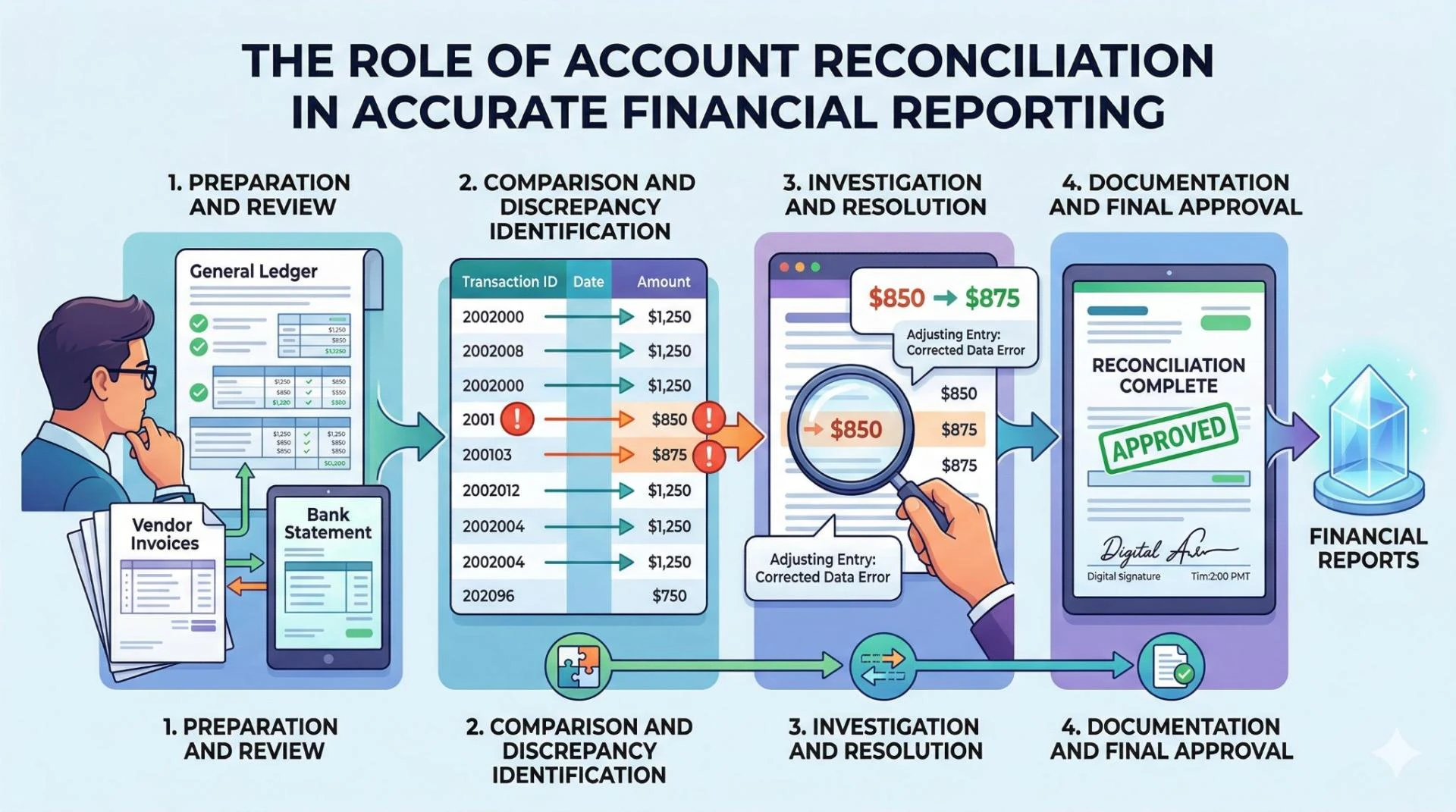
Vendor reconciliation validates whether supplier balances recorded internally match supplier records, invoices, payments, and AP ledgers.
The objective is to ensure that payable obligations remain accurate before financial close.
Definition of vendor reconciliation in accounts payable
Vendor reconciliation compares supplier statements, invoices, payment records, tax entries, and ledger balances to identify discrepancies across AP operations.
Organizations managing large supplier ecosystems frequently refine their Vendor Reconciliation workflows to reduce unresolved balances and payment discrepancies.
Difference between vendor reconciliation and invoice matching
Invoice matching validates purchase orders, invoices, and receipts during procurement workflows. Vendor reconciliation reviews the complete supplier balance relationship across invoices, payments, adjustments, and ledger activity.
Why vendor balances must align with AP ledgers
If vendor balances do not match AP records correctly, liabilities become inaccurate and financial reporting quality declines immediately.
To validate vendor balances properly, finance teams must first compare the right financial records.
Core Records Finance Teams Should Compare First
Vendor reconciliation depends heavily on comparing supplier records against internal AP data consistently.
Without accurate comparisons, discrepancies remain unresolved across reporting periods.
Vendor statements against AP ledger balances
Supplier statements should match recorded AP balances, including invoices, payments, and open liabilities.
Open invoices versus recorded liabilities
Finance teams should verify whether all supplier invoices are reflected correctly inside AP ledgers and liability accounts.
Payment records against supplier confirmations
Payment settlements, remittances, and bank records should align with supplier confirmations and payment history.
Credit notes, debit notes, and adjustment entries
Credit adjustments and debit notes frequently create mismatches if they are applied inconsistently across systems.
Tax deductions and withholding records
Tax entries and withholding calculations should align between supplier statements and internal accounting records.
Even after validating these records, reconciliation problems still emerge regularly across AP operations.
Common Vendor Reconciliation Problems Finance Teams Encounter
Vendor reconciliation issues usually originate from inconsistent transaction handling, disconnected workflows, or incomplete records.
These discrepancies accumulate quickly in high-volume AP environments.
Missing invoices and duplicate entries
Invoices may fail to enter the AP system correctly or appear multiple times because of duplicate imports or manual processing errors.
Incorrect invoice references and vendor IDs
Mismatched invoice numbers or incorrect supplier identifiers create reconciliation inconsistencies across systems.
Timing differences between invoice posting and payment updates
Payment settlements and invoice postings often update at different times across banking systems and ERPs.
Unapplied credit notes and partial settlements
Credit adjustments and partial supplier payments frequently remain unmatched during reconciliation reviews.
Currency conversion mismatches in global payables
Exchange-rate differences create small but recurring discrepancies across global supplier operations.
These issues become harder to resolve when reconciliation delays increase.
Why Vendor Reconciliation Delays Escalate Quickly
Vendor reconciliation delays spread rapidly because AP operations often depend on disconnected communication and approval structures.
Small unresolved discrepancies eventually affect financial close timelines.
Dependency on email-based confirmations with suppliers
Many AP teams still rely on manual email confirmations with suppliers during discrepancy investigations.
Delayed approval workflows across procurement and finance
Delayed invoice approvals slow reconciliation completion across procurement and AP workflows.
Lack of centralized visibility into unresolved balances
Finance leaders often struggle to monitor unresolved supplier discrepancies across entities and vendor accounts simultaneously.
Manual reconciliation effort across multiple vendor accounts
Manual review across thousands of suppliers creates repetitive operational effort and investigation delays.
Finance teams therefore need to prioritize the right checks early during reconciliation reviews.
The First Checks Finance Teams Should Prioritize During Reconciliation
Initial validation checks help finance teams identify high-risk discrepancies earlier.
These checks reduce reconciliation delays significantly.
Verification of opening balances and carry-forward entries
Opening balances should align correctly with prior-period reconciliations and supplier statements.
Validation of unmatched invoices and pending payments
Unmatched invoices and unsettled payments should be reviewed immediately before discrepancies spread further.
Review of aging payables and overdue supplier balances
Overdue balances often indicate unresolved reconciliation issues or incomplete payment activity.
Identification of duplicate invoices and duplicate payments
Duplicate invoices and repeated settlements create direct financial exposure across AP operations.
Cross-checking tax and withholding calculations
Incorrect tax deductions and withholding calculations frequently create supplier disputes and ledger inconsistencies.
These checks depend heavily on matching logic during reconciliation.
Matching Logic Used in Vendor Reconciliation
Matching logic determines how invoices, payments, and supplier balances are validated across systems.
Strong matching structures reduce unresolved discrepancies significantly.
Invoice-to-payment matching
Payments are matched directly against invoices using references, dates, and amounts.
Vendor statement-to-ledger matching
Supplier statements are compared against AP ledgers to identify missing invoices or unsupported balances.
Reference-number and invoice-date matching
Matching logic compares invoice numbers, payment references, and transaction dates across systems.
Tolerance-based matching for minor variances
Tolerance thresholds allow acceptable differences caused by taxes, rounding adjustments, or timing gaps.
Handling partial payments and grouped settlements
Grouped settlements and partial payments require more flexible reconciliation matching structures.
Many organizations still rely heavily on spreadsheets despite these reconciliation challenges.
Why Spreadsheet-Based Vendor Reconciliation Creates Operational Risk
Spreadsheet-heavy reconciliation creates visibility, governance, and validation issues across AP operations.
These problems increase significantly in high-volume environments.
Version-control problems across AP teams
Multiple spreadsheet versions frequently create duplicated effort and inconsistent balances.
Formula inconsistencies and manual adjustment risks
Broken formulas and unsupported manual adjustments reduce reconciliation accuracy.
Delayed identification of unresolved discrepancies
Spreadsheet-based workflows limit real-time visibility into supplier mismatches.
Difficulty maintaining supplier audit evidence
Audit evidence becomes difficult to maintain across disconnected files and approval chains.
These reconciliation weaknesses also affect broader AP accuracy.
Relationship Between Vendor Reconciliation and AP Accuracy
Vendor reconciliation directly affects liability reporting, cash visibility, and financial close accuracy.
Weak reconciliation processes eventually affect broader finance operations.
How vendor discrepancies affect liability reporting
Unresolved supplier balances distort liability accounts and payable obligations.
Impact on cash flow forecasting and payment planning
Incorrect vendor balances reduce visibility into future payment obligations and cash requirements.
Risk of duplicate payments and missed liabilities
Weak reconciliation controls increase the risk of duplicate settlements and unrecorded liabilities.
Relationship between vendor reconciliation and month-end close
Incomplete supplier reconciliations delay liability validation during financial close cycles.
These risks become more complicated across multi-entity finance operations.
Vendor Reconciliation Across Multi-Entity Finance Operations
Global organizations frequently manage suppliers across subsidiaries, currencies, and ERP environments simultaneously.
This creates additional reconciliation complexity.
Challenges with vendor master data consistency
Different vendor naming conventions and master data structures create reconciliation mismatches across entities.
Shared suppliers across subsidiaries and business units
Shared suppliers often maintain transactions with multiple subsidiaries simultaneously.
Intercompany vendor transactions and cross-entity settlements
Cross-entity settlements create additional reconciliation dependencies between subsidiaries.
Different tax structures across regions and entities
Regional tax structures frequently create inconsistencies across supplier balances and AP reporting.
Weak reconciliation therefore creates broader operational risks.
Operational Risks Created by Poor Vendor Reconciliation
Poor vendor reconciliation affects reporting accuracy, supplier relationships, and audit readiness across AP operations.
These risks usually spread gradually across finance workflows.
Supplier disputes and payment delays
Unresolved discrepancies frequently create supplier disputes and delayed settlements.
Audit exposure from unresolved AP discrepancies
Auditors often request additional evidence for unresolved supplier balances and unsupported adjustments.
Inaccurate accruals and liability balances
Incorrect reconciliation distorts accruals, liabilities, and reporting accuracy.
Reduced visibility into actual payable obligations
Incomplete reconciliation reduces visibility into actual payment obligations across suppliers.
Organizations therefore require structured exception management workflows.
Exception Management in Vendor Reconciliation
Exception management determines how efficiently AP teams resolve supplier discrepancies before financial close deadlines.
Without structured escalation processes, unresolved balances accumulate rapidly.
Classification of high-risk vendor discrepancies
Finance teams should prioritize discrepancies based on materiality, supplier exposure, and payment impact.
Escalation workflows for unresolved supplier balances
Defined escalation workflows reduce aging discrepancies across supplier accounts.
Aging visibility for unmatched invoices and payments
Aging reports improve visibility into unresolved supplier balances and overdue exceptions.
Root-cause analysis for recurring vendor mismatches
Recurring discrepancies should be reviewed continuously to identify operational weaknesses.
Organizations also require stronger controls to improve reconciliation consistency.
Reconciliation Controls That Improve Vendor Balance Accuracy
Control frameworks improve reconciliation consistency across AP operations.
Strong governance reduces reconciliation risk significantly.
Segregation of duties across AP workflows
Different individuals should manage invoice processing, payment approval, and reconciliation review activities.
Validation checkpoints before payment release
Payments should move through validation checkpoints before release to suppliers.
Approval structures for adjustments and write-offs
Structured approvals reduce unsupported adjustments and financial reporting inconsistencies.
Audit-ready documentation for supplier reconciliation
Organizations should maintain traceable reconciliation evidence across supplier accounts and reporting periods.
Finance teams also require measurable indicators to evaluate reconciliation performance.
Metrics That Reveal Vendor Reconciliation Health
Reconciliation metrics help organizations monitor AP accuracy and operational efficiency.
These indicators reveal where reconciliation processes require improvement.
Volume of unresolved vendor discrepancies
A growing backlog of unresolved supplier balances usually signals operational inefficiencies.
Percentage of unmatched invoices
High unmatched invoice percentages often indicate weak matching logic or disconnected workflows.
Aging of unresolved supplier balances
Aging metrics track how long discrepancies remain unresolved across supplier accounts.
Frequency of duplicate payments or adjustments
Recurring duplicate payments indicate weaknesses in invoice validation and reconciliation controls.
Financial close delays linked to vendor reconciliation issues
Delayed supplier reconciliations directly affect liability validation during close cycles.
Automation increasingly helps organizations improve reconciliation visibility and accuracy.
How Automation Improves Vendor Reconciliation
Automation reduces repetitive manual effort across AP reconciliation workflows.
It also improves discrepancy visibility significantly.
Automated matching across invoices, payments, and statements
Automation compares invoices, supplier statements, and payments using predefined matching logic.
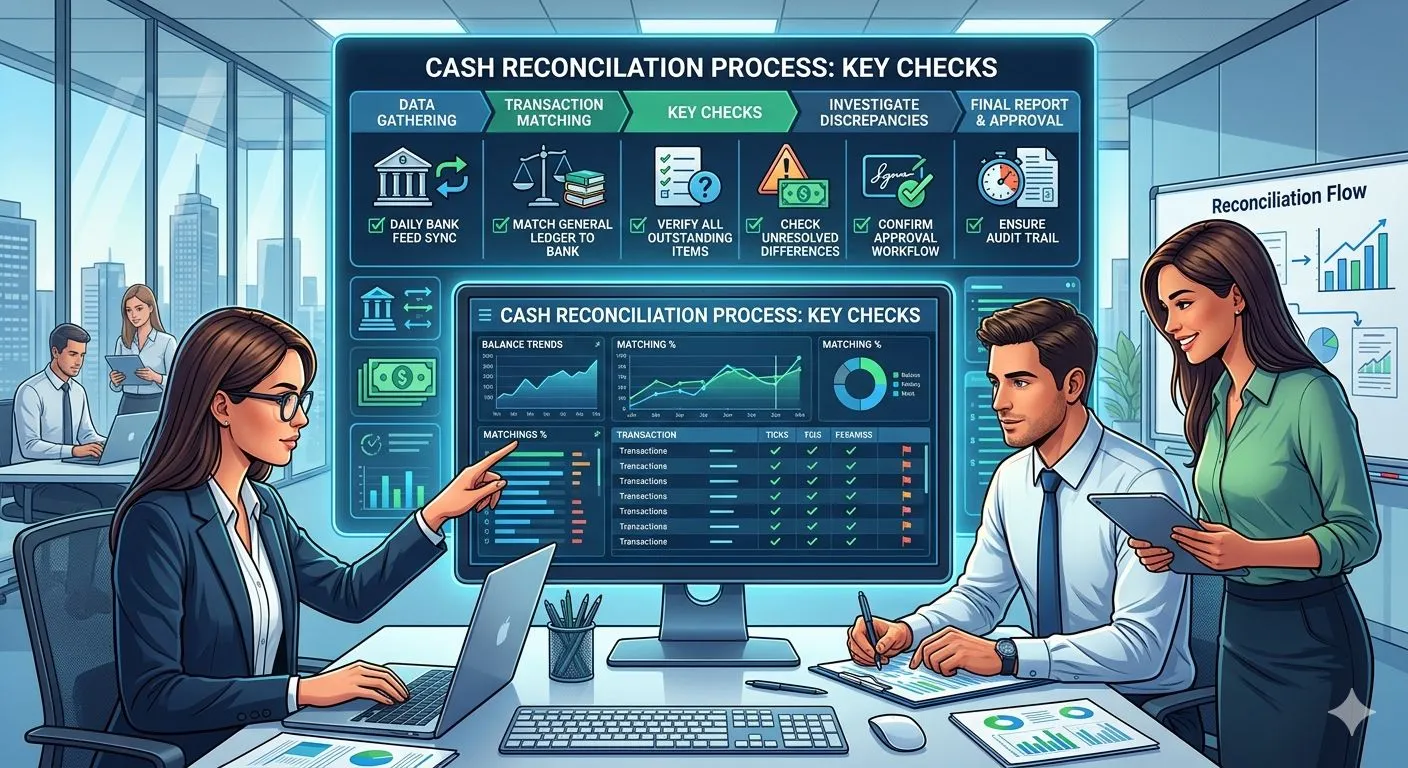
Real-time visibility into unresolved vendor balances
Finance teams gain centralized visibility into unresolved discrepancies across supplier accounts.
Continuous validation of AP transactions
Continuous validation identifies reconciliation mismatches earlier before close cycles begin.
Reduction in repetitive manual reconciliation effort
Automation reduces repetitive spreadsheet reviews and supplier confirmations across AP teams.
High-performing AP teams already operate with these principles consistently.
What High-Performing AP Teams Do Differently
High-performing AP teams focus heavily on continuous validation, centralized visibility, and structured workflows.
Their reconciliation operations are generally more scalable and predictable.
Continuous reconciliation instead of period-end dependency
Frequent reconciliation reduces unresolved discrepancies before financial close begins.
Standardized reconciliation workflows across vendors
Consistent reconciliation procedures improve supplier balance accuracy across AP operations.
Centralized dashboards for discrepancy visibility
Centralized dashboards improve visibility into unresolved supplier balances and reconciliation status.
Ongoing monitoring of recurring supplier issues
Recurring discrepancies are analyzed continuously to identify operational weaknesses.
Vendor reconciliation is now moving toward more intelligent and continuous validation environments.
Future Direction of Vendor Reconciliation in Enterprise AP
Enterprise AP operations are shifting toward predictive validation, intelligent matching, and continuous reconciliation models.
Organizations increasingly expect faster visibility into supplier discrepancies.
AI-assisted identification of vendor anomalies
AI models identify unusual supplier transactions, duplicate invoices, and abnormal payment activity.
Predictive detection of duplicate invoices and payment risks
Predictive systems identify likely reconciliation risks before discrepancies spread across AP operations.
Continuous reconciliation across supplier ecosystems
Continuous validation improves visibility into supplier balances throughout the reporting cycle.
Real-time AP visibility supported by intelligent matching logic
Organizations seeking faster reconciliation cycles and stronger AP visibility increasingly adopt enterprise account reconciliation software that supports intelligent matching, continuous validation, and centralized discrepancy management.


























Sign in to leave a comment.