

Most people use ChatGPT completely backwards for writing.
They open a blank chat, paste a vague prompt, generate a few paragraphs, and hope something magically sounds professional. Sometimes it works. Most of the time? The result feels strangely lifeless — technically correct, but emotionally hollow. You can almost hear the AI in the rhythm. The sentences are too clean. Too symmetrical. Too safe.
And honestly, that's where a lot of frustration begins.
Because people are not really searching for “AI writing tools.” They're searching for clarity. Confidence. Speed. A way to communicate ideas without staring at a blinking cursor for forty minutes wondering why every sentence feels awkward.
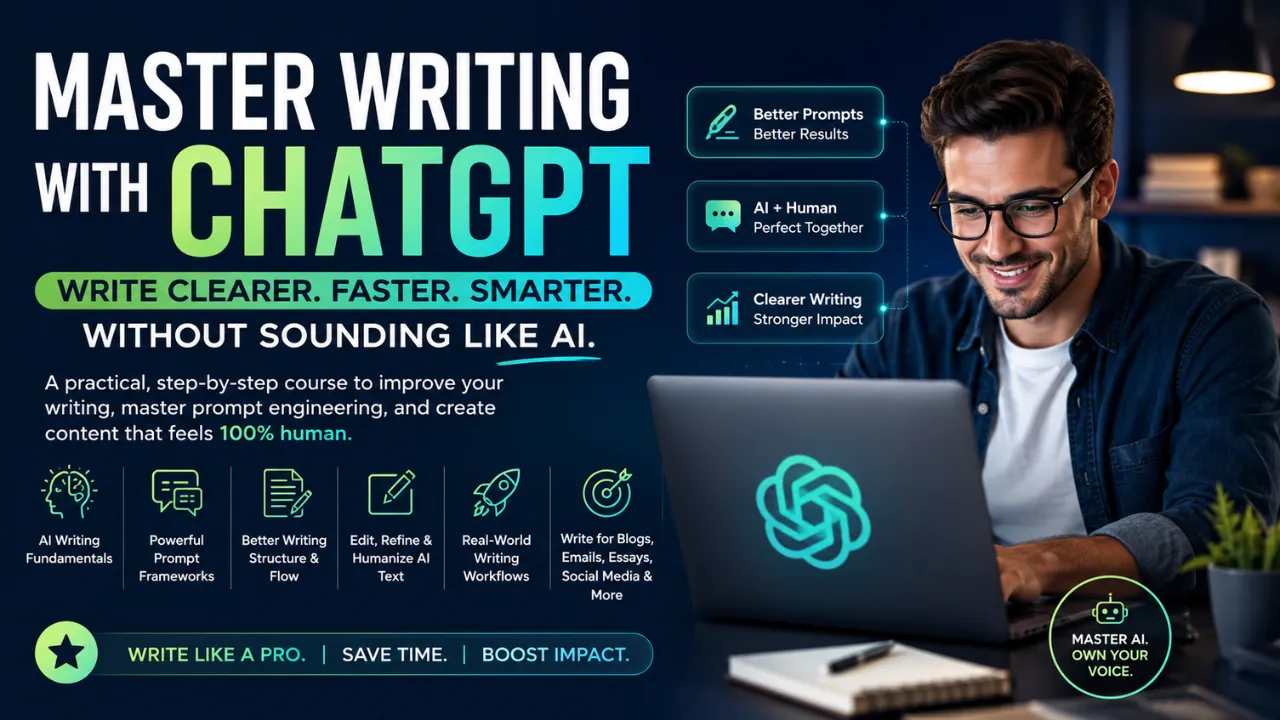
That's exactly why ChatGPT Writing Mastery for Real-World Content exists.
This isn't another generic AI course filled with recycled prompt lists and robotic productivity hacks. It's a practical, human-centered system designed to teach you how skilled writers actually use ChatGPT in the real world — for blogs, emails, content creation, essays, marketing, freelancing, professional communication, and everyday writing that still sounds unmistakably human.
Because despite what people online keep claiming, good writing didn't suddenly become obsolete when AI arrived. If anything, writing skill matters more now.
The people getting extraordinary results with ChatGPT are rarely the people blindly copying prompts from social media threads. They're the people who understand tone, clarity, structure, pacing, emotional nuance, and editing psychology. They know how to guide AI instead of surrendering to it.
That distinction changes everything.
Why Most AI Writing Still Sounds Robotic
You've probably noticed the pattern already.
A lot of AI-generated content feels oddly similar — polished on the surface, yet forgettable seconds later. The language often sounds overexplained, emotionally neutral, and strangely repetitive. Even when the grammar is perfect, something feels… off.
The reason is surprisingly simple.
Most people treat ChatGPT like a vending machine instead of a collaborative writing system.
They ask for finished outputs too early.
Instead of:
- brainstorming ideas,
- refining arguments,
- improving sentence flow,
- restructuring weak sections
- or enhancing clarity,
…they expect one prompt to magically produce publish-ready content.
That rarely works well.
Real writers use AI differently. They use it as:
- a brainstorming partner,
- an editing assistant,
- a clarity engine,
- a structure optimizer,
- and sometimes even a second set of eyes when creative fatigue kicks in.
Actually, scratch that — “use” might not even be the right word anymore.
The best writers think with AI . That's the real shift happening right now.
And once you understand that mindset, ChatGPT becomes dramatically more powerful.
PS: Please enter $0 in the suggested amount section to get this course for FREE
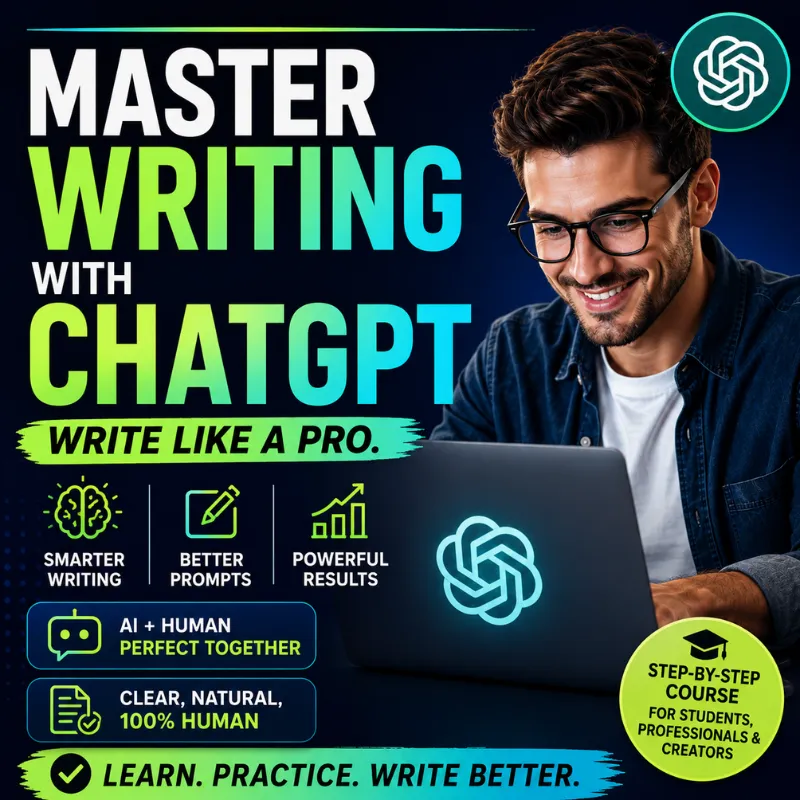
What Makes This Writing Course Different
Most ChatGPT writing courses focus heavily on prompts.
This course focuses on decision-making .
That sounds subtle, but the difference is enormous.
Anyone can copy a prompt template. But knowing:
- what to remove
- what to rewrite,
- what sounds unnatural,
- what weakens emotional impact,
- and what improves readability,
…that's the real skill.
Inside this course, you don't just learn how to generate text. You learn how to shape it into something believable, persuasive, and context-aware.
The course begins with foundational writing principles:
- sentence structure,
- subjects and predicates,
- sentence variety
- nouns,
- verbs,
- modifiers,
- flow,
- punctuation,
- and clarity mechanics.
At first glance, that may sound basic. But here's the thing people often underestimate:
Weak writing usually isn't caused by “bad ideas.”
It's caused by weak sentence construction.
And AI amplifies that weakness quickly.
If your prompts are vague, cluttered, or structurally weak, ChatGPT tends to mirror those patterns back at you. The result becomes generic content that technically answers a question but never truly connects with a reader.
That's why this course combines writing fundamentals with modern AI-assisted workflows. You're learning both the mechanics of language and the psychology of using AI effectively.
Very few courses bridge those two worlds properly.
How ChatGPT Actually Improves Writing Skills
There's a misconception floating around online that AI makes people worse writers.
Sometimes that's true.
But only when AI becomes a shortcut instead of a feedback system.
Used properly, ChatGPT can accelerate writing growth surprisingly fast.
For example, it can help you:
- identify awkward sentence patterns,
- simplify confusing paragraphs,
- improve transitions,
- generate alternative phrasing,
- refine tone,
- organize scattered ideas
- and expose repetitive writing habits you may not even notice yourself.
That last part matters more than people realize.
Most writers have invisible habits:
- overusing certain sentence lengths,
- repeating transitional sentences,
- sounding overly formal,
- relying on filler words,
- or writing in emotionally flat rhythms.
AI can surface those patterns almost instantly.
And once you become aware of them, your writing improves everywhere — not just inside ChatGPT.
This course teaches you how to use AI as a deliberate writing feedback loop rather than a dependency machine.
Because the goal isn't to sound like ChatGPT.
The goal is to sound more like your best self .
Real-World Applications Beyond Basic Writing
One of the biggest problems with traditional writing education is that it often feels disconnected from reality.
People don’t just want to “learn writing.”
They want to:
- write better emails,
- create content faster
- communicate professionally,
- grow online audiences,
- improve freelance opportunities,
- publish blog posts
- build authority,
- or simply stop second-guessing every sentence they type.
This course addresses those real-world outcomes directly.
You'll learn how ChatGPT can support:
- blog writing,
- SEO content creation
- social media captions,
- essays,
- professional communication,
- newsletters,
- product descriptions
- marketing copy
- scripts,
- brainstorming,
- rewriting,
- editing,
- and idea expansion.
And importantly, you'll also learn where AI fails .
Because yes — there are still moments where human judgment matters enormously.
Tone sensitivity. Emotional timing. Humor. Subtle persuasion. Cultural context. Narrative tension. These areas still require human awareness.
That's why blindly publishing AI-generated writing often backfires.
Readers can feel when content lacks lived experience.
Algorithms are starting to detect it too.
PS: Please enter $0 in the suggested amount section to get this course for FREE
The Hidden Skill Nobody Talks About: Humanizing AI Writing
This may be the most valuable part of the entire course.
Anyone can generate content.
Very few people know how to humanize it convincingly.
Human writing contains imperfections:
- rhythm shifts,
- emotional fluctuations,
- tonal variation,
- unfinished thoughts
- conversational pivots,
- subtle contradictions
- and moments of genuine reflection.
AI tends to flatter those human signals unless guided carefully.
That's why this course teaches practical humanization techniques like:
- sentence rhythm variation
- conversational pacing,
- emotional layering,
- structural unpredictability,
- contextual storytelling,
- and natural editing patterns.
You'll learn why some AI content instantly triggers skepticism — even when readers cannot explain exactly why.
And more importantly, you'll learn how to avoid those patterns completely.
Because the future of writing probably isn't “human vs AI.”
It's humans who know how to collaborate intelligently with AI versus those who don't.
That gap is already becoming visible across content marketing, freelancing, education, and digital communication.
Why Writing Skills Matter More in the AI Era
Ironically, AI is increasing the value of strong writers.
Not decreasing it.
Here's why.
As low-quality AI content floods the internet, clarity becomes more valuable. Authenticity becomes more valuable. Distinctive thinking becomes more valuable.
People are exhausted by generic content.
You can see it everywhere:
- repetitive LinkedIn posts,
- lifeless SEO articles
- empty emotionally marketing copy,
- and painfully obvious AI-generated blogs.
The internet is slowly becoming saturated with content that says things correctly but says nothing memorably.
That creates opportunity.
The writers who learn how to combine:
- human insight,
- strategic prompting,
- editing intelligence,
- emotional nuance,
- and AI acceleration,
…will dominate modern communication.
Not because AI replaces writing skills.
Because AI amplifies it.
That's the central philosophy behind ChatGPT Writing Mastery for Real-World Content .
Who This Course Is For
This course was designed for real-world communicators — not just “AI enthusiasts.”
It's ideal for:
- students improving essays and assignments,
- freelancers creating client content,
- bloggers and SEO writers,
- professionals writing emails and reports,
- creators building online brands,
- marketers producing faster campaigns,
- non-native English speakers improving fluency,
- and anyone who wants clearer, more confident communication.
You do not need advanced technical knowledge.
You do not need programming experience.
And honestly, you don't even need to consider yourself “a writer.”
You just need the willingness to improve how you communicate.
Because communication affects almost everything:
- careers,
- opportunities,
- credibility
- relationships,
- audience growth
- and self-confidence.
Strong writing quietly changes how people perceive you.
That's true online. Offline. Professionally. Socially. Everywhere.
The Future of Writing Is Collaborative
There's a strange fear surrounding AI writing tools right now.
Some people think AI will replace writers entirely.
Others think using AI somehow makes writing “fake.”
Reality is probably more nuanced than either extreme.
The future likely belongs to people who understand collaboration.
Writers who can:
- think critically
- guide AI intentionally,
- edit strategically,
- preserve authentic voice,
- and use technology without becoming dependent on it.
That balance matters.
Because eventually, everyone will have access to AI tools.
But not everyone will know how to use them intelligently.
That becomes the competitive advantage.
And maybe that's the deeper reason this course resonates with so many people. It doesn't just teach prompts or sentence structure. It teaches a modern writing mindset — one built around clarity, adaptability, and human-centered communication in an AI-driven world.
By the end of this course, you won't simply know how to generate text with ChatGPT.
You'll understand how to shape ideas, refine language, strengthen clarity, and create writing that feels credible, natural, and genuinely human.
And in a world increasingly flooded with artificial content…
This skill may become more valuable than ever.
PS: Please enter $0 in the suggested amount section to get this course for FREE
FAQ
Is this course beginner-friendly?
Yes. The course starts with foundational writing concepts before moving into advanced AI-assisted writing techniques, making it accessible for beginners and useful for experienced writers alike.
Will this course help me avoid robotic AI writing?
Absolutely. One of the course's core focuses is teaching you how to humanize AI-generated writing using rhythm variation, emotional nuance, editing strategies, and conversational flow techniques.
Can I use these skills for SEO content and blogging?
Yes. The course covers real-world applications including SEO writing, blog creation, email writing, social media content, and professional communication workflows.
Do I need ChatGPT Plus?
No. You can apply most techniques using the free version of ChatGPT or similar generative AI tools.
Is this course only for English learners?
Not at all. While non-native English speakers will benefit greatly, the course is also designed for creators, freelancers, marketers, students, and professionals who want stronger writing skills.























Sign in to leave a comment.