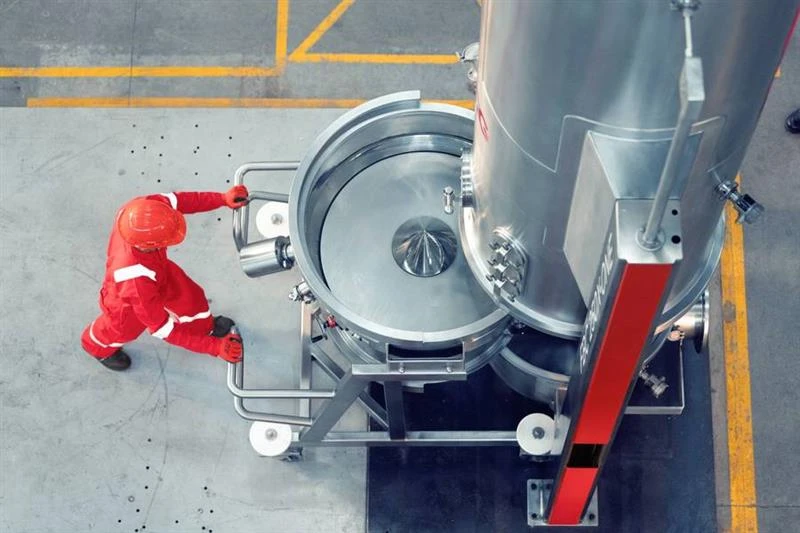

Why high-dose layering stresses Wurster technology
During Wurster coating, pellets circulate vertically through a spray column, receiving solution layer by layer. Fluidisation airflow transports particles between spray and drying regions.
As successive layers build, solvent evaporation increasingly limits throughput. Increasing concentration reduces solvent but raises viscosity and clogging risk; lowering concentration increases overages and prolongs drying.
PEPT and CFD-DEM data indicate pellets spend only 12–29% of each cycle within the Wurster tube. The remainder involves transport and heat/mass transfer outside the spray zone, slowing deposition relative to rotor systems.
Rotor-based tangential spraying overlaps process stages
Fluid beds configured for Wurster coating can often incorporate rotor assemblies for tangential spraying. Rotor operation transforms particle trajectories. Airflow, centrifugal force, and gravity drive particles along a helical path within the chamber.
Collisions and shear enhance droplet distribution and surface exposure, minimising solvent localisation.
All pellets remain in motion continuously, unlike periodic exposure in a Wurster column. Thus, layering, drying, and mixing occur simultaneously.
Rotary parameters must operate in harmony
Spray rate, atomisation pressure, and rotor speed dictate PSD and particle growth. High spray rates with low atomisation pressure create larger droplets that evaporate slowly, producing larger agglomerates and broader PSD5. Higher pressures form finer droplets that narrow PSD.
Rotor speed introduces a moisture-sensitive mechanical component. At low spray rates, high speeds fragment dry agglomerates. At high spray rates, high speeds compact wet, deformable particles, enlarging them5.
Rotor systems manage high deposition rates, yet pushing spray rate or rotor speed independently may disrupt stability.
Dry powder layering redefines liquid function
Even in rotor spraying, evaporation constrains deposition intensity. Dry powder layering shifts the liquid phase from carrier to adhesive.
Simultaneous binder and API powder application reduces liquid per pellet and shortens drying intervals.
Compared with solution spraying, powder layering can cut solvent use by up to 80% and reduce processing time by nearly 50%.
60% time reduction for a CDMO
A CDMO serving regulated markets recently optimised a Wurster process for Lansoprazole Capsules.
Spray concentration was limited to 25% to prevent clogging. Lower concentration required higher solvent input, while overages were restricted to 5%. Simply increasing solution volume was not feasible.
With ACG Laboratories engineers, they adopted rotor-based dry powder layering.
A rotor and powder feeder were integrated into the existing equipment, enabling rapid mass build-up with minimal modification and investment.
The results:
- 60% shorter process time (12 to nearly 5 hours)
- 70% lower solvent consumption
- Elimination of 5% overage
- 100% pellet coating efficiency
Conclusion
Wurster systems are highly effective for uniform functional films. However, high-dose substrate layering becomes limited by evaporation and intermittent exposure rather than machine configuration alone.
Rotor-based tangential spraying enables concurrent wetting, mixing, and drying. Dry powder layering further reduces solvent demand by transforming liquid into an adhesive medium.
Selecting the correct deposition mechanism for the intended loading objective can unlock substantial productivity gains, often with only modest equipment modification.
























Sign in to leave a comment.