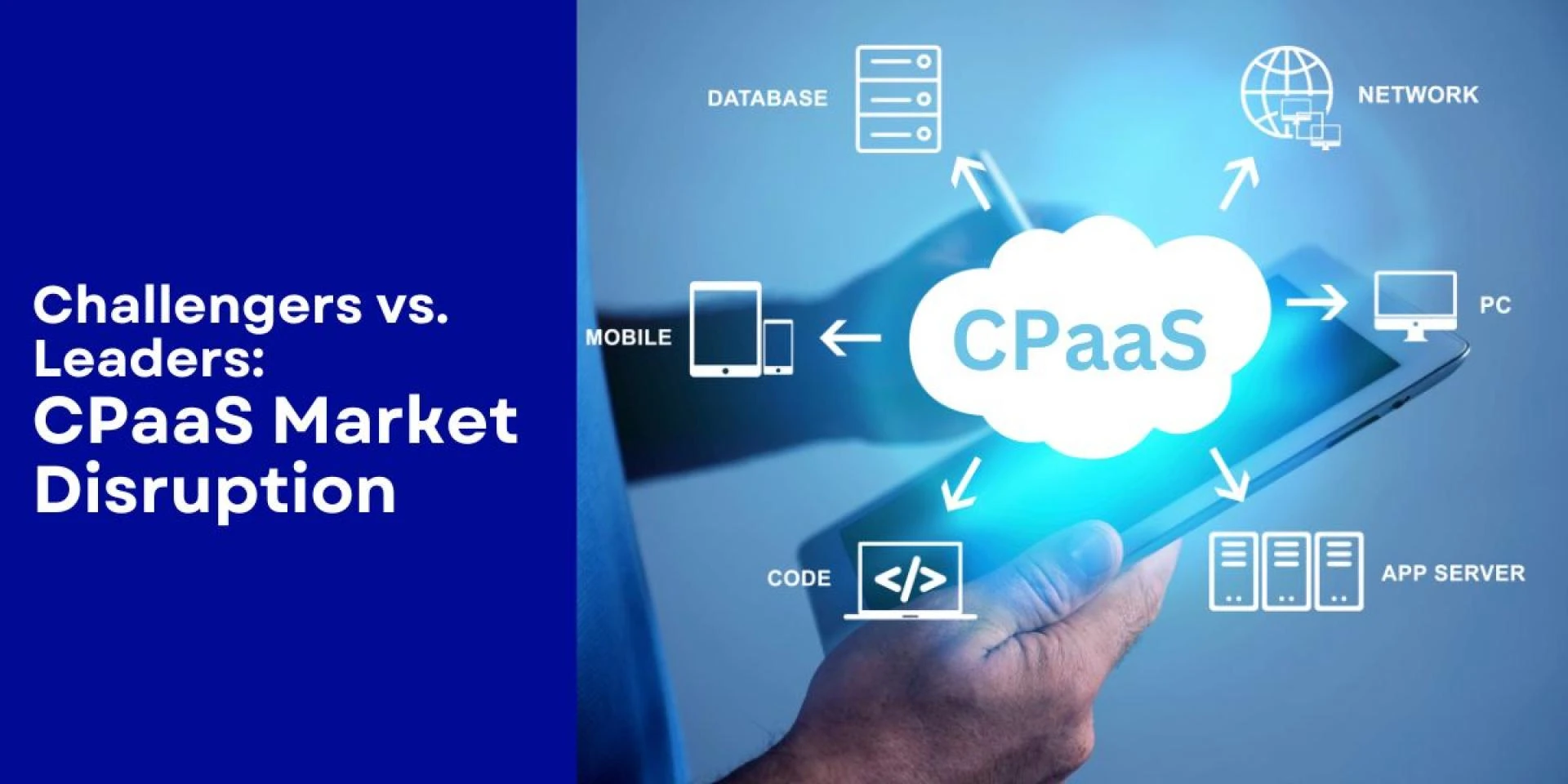

Challengers vs. Leaders: CPaaS Market Disruption
With over two decades of experience in the ever-evolving telecom industry, the importance of staying ahead of the technological becomes a big curve for success. Gartner's Magic Quadrant reports are highly anticipated in the tech world as they provide comprehensive assessments of leading players and emerging trends in specific technology sectors, much like the Oscars of technology. In this guest blog post, we delve into Gartner's inaugural Magic Quadrant for Communication Platform as a Service (CPaaS), exploring its valuable insights and their implications for professionals navigating the dynamic telecom landscape.
The ever-expanding array of communication channels, from messaging apps to social media platforms, presents a growing number of touchpoints in the customer journey. To prepare for the future and the expected rapid growth of the CPaaS market, businesses need an agile foundation. Gartner predicts that by 2026, 90 percent of businesses will utilize CPaaS platforms, compared to 30 percent in 2022. However, with numerous top CPaaS companies and vendors in the market, Gartner's evaluation of principal providers helps businesses make informed decisions by identifying the four market leaders.
Understanding CPaaS?
A CPaaS (Communications Platform as a Service) platform encompasses a range of APIs, SDKs, and cloud technologies aimed at integrating digital communication channels into customer journeys. Gartner outlines essential core capabilities, including APIs for voice calls, inbound call routing, phone number registration, identification, SMS messaging, and support for other messaging apps like WhatsApp. Vendors must also offer rich communication features such as voice calling, image sharing, and emojis. Additional services, such as onboarding programs, technical support, and dashboards, are expected to support these core capabilities. Optional functionalities may include advanced voice, video, wireless services, E-SIMs, IoT solutions, and 5G-enabled communication APIs.
Gartner's Inaugural Magic Quadrant for CPaaS
Gartner's first Magic Quadrant for CPaaS provides valuable insights for technology decision-makers. The evaluation is based on a company's "Ability to Execute" and "Completeness of Vision." The report categorizes companies into four groups:
LeadersChallengersVisionariesNiche PlayersLeaders are those with a clear vision and strong execution, offering comprehensive CPaaS capabilities and delivering substantial value. Challengers excel in execution and stability but may lack visionary perspectives. Visionaries demonstrate innovation and market understanding, positioning them for future growth. Niche Players focus on specific niches or markets, excelling in certain areas but without the breadth of Leaders or Challengers. This report serves as a compass for businesses in selecting the right CPaaS partners and solutions.
Key challenges in revealing the disruptive value of CPaaS
The communication landscape has undergone a significant transformation, driven by ever-connected customers demanding seamless, omnichannel experiences. Communications-Platform-As-A-Service (CPaaS) solutions have emerged as the answer, enabling companies to adapt to these evolving customer expectations. The CPaaS market is rapidly expanding, with projections estimating it to become a $17.2 billion industry by 2023. However, the CPaaS boom comes with its set of challenges, including security risks, the paradox of trust, low-quality communication stacks, and connectivity issues.
One pressing concern is security, with a substantial increase in spear-phishing attacks amidst the pandemic. CPaaS platforms lacking encryption become targets for malicious content, potentially leading to data breaches and reputational damage. The issue of trust arises from grey routes and SIM farms, exposing personal data as messages traverse unsecured paths, resulting in significant revenue leakage for the CPaaS ecosystem. Another challenge is the availability of low-quality communication stacks, forcing companies to integrate multiple vendors and resulting in unreliable, incohesive architecture. Connectivity problems also emerge when CPaaS offerings use multiple aggregators, causing delays and suboptimal message routes.
Despite these challenges, CPaaS stands as a potent tool for businesses. It offers end-to-end encryption, multiple communication services through a single API, and the ability to meet evolving communication needs. To unlock the disruptive potential of CPaaS, it's crucial to select the right platform that addresses the existing issues in commercial communications, ensuring a trusted customer experience and a strong market presence.
Challengers vs. Leaders
Leaders
Gartner's Magic Quadrant identifies industry leaders who significantly influence the CCaaS (Contact Center as a Service) market direction, demonstrating a vision and a proven ability to execute their strategies effectively. This year's leaders include:
Fonada: Discover the Versatility of CPaaS for Your Communication Needs and Stay at the Forefront with Fonada, a Prominent CPaaS Provider in India. Fonada's CPaaS solutions come equipped with advanced APIs and SDKs, empowering developers to seamlessly incorporate communication features into both desktop and mobile applications.
Infobip: Infobip is praised for its robust private network backbone, extensive data centers, and direct operator connections, ensuring delivery guarantees and global reach. The vendor's scaling capacity, flexibility, and responsive service have earned customer appreciation. Their solution-oriented approach, coupled with professional services, makes CPaaS accessible to a broader business audience.
Sinch: Sinch offers an extensive CPaaS platform, including email, video, and conversational AI capabilities. This diversified portfolio facilitates a broad geographic presence and local market relevance. Sinch's balance between direct and indirect revenue showcases their ability to cater to both developer-focused and solution-oriented businesses.
Twilio: Acknowledged as a pioneer in the CPaaS (Communications Platform as a Service) market, Twilio offers a robust CPaaS platform with a deep array of programmable communication channels and a strong developer ecosystem. Their operational experience, including security certifications, efficient onboarding, and global customer support, is commended.
Vonage (an Ericsson company): Vonage's innovation focus is highlighted, especially its integration of CPaaS with AI, multichannel conversation solutions, and eCommerce tools. The synergy with Ericsson's 5G network APIs, allowing mobility differentiation, stands out. Their attentive customer support and industry-specific solutions across various sectors are other strengths.
These industry leaders provide innovative CPaaS solutions and demonstrate strong execution, positioning them at the forefront of the CCaaS market.
Challengers
Gartner's Magic Quadrant highlights Challengers who demonstrate the capability to meet customer expectations and possess robust tech capabilities, which contribute to market credibility and viability. However, they may trail behind Leaders due to more limited CPaaS use case coverage and a smaller geographic footprint. This year's Challengers include:
Bandwidth: Bandwidth garners praise from customers for its dashboards, pricing, self-service features, and support services. This positive feedback has fueled the vendor's expansion, serving numerous Global 2000 businesses. The strength of its extensive voice ecosystem, featuring high network resiliency, emergency services, and number management, is emphasized. However, Bandwidth's CPaaS offering may be less suitable for non-voice use cases due to its limited breadth.
Tencent Cloud: Tencent Cloud excels in scalability, supporting applications across industries like eCommerce, education, and gaming that serve millions of customers. It offers robust real-time capabilities encompassing audio, codecs, noise reduction, video streaming, and WebRTC. Nonetheless, its limited presence outside China and select Asian markets, along with geopolitical constraints in Europe and North America, are noted challenges.
Conclusion
The CPaaS market is at the forefront of technological disruption, with both Challengers and Leaders vying for prominence. As businesses adapt to an ever-evolving communication landscape, the importance of choosing the top CPaaS companies cannot be overstated. Gartner's Inaugural Magic Quadrant for CPaaS offers valuable insights into these industry players, helping decision-makers navigate the complex vendor landscape. Challengers may excel in certain aspects but could lag in broader use cases or geographic reach, while Leaders combine vision and execution for comprehensive solutions. As the market continues to expand, CPaaS is poised to revolutionize communication, making it crucial for businesses to align with the right partner to stay competitive and meet evolving customer demands.
























Sign in to leave a comment.