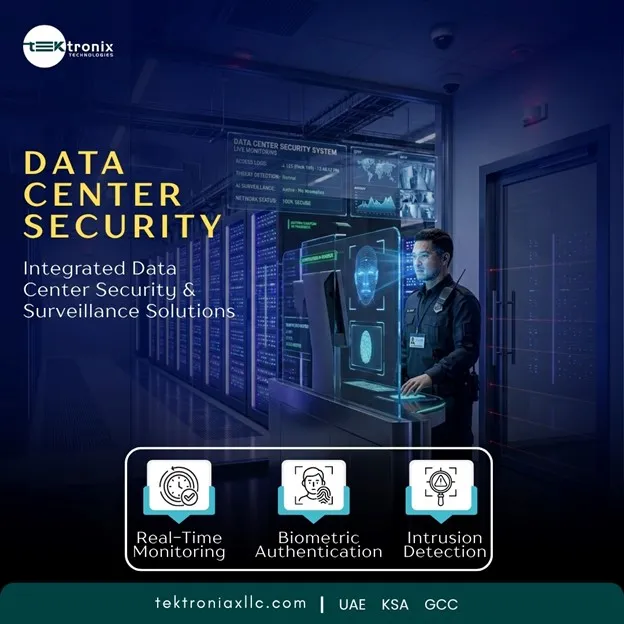

Data Center Security has become a defining priority for digital enterprises across Kuwait and the wider Gulf region, as banks, telecom operators, and government entities shift increasingly sensitive workloads into colocation and enterprise-grade facilities. A single lapse — whether a physical breach at the perimeter or a gap in network defense — can disrupt critical services and expose an organization to significant regulatory and financial consequences.
This guide outlines the layered defenses that modern Gulf facilities require, from network-level protection through to physical perimeter hardening, and explains why a coordinated, multi-discipline strategy has become essential for organizations operating critical infrastructure across Kuwait and the broader GCC.
Why a Layered Security Model Is Essential for Gulf Facilities?
A data center concentrates extremely high-value digital assets in a single location, making it a prime target for both physical intruders and cyber adversaries. A single weak point — an unmonitored service entrance, an outdated firewall rule set, or an over-permissioned access credential — can place an entire facility at risk.
Leading regional operators address this through a six-layer security model spanning perimeter fencing, building entry, mantrap vestibules, server-room access, cabinet-level locking, and continuous monitoring. Each layer slows, detects, or denies an intrusion attempt before it can progress further, ensuring no single failure compromises the entire site.
Cybersecurity for Data Center Operations Across the Region
Physical hardening alone cannot protect a modern facility. Comprehensive Cybersecurity for Data Center operations must cover network segmentation, credential management, and continuous vulnerability assessment across every connected system — including the physical security devices themselves, which are now IP-networked and represent a genuine attack surface if left unmanaged.
Security teams should apply the same discipline to surveillance cameras, access control panels, and environmental sensors as they would to any other network endpoint, including regular firmware updates, strong authentication, and isolated network segments to prevent lateral movement in the event of a compromise.
Data Center Encryption for Data at Rest and in Transit
Strong Data Center Encryption protects information both while stored on disk arrays and while moving between racks, sites, or cloud connections. Even if physical media is removed or network traffic intercepted, properly encrypted data remains unreadable without the correct keys, which must themselves be governed by strict access policies and routine rotation schedules.
Data Center Firewalls as the First Line of Network Defense
Carefully configured Data Center Firewalls filter traffic between internal segments and external connections, enforcing rule sets that limit lateral movement should one segment be compromised. Next-generation deployments increasingly add deep packet inspection and behavioural analysis to catch threats that traditional signature-based filtering alone would miss.
Proactive Data Center Threat Detection
Advanced Data Center Threat Detection platforms combine network traffic analysis, anomaly detection, and AI-driven behavioural baselining to surface suspicious activity before it escalates into a full incident. Early detection is critical in a facility where even brief downtime can carry a steep financial and reputational cost for the organizations it serves.
- Continuous monitoring of network traffic for unusual data flow patterns
- AI-driven behavioural baselining to flag anomalous device or user activity
- Automated alerting routed directly to the security operations center
Data Center Access Control for Restricted Physical Zones
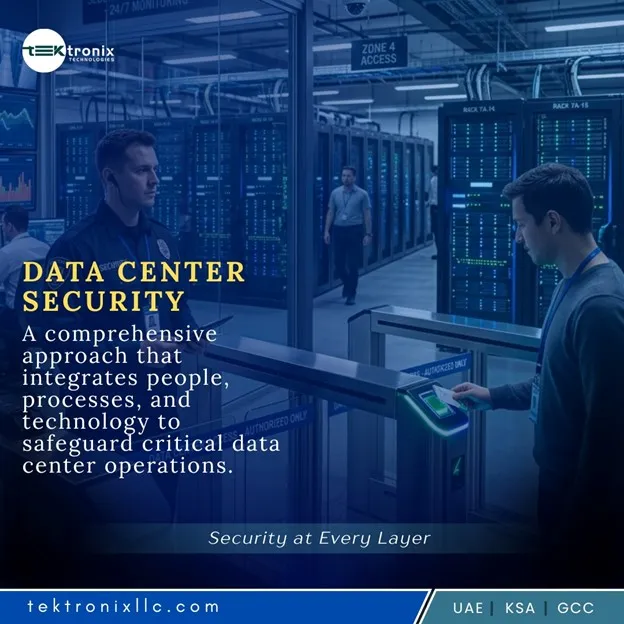
On the physical side, strict Data Center Access Control governs entry to each zone of the facility, typically combining biometric verification, mantrap vestibules, and cabinet-level electronic locking. Role-based permissions ensure that even authorized staff can only reach the specific racks or rooms relevant to their function, reducing insider risk and simplifying audit preparation.
Organizations designing a layered entry strategy can review our six-layered data center security framework for a detailed breakdown of access control, mantrap, and monitoring components suited to colocation and enterprise facilities across the Gulf.
Continuous Data Center Surveillance
End-to-end Data Center Surveillance extends visibility across every entry point, server hall, and loading dock through high-resolution cameras, video analytics, and direct integration with the access control log. This creates a complete, timestamped visual record that correlates with every badge swipe or biometric authentication, making post-incident investigation faster and far more accurate.
Data Center Intrusion Detection at the Outer Perimeter
Before an intruder reaches the building itself, perimeter-level Data Center Intrusion Detection — including fence-mounted vibration sensors, microwave barriers, and thermal imaging cameras — provides early warning of an attempted breach. This layer is particularly valuable for standalone facilities with large outdoor perimeters common across industrial zones in Kuwait and neighbouring GCC states.
Comprehensive Data Center Solutions from Design to Maintenance
True resilience comes from treating security as a complete program rather than a collection of individual products. End-to-end Data Center Solutions span site risk assessment, system design, certified installation, and ongoing maintenance — ensuring every layer of the model works together rather than functioning as disconnected point solutions managed by separate vendors.
For organizations evaluating a full deployment, our data center security specialists provide site-specific risk assessments covering perimeter hardening, access control, and surveillance integration tailored to each facility's operational requirements.
Data Center Security Kuwait: Local Compliance and Market Demand
Delivering Data Center Security Kuwait-wide requires familiarity with the regulatory environment overseen by the Communication and Information Technology Regulatory Authority (CITRA), which shapes data governance and critical infrastructure protection requirements for facilities serving the banking, telecommunications, and government sectors.
Kuwait's growing colocation and enterprise data center footprint reflects rising demand from regional banks and telecom operators seeking facilities that can demonstrate verifiable physical hardening alongside strong network-level governance, rather than relying on outdated single-layer protection models.
Data Center Security GCC: A Consistent Regional Standard
Beyond Kuwait, demand for robust Data Center Security GCC-wide continues to accelerate as organizations expand operations across Saudi Arabia, the UAE, Bahrain, and Oman. Regional frameworks — including NCA ECC and CSCC guidance in Saudi Arabia, NESA and DESC standards in the UAE, CBB TRM requirements in Bahrain, and ICTD oversight in Oman — share a common emphasis on layered physical and cyber protection.
A security partner with proven multi-country delivery experience can apply a consistent protection standard across every facility in a regional portfolio, regardless of which jurisdiction-specific framework applies at each individual site.
Why Choose Tektronix LLC for Data Center Security in the Gulf
Tektronix LLC has completed 500+ security and access technology installations since 2009 across the GCC, and operates as a SIRA-licensed systems integrator holding ISO 9001:2015 and ISO/IEC 27001:2022 certifications for quality and information security management — a critical credential for any partner handling critical infrastructure projects.
- Genetec Gold Certified Partner for unified physical security platforms
- HID Global Authorised Dealer for biometric and mantrap access control
- Suprema Certified Installer and Dahua Certified Engineer for video analytics
- 4-hour on-site SLA with 24/7 AMC support across Kuwait and the GCC
Our engineering team works closely with facility operators from initial risk assessment through commissioning and ongoing maintenance, ensuring every layer of the security model is properly integrated rather than deployed as disconnected point solutions.
Conclusion
Protecting a modern facility in the Gulf demands far more than a single safeguard. Comprehensive Data Center Security brings together strong Cybersecurity for Data Center operations, reliable Data Center Encryption, properly configured Data Center Firewalls, and proactive Data Center Threat Detection on the digital side, paired with strict Data Center Access Control, continuous Data Center Surveillance, and perimeter-level Data Center Intrusion Detection on the physical side. With complete Data Center Solutions covering design through maintenance, organizations across the region gain a single, accountable partner for every layer of protection. Whether your facility requires Data Center Security Kuwait-specific expertise or broader Data Center Security GCC coverage across multiple sites, Tektronix LLC brings certified, ISO-aligned experience to every deployment. Contact our team today to schedule a complimentary risk assessment.
Frequently Asked Questions
1. What is the difference between physical and cyber data center security?
Physical security covers tangible safeguards such as fencing, mantraps, biometric access control, and surveillance cameras, while cybersecurity protects the networks, servers, and data flowing through the facility. A complete strategy requires both layers working together, since a breach in one domain can often expose the other.
2. What is a mantrap and why is it used in data center design?
A mantrap is a small, secured vestibule with two interlocking doors that only allows one person to pass through at a time after successful authentication. It prevents tailgating, where an unauthorized individual follows closely behind an authorized employee to bypass entry controls.
3. How often should a facility's security systems be audited in Kuwait?
Most regional compliance frameworks recommend at least an annual comprehensive audit, supplemented by quarterly reviews of access logs, firmware versions, and credential lists. Facilities handling regulated data, such as banking or government workloads, often conduct audits more frequently to satisfy specific local obligations.
4. Can existing surveillance and access control systems be integrated into a single platform?
In most cases, yes. Open-architecture platforms are designed to unify video surveillance, access control, and intrusion detection into a single management interface, allowing security operations teams to correlate events across systems rather than monitoring each one in isolation.
5. What perimeter detection technology works best for large outdoor facilities?
For extensive outdoor perimeters common across Kuwait's industrial zones, a combination of fence-mounted vibration sensors, microwave or infrared beam barriers, and thermal imaging cameras typically provides the most reliable early-warning coverage, since each technology compensates for the others' limitations in varying weather and lighting conditions.
For more information contact us on:
Tektronix Technology Systems Dubai-Head Office
+971 55 232 2390
























Sign in to leave a comment.