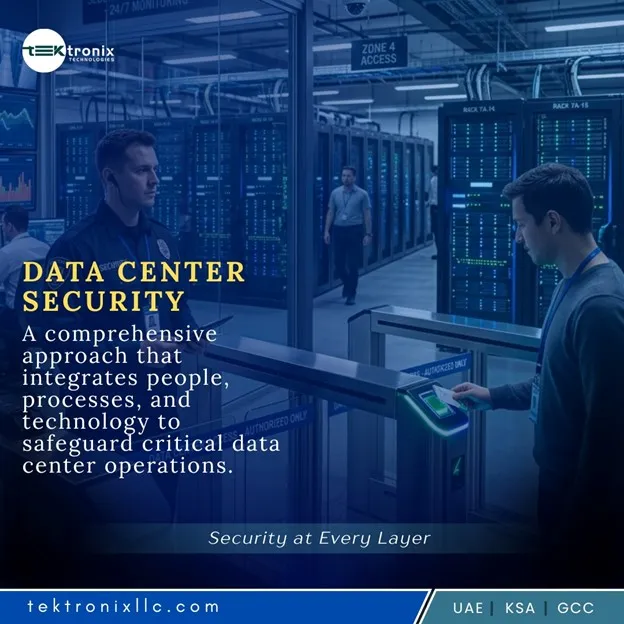

Across the Gulf Cooperation Council, an unprecedented wave of digital infrastructure investment is reshaping the region's economic and technological landscape. Saudi Arabia's Vision 2030 programme is driving hyperscale data centre construction at a pace unmatched in the GCC's history, while Bahrain, Kuwait, and Oman are each accelerating sovereign cloud and colocation facility development to serve their national digital transformation agendas. At the heart of this expansion sits a non-negotiable requirement: robust, multi-layered Data Center Security that protects sovereign data assets, critical financial infrastructure, and national digital services from both physical intrusion and cyber-attack.
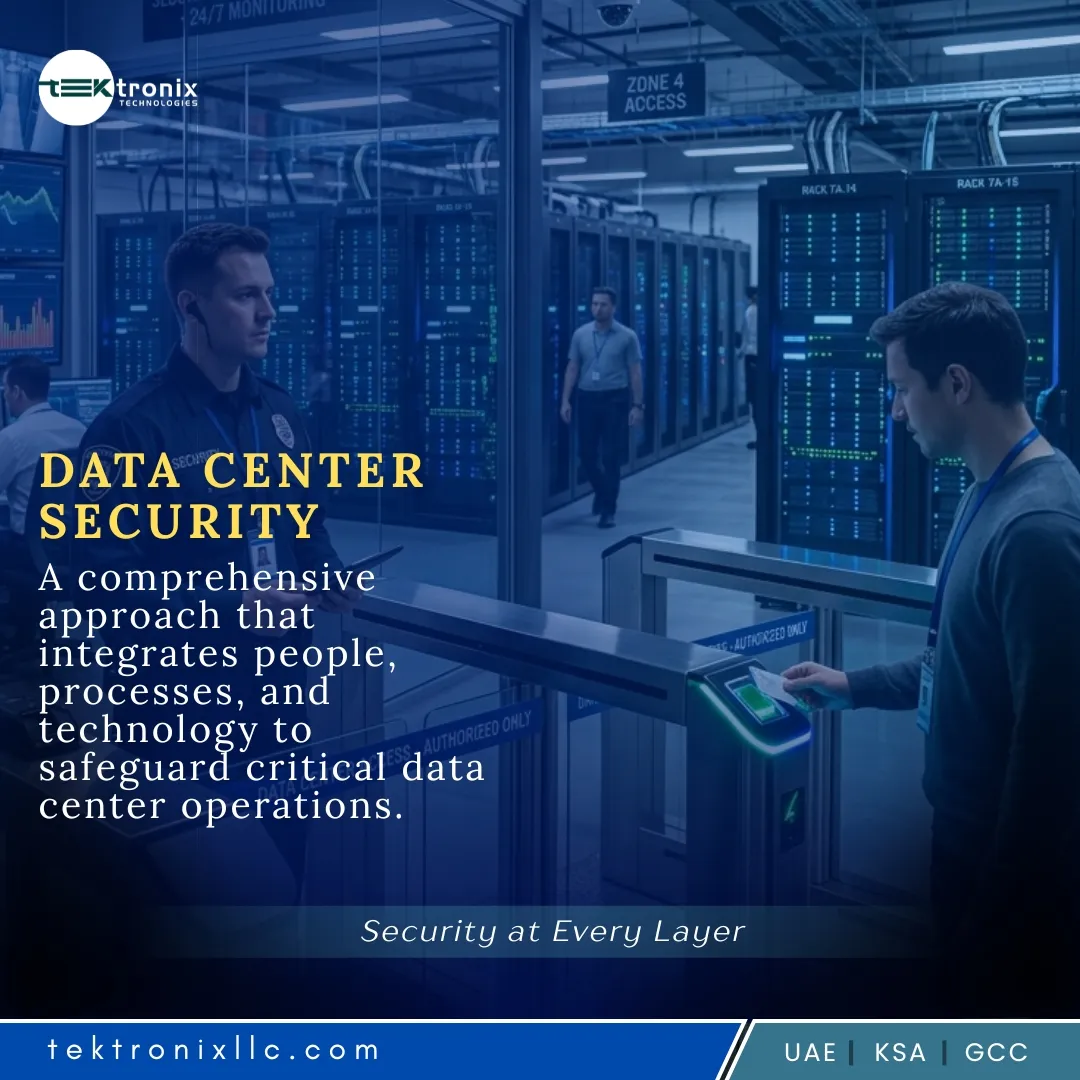
Tektronix LLC, an ISO 9001:2015 and ISO/IEC 27001:2022 certified security systems integrator with over 500 deployments across the UAE and GCC since 2009, delivers comprehensive Data Center Security GCC solutions aligned with the Saudi National Cybersecurity Authority (NCA), Gulf central bank technology risk frameworks, and international data centre security standards — engineering converged physical and cyber protection architectures that GCC operators can rely on through every phase of the facility lifecycle.
This article examines each critical security layer that KSA and GCC data centre operators must implement — from perimeter hardening, biometric access zoning, and encrypted storage through next-generation firewall architectures, AI-driven threat analytics, and intrusion detection systems — alongside the specific regulatory obligations and geopolitical threat context that make this region's data centre security requirements among the most demanding in the world.
The GCC Threat Landscape: Why Regional Context Shapes Security Architecture
The GCC's data centre sector operates in one of the world's most actively targeted cyber environments. State-sponsored threat actors operating from outside the region have consistently targeted GCC critical infrastructure — energy sector SCADA systems, financial institution payment networks, and government digital services — with campaigns ranging from destructive malware to prolonged low-and-slow credential harvesting operations. The 2012 Shamoon attack on Saudi Aramco, which destroyed data on approximately 35,000 workstations, remains the defining reference event for KSA data centre security planning and continues to inform the NCA's Essential Cybersecurity Controls (ECC) framework design.
Physical security threats in the GCC context include insider threat from the large temporary contractor workforces involved in data centre construction and commissioning, social engineering attacks targeting reception and facilities staff at colocation facilities, and the risk of equipment tampering during the supply chain transit phase — a threat vector that NCA's Supply Chain Cybersecurity Controls (CSCC) framework directly addresses. Tektronix LLC's security architecture methodology for GCC data centre clients integrates both threat landscapes into a single converged design — recognising that the most sophisticated attacks combine physical access with cyber exploitation, and that a security architecture addressing only one dimension leaves the other as an open vector.
Cybersecurity for Data Center: NCA and GCC Regulatory Framework
Effective Cybersecurity for Data Center operations in Saudi Arabia and the GCC is not simply best practice — it is a regulatory obligation enforced by multiple authorities with meaningful penalty and licence revocation powers. The key frameworks governing GCC data centre cybersecurity include:
- NCA ECC-1:2018 (Essential Cybersecurity Controls): Saudi Arabia's primary cybersecurity compliance framework, mandatory for all government entities and critical national infrastructure operators, covering 114 controls across five domains including data centre physical security, access management, and threat detection
- NCA CSCC-1:2021 (Cloud Computing Cybersecurity Controls): Governs cloud service providers and data centre operators offering cloud-hosted services in Saudi Arabia, with specific requirements for tenant isolation, data sovereignty, encryption key management, and incident response timelines
- NCA OT Cybersecurity Controls: Applies to data centres co-located with or connected to operational technology environments — particularly relevant for energy sector and utility data hosting facilities
- SAMA Cyber Security Framework (CSF): Saudi Arabian Monetary Authority's technology risk framework mandates specific data centre security controls for all financial sector entities operating or contracting data hosting services in the Kingdom
- CITC Cloud Computing Regulatory Framework: Communications and Information Technology Commission requirements for licensed cloud operators in Saudi Arabia, including data residency, physical security certification, and annual third-party audit obligations
- CBB TRM (Central Bank of Bahrain Technology Risk Management): Bahrain's financial sector data centre security requirements, widely referenced as a model framework across the GCC banking sector
- CITRA (Kuwait): Kuwait's Communications and Information Technology Regulatory Authority governs data centre licensing and operational security standards for cloud and hosting operators in the country
Tektronix LLC's GCC compliance team prepares regulatory documentation packages — NCA ECC control mapping reports, SAMA CSF gap analyses, and CITC audit preparation packages — for every data centre security engagement, ensuring clients enter regulatory reviews with confidence rather than discovering compliance gaps during inspection.
Data Center Encryption: Sovereign Data Protection Across KSA and GCC
Saudi Arabia's Personal Data Protection Law (PDPL), enforced by the Saudi Data and AI Authority (SDAIA), and equivalent data protection legislation across Bahrain (PDPL 2019), Kuwait, and Oman impose specific obligations on how personal data stored in GCC data centres is protected at rest, in transit, and during processing. Data Center Encryption strategy for GCC facilities must therefore satisfy both regulatory data protection obligations and the NCA's cryptographic control requirements simultaneously.
Encryption at Rest: Saudi PDPL and NCA Alignment
AES-256 full-disk encryption with Hardware Security Module (HSM) key management is the standard Tektronix LLC recommends and implements for GCC data centre storage encryption — aligning with NCA ECC Domain 2 (Data and Privacy Protection) requirements and SAMA CSF technical security controls. HSMs deployed in KSA data centres are configured for dual-control, split-knowledge key custody procedures, with key ceremony documentation prepared in the format required by SAMA for financial sector audits. For sovereign government data hosting — encompassing Vision 2030 programme data, NEOM project infrastructure, and Saudi Aramco digital operations — Tektronix LLC recommends HSM appliances with FIPS 140-3 Level 3 validation, providing the hardware-enforced tamper evidence required for the most sensitive data classification levels.
Data Sovereignty and Cross-Border Transfer Controls
Saudi PDPL Article 29 prohibits cross-border personal data transfers to jurisdictions without an adequate level of data protection unless specific contractual safeguards are in place. For GCC data centre operators hosting personal data of Saudi residents, this creates an architectural requirement to ensure that replication, backup, and disaster recovery traffic does not transit data to non-GCC jurisdictions without contractual controls in place. Tektronix LLC architect’s data replication configurations with geo-fencing controls that restrict backup and DR traffic to approved GCC regional pairs — Riyadh to Jeddah for KSA-domestic replication, or Saudi Arabia to Bahrain for GCC-regional DR arrangements — with encrypted tunnel configurations that satisfy the PDPL's technical safeguard requirements for cross-border transfers where approved.
Data Center Firewalls: Next-Generation Perimeter Defence for GCC Infrastructure
The sophistication of nation-state and financially motivated threat actors targeting GCC critical infrastructure demands Data Center Firewalls that go well beyond stateful packet inspection. Next-generation firewall platforms deployed by Tektronix LLC in KSA and GCC data centres are architected to deliver inline TLS 1.3 inspection at 100G+ line rates, application-layer filtering against the OWASP Top 10 and GCC-specific attack patterns catalogued by Saudi CERT (zatca.gov.sa) and Bahrain's National Cyber Security Centre (NCSC), and threat intelligence integration receiving IOC feeds from NCA's national threat intelligence sharing platform.
Defence-in-depth firewall architecture for GCC data centres follows a four-zone model tailored to the region's regulatory requirements. The sovereign perimeter zone enforces data residency controls — blocking traffic to non-approved jurisdictions at the network layer to support PDPL compliance. The internet-facing DMZ zone hosts reverse proxies, DDoS mitigation appliances, and WAF platforms with Arabic-language content inspection capabilities. The tenant production zone enforces micro-segmentation between individual tenant environments — mandatory for CITC-licensed colocation operators who must demonstrate tenant isolation in annual audits. The management and out-of-band zone carry only encrypted management traffic on a completely isolated network segment, ensuring that a compromise of the production network cannot reach the management plane.
Data Center Access Control: Physical Security for KSA Vision 2030 Infrastructure
Saudi Arabia's Vision 2030 data centre pipeline — encompassing NEOM's cognitive city infrastructure, the Red Sea Project's hospitality and tourism data platforms, Qiddiya's entertainment technology systems, and the Kingdom's expanding e-government hosting estate — represents the largest single concentration of new data centre construction in the GCC. Data Center Access Control for these facilities must be designed from the ground up with NCA ECC physical security requirements, CITC facility certification standards, and the site-specific threat models of large-scale infrastructure projects operating in remote or newly developed locations.
Concentric Zone Physical Security
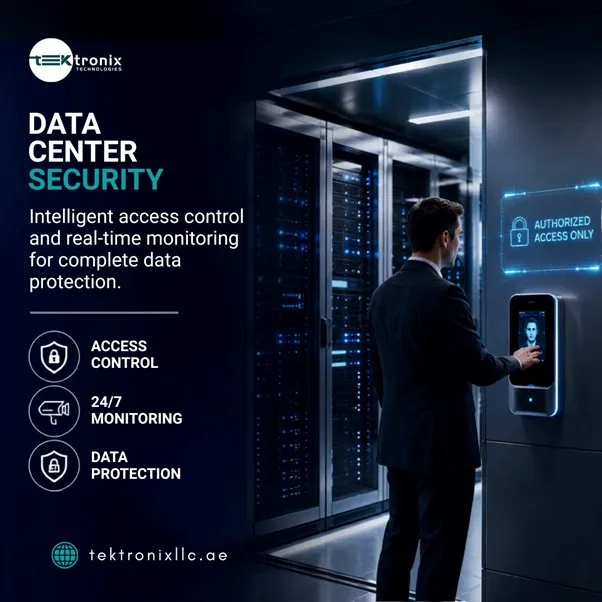
Tektronix LLC designs KSA data centre physical access architectures following the TIA-942 and Uptime Institute concentric zone model: secured site perimeter with vehicle anti-ram barriers and ANPR-integrated guard house → building envelope mantrap airlock with biometric multi-factor authentication → data hall entry with anti-tailgating detection and two-person integrity enforcement → individual cabinet electronic locks with independent audit logging. As a Suprema Certified Installer and HID Global Authorised Dealer, Tektronix LLC provisions biometric readers combining facial recognition, fingerprint verification, and smart card credentials at data hall boundaries — creating a three-factor authentication event that satisfies NCA ECC Control 2-10-3 (physical access to critical systems) and SAMA CSF physical security requirements simultaneously.
Workforce Identity Management for Large Construction Projects
Vision 2030 megaproject data centre construction involves workforces of thousands of contractors across multiple phases — creating an identity management challenge that static access control configurations cannot address. Tektronix LLC deploys temporary construction-phase access control infrastructure with HRMS-integrated credential lifecycle management, ensuring that subcontractor workers are enrolled on their first approved site day and their credentials automatically expire at project phase completion — eliminating the ghost credential accumulation that represents the primary insider threat vector during large construction programmes.
Data Center Surveillance: Forensic Coverage for GCC Facilities
A comprehensive Data Center Surveillance architecture in a KSA or GCC data centre must satisfy both operational security requirements and the evidentiary standards of regional law enforcement agencies — ensuring that video evidence captured during a security incident can be submitted to Saudi public prosecution or GCC national authorities in an admissible format. Tektronix LLC, as a Dahua Certified Engineer and Genetec Gold Certified Partner, designs surveillance systems delivering 4K resolution coverage of every access point, server aisle, raised floor entry, and loading bay — with retention periods configured to satisfy NCA ECC minimum 12-month log retention requirements and SAMA CSF audit trail obligations.
Genetec Security Center — deployed by Tektronix LLC as a Gold Certified Partner — provides the unified platform that integrates access control event data with CCTV footage streams, automatically presenting the synchronised video segment for every physical access event in the audit log. For KSA government data centre clients subject to NCA oversight, Tektronix LLC configures the video archive with SHA-256 hash verification of every stored file — creating a tamper-evident chain of custody that satisfies Saudi digital evidence admissibility standards. All video data is stored on-premise or in Kingdom-resident cloud storage to satisfy Saudi PDPL data residency obligations.
Data Center Intrusion Detection: Physical and Network Layers
Given the GCC's documented exposure to sophisticated physical and cyber intrusion campaigns, Data Center Intrusion Detection must operate simultaneously at the physical perimeter and the network boundary — with event correlation between both layers enabling the detection of coordinated attacks that use physical access to facilitate cyber exploitation.
Physical Intrusion Detection
Tektronix LLC deploys layered physical intrusion detection at GCC data centres comprising microwave perimeter beam sensors at site boundary walls, passive infrared (PIR) motion detectors in non-operational zones during out-of-hours periods, seismic vibration sensors on raised floor panels and false ceiling tiles in data halls where covert access attempts via floor void or ceiling plenum represent a documented attack vector, fibre-optic fence detection systems on outdoor perimeters rated for KSA desert environments with sand and heat tolerance, and under-vehicle inspection mirrors integrated with ANPR at vehicle entry barriers. All physical intrusion events are fed to the central security operations console with GPS-referenced zone mapping, enabling the security team to identify the precise location of an intrusion attempt on a facility floor plan within seconds of detection.
Network Intrusion Detection
Network Intrusion Detection System (NIDS) sensors are deployed on SPAN ports across all critical switching planes — analysing traffic against NCA ECC-aligned detection rule sets that include signatures for the specific attack tools and techniques documented in Saudi CERT's annual threat landscape reports. Tektronix LLC configures east-west traffic inspection between tenant segments in colocation environments, detecting lateral movement attempts that originate from a compromised tenant workload and target adjacent tenants' systems — a threat scenario that regulatory auditors increasingly probe during CITC certification assessments.
Data Center Threat Detection: AI-Driven Analytics Aligned with NCA Requirements
Saudi Arabia and GCC threat actors have demonstrated the capability and intent to conduct multi-year low-and-slow intrusion campaigns — harvesting credentials, mapping networks, and staging destructive payloads before executing at a strategically chosen moment. Signature-based detection is categorically insufficient against these adversaries. Data Center Threat Detection for KSA and GCC critical infrastructure requires behavioural analytics platforms that establish normal operational baselines and surface deviations that indicate compromise — regardless of whether those deviations match any known attack signature.
Tektronix LLC designs threat detection architectures for GCC data centres incorporating SIEM platforms with NCA ECC-aligned use case libraries, UEBA (User and Entity Behaviour Analytics) engines that detect anomalous administrator behaviour — the primary indicator of privilege escalation and insider threat — and XDR (Extended Detection and Response) platforms providing correlated visibility across endpoint, network, and identity layers. Threat intelligence integration sources include Saudi CERT IOC feeds, the OIC-CERT (Organisation of Islamic Cooperation CERT) regional sharing platform, and Gulf-focused commercial threat intelligence services that track threat actor campaigns specifically targeting GCC energy, finance, and government sectors.
MITRE ATT&CK for ICS and Enterprise threat hunting playbooks are configured as scheduled queries running continuously on ingested log data — proactively searching for the TTPs (Tactics, Techniques, and Procedures) documented in post-incident analysis reports from previous GCC critical infrastructure attacks. This proactive hunt capability directly addresses NCA ECC Control 3-5 (Cybersecurity Event Management) requirements for continuous threat monitoring and aligns with SAMA CSF's expectation that financial sector data centre operators maintain a demonstrable threat detection capability above the reactive-alert baseline.
Data Center Security KSA: Vision 2030 Programmes and National Infrastructure
Saudi Arabia's ambition to become a global technology hub by 2030 is creating a data centre construction and commissioning pipeline of historic proportions. Data Center Security KSA deployments by Tektronix LLC serve this pipeline across its principal programme areas:
- NEOM and The Line: The cognitive city's AI-driven service infrastructure requires data centre security architectures that support the convergence of physical and digital access control across a linear urban environment — a deployment model that demands new thinking about zone definition, perimeter monitoring, and identity management at scale
- Saudi Aramco and SABIC Digital Infrastructure: Energy sector data centres hosting OT-connected systems require the converged IT/OT security architecture that Tektronix LLC delivers — ensuring that physical perimeter controls, network segmentation, and threat detection platforms address both corporate IT and industrial control system environments in a unified security operations framework
- Government Cloud (G-Cloud): SDAIA's national government cloud programme requires participating data centre operators to demonstrate NCA ECC compliance across all six security layers — a requirement that Tektronix LLC's integrated deployment methodology addresses comprehensively
- Financial Sector Data Centres (Riyadh Financial District): Banking and capital markets infrastructure in the RFD and Riyadh's financial technology ecosystem requires SAMA CSF-aligned security controls with quarterly audit evidence generation — a repeatable compliance workflow that Tektronix LLC's managed service clients receive as a standard AMC deliverable
Conclusion
Saudi Arabia and the broader GCC are building the digital infrastructure that will underpin their economies for the next generation — and the security of that infrastructure cannot be an afterthought addressed after construction completes. Every layer of a robust Data Center Security architecture must be designed in from the first blueprint: Data Center Encryption protecting sovereign data against exfiltration, Data Center Firewalls enforcing granular network segmentation against both external and insider threats, Data Center Access Control restricting physical presence to verified, role-appropriate personnel at every zone boundary, Data Center Surveillance providing forensic-quality coverage aligned with regional evidentiary standards, Data Center Intrusion Detection raising immediate alerts at both physical and network perimeters, and Data Center Threat Detection continuously hunting for the behavioural indicators of the sophisticated campaigns that target this region.
Whether you are securing a new Data Center Security KSA facility under Vision 2030, protecting financial sector infrastructure subject to SAMA CSF requirements, or building a compliant colocation platform aligned with CITC and Cybersecurity for Data Center regulatory obligations across the wider GCC, Tektronix LLC brings the certified expertise, regulatory alignment, and operational track record to deliver every layer.
Frequently Asked Questions (FAQs)
Q1. What are the key differences between NCA ECC compliance and UAE NESA IA Standards for data center security?
Both frameworks share a common foundation in ISO/IEC 27001 and NIST SP 800-53, but differ significantly in scope, enforcement mechanism, and regional specificity. NCA ECC-1:2018 is mandatory for all Saudi government entities and critical infrastructure operators, enforced by the National Cybersecurity Authority with audit powers and penalty authority — making it one of the most comprehensively enforced cybersecurity frameworks in the GCC. It contains 114 controls across five domains, with particular emphasis on supply chain security (CSCC) and cloud computing controls (CSCC) that reflect Saudi Arabia's specific procurement and digital transformation context. UAE NESA IA Standards apply primarily to federal entities and critical information infrastructure operators, with a similar ISO 27001 foundation but different control numbering and sector-specific annexes. Tektronix LLC maintains expertise in both frameworks, enabling GCC-wide clients operating in both Saudi Arabia and the UAE to receive a single integrated compliance architecture rather than managing two separate vendor relationships.
Q2. How does Saudi Arabia's Personal Data Protection Law (PDPL) affect data center encryption and storage architecture?
Saudi PDPL, enforced by SDAIA and effective from September 2023, classifies personal data stored in Saudi-resident data centres as subject to processing restrictions, cross-border transfer controls, and technical safeguard requirements. For data centre operators, the most architecturally significant implications are the data residency obligation — personal data of Saudi residents must be processed in Saudi Arabia unless specific contractual safeguards for cross-border transfer are in place — and the security requirement for encryption of personal data at rest and in transit using controls appropriate to the data's sensitivity classification. Tektronix LLC addresses these requirements by configuring AES-256 storage encryption with HSM key management for all personal data tiers, implementing geo-fenced replication policies that prevent personal data from transiting non-approved jurisdictions, and producing the technical security documentation that SDAIA expects operators to maintain as evidence of PDPL compliance.
Q3. Can Tektronix LLC deploy and support data center security systems across multiple GCC countries simultaneously?
Yes. Tektronix LLC operates across the UAE, Saudi Arabia, Kuwait, Bahrain, and Oman through its regional entity structure, with in-country technical teams or certified partner networks in each jurisdiction. For multi-country data centre clients, Tektronix LLC designs a unified security architecture with jurisdiction-specific compliance overlays — ensuring the same physical security hardware, access control platform, and SIEM configuration satisfies NCA ECC in Saudi Arabia, CBB TRM in Bahrain, and CITRA requirements in Kuwait simultaneously, rather than deploying entirely separate systems in each country. A single AMC contract covers all sites with jurisdiction-specific SLA terms reflecting each country's regulatory incident response timelines.
Q4. What physical security certifications does Tektronix LLC hold that are relevant to GCC data center deployments?
Tektronix LLC holds ISO 9001:2015 quality management certification and ISO/IEC 27001:2022 information security management certification — the latter directly relevant to data centre security deployments as it demonstrates the integrator's own information security management maturity. Technology-specific authorisations include Genetec Gold Certified Partner status for unified physical security platform deployments, HID Global Authorised Dealer status for biometric and smart card access control, Suprema Certified Installer for fingerprint and facial recognition readers, ZKTeco Partner for high-volume biometric deployments, and Dahua Certified Engineer for surveillance system design and commissioning. These credentials ensure that every component of a GCC data centre security deployment is installed and configured by engineers with factory-authorised training — a requirement increasingly specified in GCC data centre procurement documents and NCA compliance audit checklists.
Q5. What does Tektronix LLC's ongoing support programme include for GCC data center security clients?
Tektronix LLC's Annual Maintenance Contract for GCC data centre security deployments covers quarterly preventive maintenance visits for all physical security hardware, remote monitoring of access control, intrusion detection, and surveillance system health metrics with 24/7 NOC coverage, firmware and signature update management for network security platforms with NCA-aligned patching timelines, annual NCA ECC and SAMA CSF compliance review assessments generating updated control evidence packages, and incident response support with jurisdiction-specific SLA terms — four-hour on-site response in the UAE, and agreed response timelines for Saudi Arabia and other GCC markets based on in-country resource availability. The AMC also includes an annual penetration testing coordination service, managing the third-party testing requirement that CITC, SAMA, and NCA frameworks impose on data centre operators, and ensuring the test scope and methodology satisfy each regulator's specific requirements.
For more information contact us on:
Tektronix Technology Systems Dubai-Head Office
+971 55 232 2390





























Sign in to leave a comment.