
In an economy where sovereign wealth management, hydrocarbon trading, cross-border e-commerce, and AI-driven government services all depend on uninterrupted digital infrastructure, Data Center Security has become one of the UAE's most strategically critical disciplines. A single physical breach of a server room — or a single undetected intrusion into a hyperscale facility's network perimeter — can cascade into regulatory sanctions, client data exposure, and irreparable reputational damage measured in billions of dirhams. Tektronix LLC, a SIRA-licensed, ISO-certified security systems integrator with over 500 installations since 2009, designs and deploys converged physical and cyber security architectures for Data Center Security UAE clients — from colocation providers and telecommunications carriers to banking infrastructure operators and federal government data hosting facilities.
This article provides a comprehensive examination of every security layer that a modern UAE data centre must implement — from physical perimeter hardening and biometric access zoning through encrypted network segmentation, advanced firewall architectures, continuous threat intelligence, and AI-powered anomaly detection — along with the specific regulatory obligations and deployment considerations unique to Dubai, Abu Dhabi, and the broader Emirates.
The Converged Security Imperative: Why Physical and Cyber Must Unite
The most sophisticated network security stack is fundamentally undermined if an unauthorised individual can walk into a server room and remove a drive, attach a rogue device to a switch port, or disable a cooling unit to trigger a thermal shutdown. Equally, the most robust physical perimeter provides no protection against a remotely executed ransomware payload delivered through an unpatched hypervisor. Modern Cybersecurity for Data Center strategy therefore begins with the recognition that physical security and cyber security are not parallel disciplines — they are a single converged attack surface that must be governed by a unified security operations architecture.
Tektronix LLC's engineering methodology — informed by ISO/IEC 27001:2022 information security management requirements and aligned with the UAE National Electronic Security Authority (NESA) UAE Information Assurance (IA) Standards — treats every data centre engagement as a converged security design exercise. Physical access controls, surveillance systems, intrusion detection sensors, and network security platforms are specified, integrated, and commissioned as a single architecture, with all event data feeding a unified Security Operations Centre (SOC) dashboard for real-time correlation and response.
Data Center Encryption: Protecting Data at Rest, in Transit, and in Use
No security architecture is complete without a rigorous Data Center Encryption strategy that ensures data remains protected at every point in its lifecycle — whether stored on NVMe drives in a production server, traversing inter-rack fibre, crossing a WAN interconnect between data centre campuses, or being processed by a virtual machine in a multi-tenant cloud environment.
Encryption at Rest
Full-disk encryption using AES-256-XTS is the baseline standard for all storage media in UAE data centres subject to NESA IA Standards and the Dubai Electronic Security Centre (DESC) Cloud Security Standard. Hardware Security Modules (HSMs) — dedicated cryptographic processors that generate, store, and manage encryption keys in tamper-resistant hardware — ensure that key material never exists in plaintext in memory or on disk, eliminating the key exposure vector that defeats software-only encryption implementations. Tektronix LLC procures and commissions HSM deployments as part of its data centre security engagements, with key custody procedures designed to satisfy UAE Central Bank (CBUAE) Technology Risk Management requirements for financial sector clients.
Encryption in Transit
Inter-facility replication traffic, management plane communications, and API calls between data centre systems are enforced over TLS 1.3 or IPsec tunnels with Perfect Forward Secrecy (PFS) enabled — ensuring that compromise of a long-term key does not decrypt previously captured session data. MACsec (IEEE 802.1AE) layer-2 encryption is applied to intra-data-centre east-west traffic across high-speed switching fabrics, protecting against insider threat actors with physical access to distribution layer cabling.
Data Center Firewalls: Multi-Layer Network Perimeter Defence
Next-generation Data Center Firewalls deployed in UAE facilities must perform at line rate for 100G and 400G interfaces while executing deep packet inspection, TLS decryption, application-layer filtering, and real-time threat intelligence lookups simultaneously — a computational demand that requires purpose-built ASIC hardware rather than software-defined filtering on general-purpose CPUs.
Tektronix LLC designs data centre firewall architectures following a defence-in-depth model comprising three distinct enforcement zones. The Internet perimeter zone deploys stateful inspection with IPS signature sets updated on a sub-hourly cadence, rate limiting to absorb volumetric DDoS attacks, and BGP Flowspec integration for upstream null-routing of attack traffic. The DMZ zone hosts reverse proxies, load balancers, and API gateways with application-aware filtering policies that permit only explicitly whitelisted request patterns. The core production zone applies micro-segmentation policies enforced at the hypervisor virtual switch layer, ensuring that a compromised workload cannot communicate laterally to adjacent systems — containing the blast radius of a successful intrusion to a single segment.
Data Center Access Control: Zoned Physical Security from Perimeter to Cabinet
Physical Data Center Access Control in a Tier III or Tier IV facility is not a single checkpoint — it is a series of progressively restrictive security zones, each requiring re-authentication, each independently logged, and each enforcing the principle of least privilege for the personnel authorised to operate within it.
Concentric Zone Architecture
Tektronix LLC designs data centre physical access architectures following the Uptime Institute and TIA-942 concentric zone model: Site Perimeter (vehicle barriers, ANPR, guardhouse) → Building Envelope (mantrap airlock, biometric reader, anti-tailgating sensor) → Data Hall (per-row access control, two-person integrity for critical rows) → Individual Cabinet (electronic cabinet locks with independent audit logging). Each zone transition requires a credential that is specific to that zone — an employee's building access card does not grant data hall access; a data hall badge does not open specific cabinets assigned to other tenants or departments.
Biometric Multi-Factor Authentication
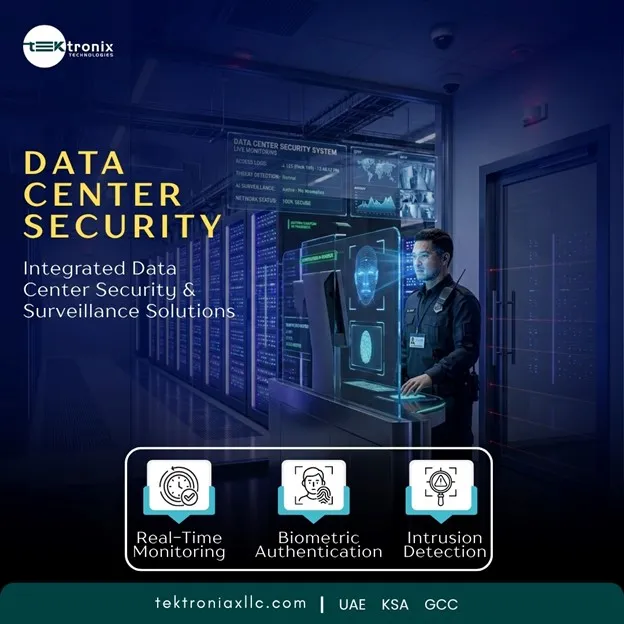
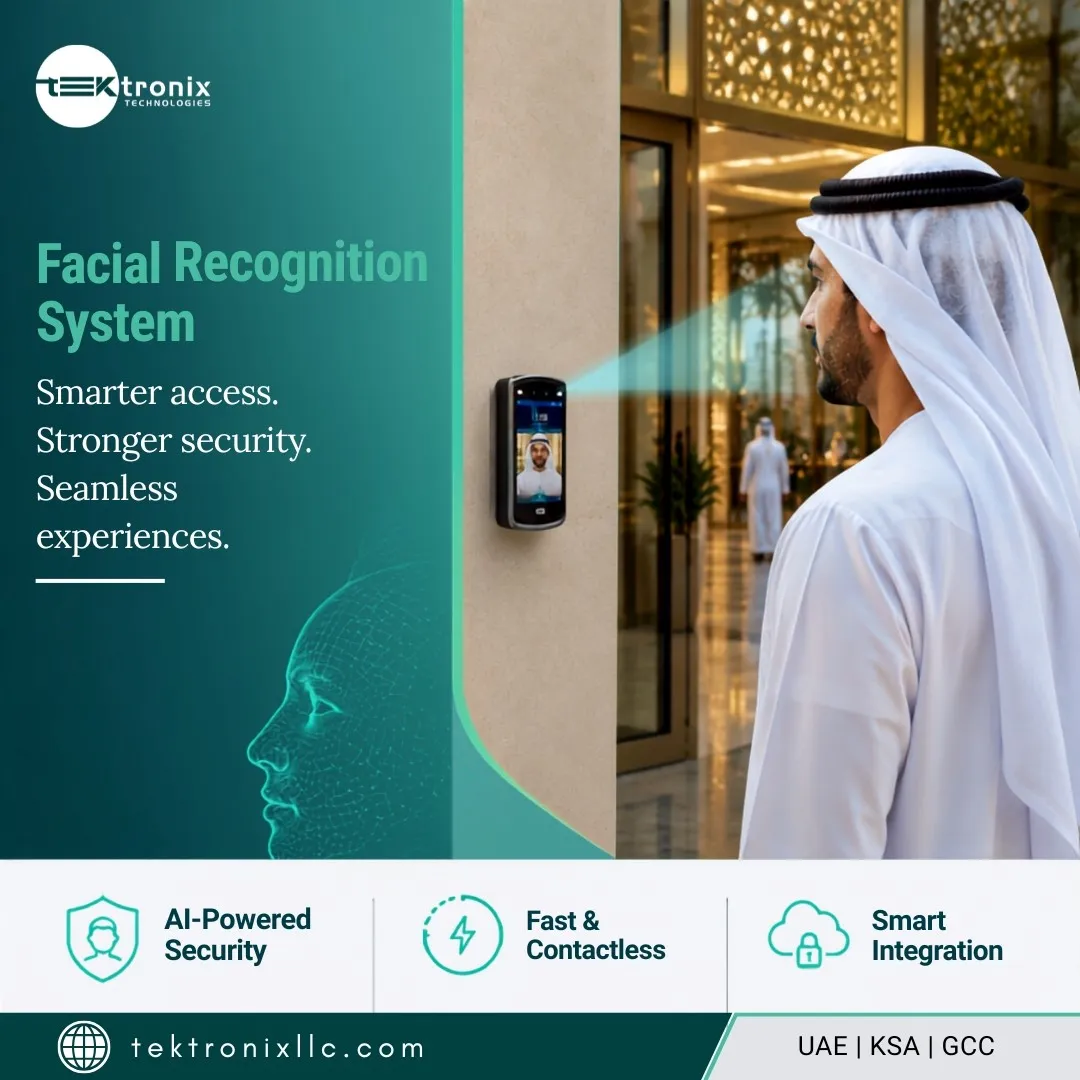
As an HID Global Authorised Dealer and Suprema Certified Installer, Tektronix LLC provisions multi-factor authentication at data hall entry points combining HID Amico facial recognition, Suprema fingerprint readers, and smart card credentials — creating a three-factor verification event (something you are + something you are + something you have) that eliminates the tailgating, card-sharing, and PIN-observation vulnerabilities that single-factor systems suffer. Anti-passback enforcement at the controller level prevents a single credential event from admitting multiple individuals, and the two-person integrity rule requires simultaneous authentication from two independently enrolled personnel before particularly sensitive zones — such as core routing rooms or HSM vaults — can be accessed.
Data Center Surveillance: Forensic-Quality Visual Intelligence
A comprehensive Data Center Surveillance architecture provides the forensic evidence layer that transforms a security event from an unanswered question into a fully documented incident with timestamped visual confirmation. Tektronix LLC, as a Dahua Certified Engineer and Genetec Gold Certified Partner, designs and installs surveillance systems that deliver 4K resolution coverage of every access point, aisle end, and cabinet row — with sufficient pixel density at target distances to support facial identification, badge number legibility, and equipment serial number capture without camera repositioning.
Video Management System (VMS) platforms deployed by Tektronix LLC — principally Genetec Security Center — integrate access control event data with CCTV footage streams, automatically presenting the video segment corresponding to every access event in the audit log. When a door access event is reviewed days or weeks after the fact, the security operator sees not just the log entry but the synchronised camera feed showing exactly who entered, what they carried, and whether any tailgating occurred — a forensic capability that paper logs and standalone VMS systems categorically cannot replicate.
Data Center Intrusion Detection: Physical and Network Perimeter Monitoring
Preventing unauthorised entry is the first objective; detecting it the instant it occurs is the second. Data Center Intrusion Detection at the physical layer encompasses passive infrared (PIR) motion sensors in non-operational areas activated during out-of-hours periods, door contact sensors on every access-controlled boundary, glass-break detectors on any glazed facade, under-floor void sensors in raised-floor environments where access panels could be covertly removed, and vibration sensors on server cabinet doors that detect forcible entry attempts without triggering on normal operational vibration from adjacent cooling units.
At the network layer, Tektronix LLC integrates Network Intrusion Detection System (NIDS) sensors on SPAN ports across all critical switching planes — analysing packet headers and payloads for known attack signatures, protocol anomalies, lateral movement patterns, and data exfiltration behaviours. NIDS alert feeds are correlated with physical intrusion events in the unified SOC dashboard: if a network anomaly coincides temporally with a physical access event in a server room, the combined alert severity is automatically elevated and assigned to a human analyst, ensuring that sophisticated attacks attempting to use an insider's physical access to mask a cyber extraction are surfaced immediately.
Data Center Threat Detection: AI-Driven Analytics and Continuous Intelligence
Signature-based detection catches known attacks. Data Center Threat Detection at the level required to protect UAE critical infrastructure demands behavioural analytics that identify novel attack patterns — zero-day exploits, living-off-the-land techniques, slow-burn credential harvesting, and supply chain compromise indicators — that carry no signature and generate no single high-confidence alert, but whose combined behavioural profile deviates measurably from the established baseline of normal operations.
Tektronix LLC designs threat detection architectures incorporating Security Information and Event Management (SIEM) platforms with machine-learning-driven User and Entity Behaviour Analytics (UEBA), Extended Detection and Response (XDR) agents on every server and network device, and threat intelligence feeds sourced from UAE Computer Emergency Response Team (aeCERT), regional ISAC sharing groups, and global commercial intelligence platforms. Threat hunt workflows are configured to run continuously on ingested log data, proactively querying for Indicators of Compromise (IoCs) and Tactics, Techniques, and Procedures (TTPs) mapped to the MITRE ATT&CK framework — a methodology aligned with NESA's recommended incident detection approach for critical information infrastructure operators.
Data Center Security Dubai and Abu Dhabi: Jurisdiction-Specific Deployments
Data Center Security Dubai
Dubai's position as the Middle East's premier cloud and colocation hub — anchored by facilities in Dubai Internet City, Dubai Silicon Oasis, and Jebel Ali — creates a regulatory environment governed by SIRA licensing requirements, DESC Cloud Security Standard v2, and Dubai Smart City cybersecurity frameworks. Data Center Security Dubai deployments by Tektronix LLC are designed from the outset to satisfy DESC audit requirements, which include physical security zoning documentation, access log retention for a minimum of 12 months, encrypted CCTV storage, and penetration testing evidence for network perimeter defences. Tektronix LLC's SIRA-licensed status ensures that every physical security installation in Dubai meets the mandatory performance specifications required for regulatory approval.
Data Center Security Abu Dhabi
Abu Dhabi's data centre landscape is dominated by sovereign and quasi-sovereign operators — ADNOC, ADIB, ADQ, and multiple federal ministry hosting environments — whose security requirements are shaped by NESA IA Standards, Abu Dhabi Government ICT (ADGICT) procurement security frameworks, and sector-specific regulations from the Central Bank of the UAE (CBUAE) for financial data hosting. Data Center Security Abu Dhabi deployments by Tektronix LLC incorporate the additional physical hardening measures these environments demand: anti-drone perimeter monitoring, seismic vibration sensing for underground cable vault protection, and hardened SCADA-connected physical security management platforms for facilities where data centre infrastructure is co-located with operational technology systems.
Conclusion
The UAE's ambition to lead the region in AI, cloud computing, and digital government services rests entirely on the integrity of the data centre infrastructure that underpins those platforms. Achieving that integrity requires a security architecture where Data Center Encryption protects every byte at rest and in transit, Data Center Firewalls enforce granular network segmentation at line rate, Data Center Access Control restricts physical presence to verified, authorised personnel at every zone boundary, Data Center Surveillance provides forensic-quality visual coverage of every critical space, Data Center Intrusion Detection raises immediate alerts on any physical or network boundary violation, and Data Center Threat Detection continuously hunts for the behavioural indicators of attacks that evade signature-based defences.
Tektronix LLC brings the technical depth, regulatory authority, and operational experience to design and deliver this complete architecture — whether you are securing a new Data Center Security Dubai colocation build, upgrading the physical security posture of an existing Data Center Security Abu Dhabi government hosting facility, or deploying a Cybersecurity for Data Center programme across a distributed UAE enterprise infrastructure estate.
Contact Tektronix LLC today for a converged security assessment of your Data Center Security UAE infrastructure — and let our certified engineers design a protection architecture that meets today's threats and scales with tomorrow's requirements.
FAQs
Q1. What regulatory frameworks govern data center security in the UAE?
UAE data centres must navigate a layered regulatory environment depending on their sector and emirate of operation. NESA's UAE Information Assurance (IA) Standards apply to critical information infrastructure operators nationwide, mandating specific physical security zoning, access logging, and incident response requirements. The Dubai Electronic Security Centre (DESC) Cloud Security Standard governs cloud and colocation providers operating in Dubai. The Central Bank of the UAE (CBUAE) Technology Risk Management framework applies to financial sector data hosting. The UAE Personal Data Protection Law (PDPL) governs the processing of personal data within data centre environments. Tektronix LLC's compliance team maps each client's regulatory obligations at the outset of every engagement, ensuring the security architecture satisfies all applicable frameworks simultaneously.
Q2. How does Tektronix LLC approach the physical security zoning of a data center?
Tektronix LLC follows the Uptime Institute and TIA-942 concentric zone model, designing progressively restrictive physical security layers from the site perimeter inward to individual server cabinets. Each zone boundary is enforced by multi-factor authentication hardware — typically combining HID Global biometric readers with smart card credentials — and independently logged by the access control management system. Anti-tailgating sensors, mantrap airlocks, and two-person integrity rules are applied at the data hall boundary and at particularly sensitive inner zones. Every zone design is documented in an as-built security architecture diagram submitted to the relevant regulatory authority as part of the compliance package.
Q3. Can Tektronix LLC integrate physical security and cybersecurity monitoring into a single SOC dashboard?
Yes. Tektronix LLC designs converged SOC architectures where physical security event data from access control systems, CCTV platforms, and intrusion detection sensors is fed into the same SIEM platform receiving network security logs from firewalls, NIDS sensors, and endpoint agents. Genetec Security Center — deployed by Tektronix LLC as a Gold Certified Partner — provides the physical security event layer, with API integration to leading SIEM platforms enabling cross-domain correlation. When a network anomaly coincides with a physical access event, the correlated alert severity is automatically elevated, ensuring that multi-vector attacks — where a physical intrusion is used to facilitate a cyber extraction — are surfaced to the SOC analyst immediately rather than appearing as two separate low-priority alerts in different systems.
Q4. What encryption standards does Tektronix LLC recommend for UAE data center compliance?
For storage encryption, AES-256-XTS with Hardware Security Module (HSM) key management is the baseline recommendation, aligned with NESA IA Standards and DESC Cloud Security Standard requirements. For data in transit, TLS 1.3 with Perfect Forward Secrecy is mandatory for all management and replication traffic, with MACsec applied to intra-facility switching fabric connections. For key management, Tektronix LLC follows the NIST SP 800-57 key management lifecycle framework, adapted to UAE regulatory requirements, including key escrow provisions required by CBUAE for financial sector clients and key deletion procedures aligned with UAE PDPL data subject deletion rights.
Q5. What ongoing support does Tektronix LLC provide for data center security deployments?
Tektronix LLC's Annual Maintenance Contract for data centre security deployments covers quarterly preventive maintenance visits for all physical security hardware, continuous remote monitoring of access control and intrusion detection systems, firmware and signature update management for network security platforms, annual penetration testing coordination, and regulatory compliance review to reflect updates to NESA IA Standards, DESC, or CBUAE frameworks. A dedicated 24/7 helpdesk staffed by ISO/IEC 27001:2022-certified engineers provide incident response support with a guaranteed 4-hour on-site SLA — ensuring that security incidents are contained and documented within the timeframes required by UAE regulatory breach notification obligations.
For more information contact us on:
Tektronix Technology Systems Dubai-Head Office
+971 50 814 4086


























Sign in to leave a comment.