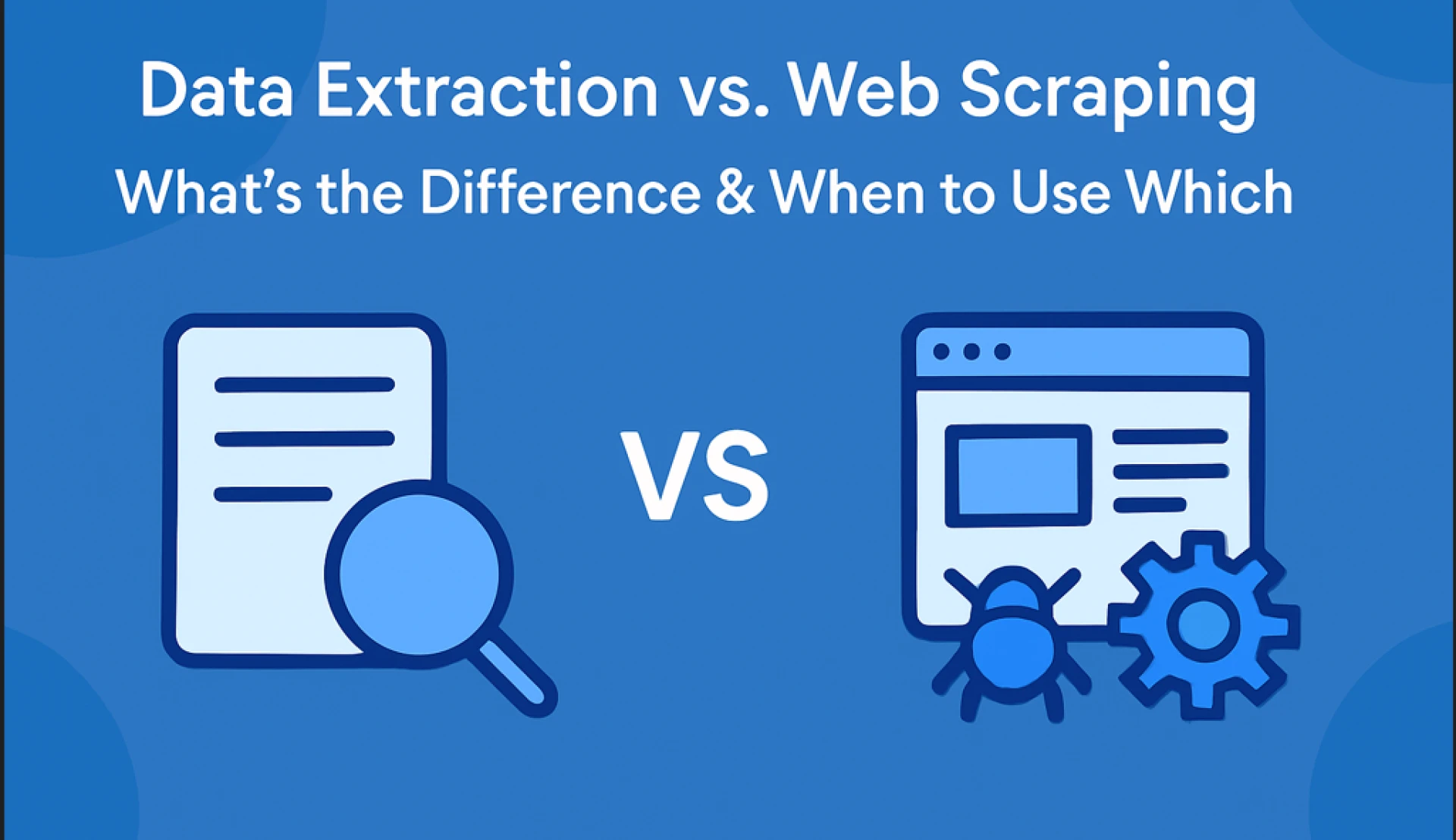
In the age of data-driven decision-making, businesses rely heavily on information sourced from diverse online and offline channels. Two techniques dominate the data collection landscape Web Scraping and Data Extraction. Although often used interchangeably, they are not identical. Each serves unique purposes, follows different processes, and is suited for specific business needs.
This article explores the key differences between data extraction and web scraping, their advantages, and how to decide which approach best fits your goals. We’ll also discuss how Iconic Data Scrap integrates both techniques to deliver precise, scalable, and business-ready data solutions.
Understanding the Basics What is Web Scraping?
Web scraping is the automated process of collecting data from websites. It involves using scripts or tools to crawl web pages, extract specific information (like product prices, reviews, or contact details), and convert it into structured formats such as CSV, JSON, or Excel.
For example, an e-commerce company might use web scraping to track competitor prices, monitor inventory changes, or extract product details from multiple online stores in real time.
Common Use Cases:
· E-commerce price monitoring
· Competitor analysis
· Market research
· Content aggregation
· Sentiment analysis
What is Data Extraction?
Data extraction is a broader process that involves retrieving data from multiple structured and unstructured sources not just websites. These sources can include databases, PDFs, APIs, social media feeds, online directories, or spreadsheets. The extracted data is then transformed and loaded into data warehouses or analytics systems for deeper insights.
For instance, a retailer might extract data from CRM systems, invoices, and customer reviews to get a unified view of customer behavior and sales performance.
Common Use Cases:
· Business intelligence and reporting
· Financial and sales data consolidation
· API-based data integration
· Document and file data extraction
· Large-scale enterprise analytics
Key Differences Between Web Scraping and Data Extraction
Although both web scraping and data extraction aim to collect and organize data, their scope, process, and application differ significantly.
Web scraping is primarily concerned with gathering information from websites. It focuses on retrieving publicly available data from web pages, such as product listings, prices, or reviews, using automated scripts or tools. The data is usually unstructured or semi-structured, often requiring additional cleaning and formatting before it can be used for analysis. Web scraping is most effective when a business needs to monitor real-time market information, competitor updates, or online trends.
In contrast, data extraction is a broader and more comprehensive process. It involves collecting data from multiple sources not just the web. These sources can include databases, APIs, spreadsheets, PDFs, CRM systems, or enterprise software. The extracted data is then transformed and loaded into data warehouses or business intelligence platforms for advanced analysis. It handles both structured and unstructured data, ensuring that information from diverse systems is harmonized for reporting and decision-making.
Another difference lies in the tools and outputs. Web scraping typically relies on frameworks like Scrapy, BeautifulSoup, or Selenium, which are built to navigate and capture web content efficiently. Data extraction, on the other hand, employs ETL (Extract, Transform, Load) pipelines, APIs, and OCR technologies to integrate large-scale datasets across systems.
While web scraping generates outputs like CSV, JSON, or Excel files, data extraction usually results in cleaned and structured datasets stored in databases or analytics dashboards ready for business use.
In essence, web scraping can be seen as a subset of data extraction. Scraping focuses on online sources, while extraction encompasses a wider range of data types and systems. Both methods are invaluable web scraping provides speed and real-time insights, whereas data extraction delivers depth, structure, and strategic value across an organization.
Advantages and Limitations of Each
Advantages of Web Scraping
· Speed & Automation: Efficiently collects large volumes of online data.
· Real-Time Insights: Ideal for monitoring live data such as prices or product availability.
· Scalability: Can handle multiple websites and dynamic pages with automation tools.
Limitations:
· Web Restrictions: Some sites restrict scraping via CAPTCHAs or robots.txt.
· Data Accuracy Risks: Dynamic or changing website structures can affect extraction quality.
· Legal Compliance: Must adhere to terms of service and data privacy laws.
Advantages of Data Extraction
· Comprehensive Integration: Combines data from internal and external sources.
· Structured Output: Data is cleansed, normalized, and ready for analytics.
· Enterprise-Ready: Integrates with BI tools, CRMs, or cloud warehouses for decision-making.
Limitations:
· Complex Setup: Requires technical infrastructure and data pipelines.
· Time-Intensive: Extracting, cleaning, and transforming data can be resource-heavy.
· Varied Data Sources: Managing multiple file formats and systems can add complexity.
When to Use Which
Choosing between web scraping and data extraction depends on your data goals, source types, and business needs.
Use Web Scraping When:
· You need to monitor competitor prices or market trends regularly.
· Your data source is primarily public websites or e-commerce platforms.
· You want to automate data collection from multiple sites in real time.
Use Data Extraction When:
· You need to aggregate data from multiple systems or internal databases.
· You aim to build data warehouses or dashboards for analytics.
· Your organization requires clean, standardized, and verified data for reporting.
Use a Hybrid Approach When:
· You want both external web data and internal business data to inform strategies.
· You’re integrating scraped data into analytics systems for predictive insights.
· You need to combine structured and unstructured data for comprehensive reporting.
For instance, a retail enterprise might scrape competitor pricing data while extracting internal sales and inventory data then merge them to drive dynamic pricing strategies.
How Iconic Data Scrap Combines Both Approaches
At Iconic Data Scrap, we understand that modern businesses require more than just raw data they need accurate, contextual, and actionable insights. That’s why our solutions integrate both web scraping and data extraction techniques for end-to-end data automation.
Here’s how we stand out:
1. Hybrid Data Infrastructure
We build systems that can collect data from websites, APIs, databases, and documents simultaneously. This ensures that you get both external and internal data unified in one pipeline.
2. Advanced Automation & Scalability
Our Python-powered scraping and extraction engines are optimized for high-volume, real-time processing. Whether you’re monitoring 10 products or 10,000, our infrastructure scales effortlessly.
3. Data Cleaning & Validation
We don’t just extract data we refine it. Our automated workflows remove duplicates, fix inconsistencies, and standardize formats so you get clean, reliable datasets ready for analytics.
4. Compliance & Security
Data ethics matter. Iconic Data Scrap ensures compliance with data privacy laws (like GDPR) and respects site terms of service, maintaining the highest standards of transparency and legality.
5. Tailored Solutions
From custom price monitoring dashboards to enterprise data extraction systems, we tailor solutions to your specific business model, ensuring seamless integration with your existing tech stack.
The Future of Data Extraction and Web Scraping
As AI and automation evolve, the boundary between web scraping and data extraction will blur further. Future systems will automatically detect, interpret, and extract insights from any digital data source web or otherwise with minimal human intervention.
Companies that leverage this unified approach will gain a competitive edge through faster, smarter, and more reliable decision-making.
Conclusion
Both data extraction and web scraping play crucial roles in transforming raw data into actionable business insights. While web scraping helps organizations collect timely information from online sources, data extraction ensures that this information along with data from internal systems is structured, analysed, and ready to drive strategic decisions.
For businesses looking to stay competitive in today’s fast-paced digital environment, combining both techniques are the key to unlocking full data potential.
At Iconic Data Scrap, we specialize in creating customized, end-to-end data solutions that integrate powerful web scraping with enterprise-grade data extraction. Whether you want to monitor prices, gather market intelligence, or build scalable data pipelines we make it seamless, secure, and efficient.
Ready to turn raw data into real results?
Get in touch with Iconic Data Scrap today and empower your business with smarter, data-driven decisions.























Sign in to leave a comment.