

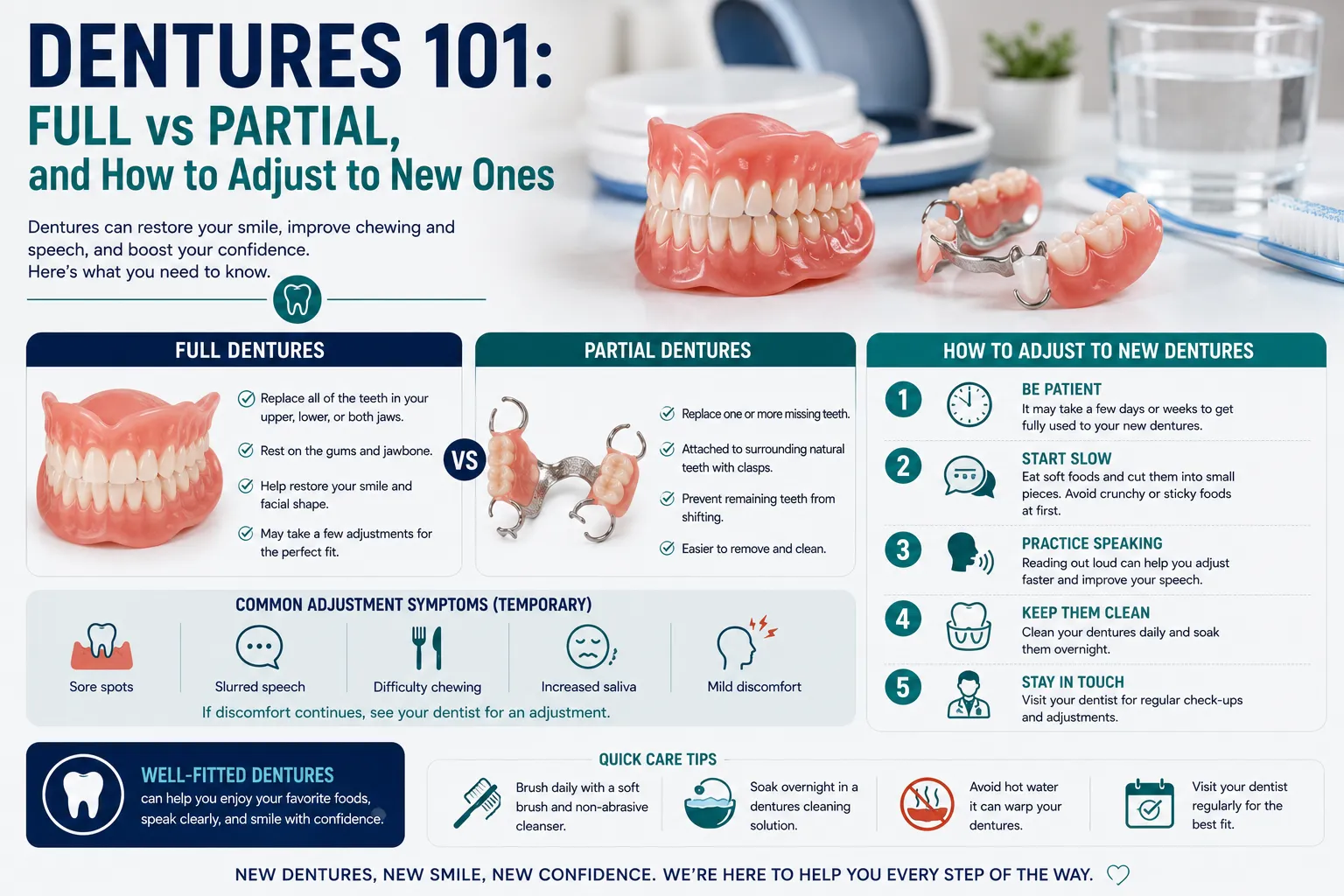
Full dentures replace an entire arch of missing teeth, while partial dentures fill in gaps where some natural teeth remain, and choosing between them depends entirely on how many teeth you've lost and the condition of those that are left. Both options typically take 2 to 4 weeks to get used to, with early speech and eating adjustments being completely normal as your mouth adapts. Below, we break down the difference between the two, how to know which one fits your situation, and exactly what to expect during the adjustment period.
What's the Difference Between Full and Partial Dentures?
Full dentures replace every tooth in an arch, resting directly on the gums and jawbone, while partial dentures attach to your remaining natural teeth using clasps or a metal framework, filling in the gaps left by missing teeth. This structural difference means partial dentures rely on the strength and health of your existing teeth for support and stability, whereas full dentures depend on the shape and condition of your gums and jawbone instead. The right option for you comes down to how many of your natural teeth remain and whether they're healthy enough to support a partial denture long-term.
Who Needs Full Dentures vs Partial Dentures?
Full dentures are typically recommended when all teeth in an arch are missing or beyond saving, while partial dentures are the better fit when several healthy teeth remain and only need to be supplemented rather than fully replaced. Patients with extensive decay, advanced gum disease, or significant tooth loss across an entire arch are usually guided toward full dentures, since a partial wouldn't have enough remaining healthy structure to anchor to securely. Our dentures page covers the assessment process in more detail, including how your dentist determines which option best matches your specific situation.
Can You Switch From a Partial Denture to a Full Denture Later?
You can switch from a partial denture to a full denture later, if the remaining natural teeth supporting your partial eventually become unhealthy or need to be removed. This transition is a fairly common part of long-term denture care, since teeth supporting a partial denture can be more prone to wear and decay over time due to the additional pressure placed on them. Regular dental check-ups help monitor the health of these supporting teeth, so any need to transition toward a full denture can be identified and planned for well in advance.
What Are Dentures Made Of?
Dentures are typically made from a combination of acrylic resin for the gum-coloured base and either acrylic or porcelain for the artificial teeth, with partial dentures sometimes incorporating a metal framework for added strength and a more secure fit. The base is custom-moulded to fit the precise contours of your mouth, which is what allows dentures to sit comfortably and function effectively for eating and speaking once you've adjusted to wearing them. Modern denture materials are designed to closely mimic the appearance of natural gums and teeth, so the result looks as natural as possible.
How Long Does It Take to Adjust to New Dentures?
Most patients take 2 to 4 weeks to fully adjust to new dentures, with the initial days often involving some soreness, increased saliva production, and a noticeable change in how speaking and eating feel. This adjustment period is completely normal, since your mouth muscles, tongue, and cheeks need time to learn how to work with the new denture in place, much like adapting to any new object introduced into daily oral function. Sticking with your dentures consistently during this period, rather than removing them frequently, generally speeds up the adjustment rather than prolonging it.
Why Do New Dentures Feel Strange or Uncomfortable at First?
New dentures feel strange or uncomfortable at first because your mouth hasn't yet learned the new pattern of movement required to keep them in place while talking, chewing, and swallowing. This sensation is temporary for the vast majority of patients, and it typically fades noticeably within the first couple of weeks as your muscles and soft tissue adapt to the denture's shape and presence. Some initial soreness at specific pressure points is also common, and minor adjustments from your dentist during a follow-up visit often resolve this quickly if discomfort continues beyond the first week or so.
What Foods Should You Eat While Adjusting to New Dentures?
You should start with soft foods cut into small pieces while adjusting to new dentures, gradually working up to a normal diet as your confidence and chewing ability improve over the following weeks. Foods like scrambled eggs, mashed potato, soft pasta, and well-cooked vegetables are easier to manage early on, since they require less chewing pressure than tougher or more fibrous foods. Chewing evenly on both sides of your mouth, rather than favouring one side, also helps keep the denture balanced and stable while you're still getting used to it.
How Do You Manage Speech Changes With New Dentures?
You manage speech changes with new dentures primarily through practice, since certain sounds — particularly those involving the tongue and roof of the mouth — often feel different until your tongue learns to work around the denture's shape. Reading aloud for a few minutes each day during the first couple of weeks is a commonly recommended technique, since it gives your tongue and mouth repeated practice adjusting to the new fit in a low-pressure way. Speech typically returns to feeling completely natural well before the full adjustment period ends, often within the first week or two.
How Do You Care for Dentures Once You've Adjusted?
You care for dentures by removing and rinsing them after eating, brushing them daily with a denture-specific brush and cleanser rather than regular toothpaste, and soaking them overnight in a denture-cleaning solution to keep them fresh and free of bacteria buildup. Handling dentures over a folded towel or a basin of water when cleaning them helps prevent damage if they're accidentally dropped, since they can crack or break more easily than natural teeth. Continuing with regular dental check-ups is also important even after you've fully adjusted, since your gums and jawbone can change shape gradually over time, which may eventually require your denture to be relined or adjusted for a continued proper fit.
When Should You See a Dentist About Denture Discomfort?
You should see a dentist about denture discomfort if soreness persists beyond the first couple of weeks, if you notice specific pressure points that don't improve, or if the denture feels loose or shifts noticeably during eating or speaking. Ongoing discomfort generally indicates a minor adjustment is needed to the fit, which is a routine and usually quick part of the denture process rather than a sign that something has gone fundamentally wrong. Waiting too long to address persistent discomfort can lead to irritation or sores developing, so it's worth booking a follow-up rather than trying to push through significant ongoing pain.
Frequently Asked Questions
Can you sleep with dentures in?
Most dentists recommend removing dentures at night to give your gums a chance to rest and to reduce the risk of irritation or infection developing from prolonged wear. Soaking your dentures overnight in a cleaning solution also helps maintain their shape and cleanliness ready for the next day.
How often do dentures need to be replaced or relined?
Dentures typically need to be relined or replaced every 5 to 7 years, since the shape of your gums and jawbone gradually changes over time, affecting how well the original fit holds up. Regular check-ups help monitor this fit and catch the need for adjustment before it becomes uncomfortable.
Will people be able to tell I'm wearing dentures?
Well-fitted, properly designed dentures are generally not noticeable to others, since modern materials are shade-matched and shaped to closely resemble natural teeth and gums. Most of the initial self-consciousness patients feel fades quickly once they're used to speaking and smiling confidently with their new dentures.
Can dentures be used alongside dental implants?
Yes, dentures can be stabilised using dental implants, an option that provides significantly more security and chewing stability than a standard denture resting on the gums alone. This combined approach is often considered for patients who find a standard denture uncomfortably loose, particularly on the lower jaw.




























Sign in to leave a comment.