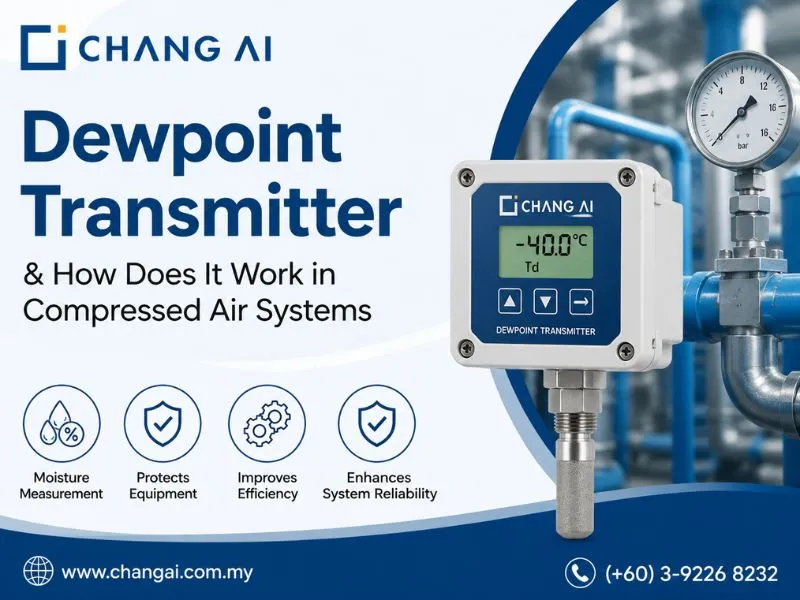

Dewpoint transmitter is an instrument that can continuously measure the moisture content of a gas (typically compressed air) by observing when water vapour starts to condense. Produces a real time signal which can be returned to a control system, enabling the operator to monitor the dryness remotely and, by this means, avoiding condensation and preventing any moisture damage to downstream equipment.
Why Moisture in Compressed Air Is a Bigger Problem Than It Looks
When air is compressed, its water vapour concentration increases significantly. A compressor drawing in ambient air at 28°C and 80% relative humidity - common conditions in Malaysia - can push moisture levels to a point where condensation forms inside pipelines within minutes of operation.
That condensation is not just inconvenient. It causes:
- Corrosion inside steel pipelines and fittings
- Freezing and blockages in outdoor or chilled systems
- Contamination in food, pharmaceutical, and electronics manufacturing
- Premature failure of pneumatic valves and actuators
- Damage to air-operated instruments and analysers
For maintenance engineers, a single moisture-related line freeze can mean hours of unplanned downtime. For plant managers, the downstream product contamination risk is often the bigger concern. Both problems share the same root cause: no real-time visibility into moisture levels.
How a Dewpoint Transmitter Works: The Core Physics
The fundamental concept behind dew point measurement in air is straightforward. Every gas mixture holds a specific amount of water vapour. The dewpoint is the temperature at which that vapour begins to condense into liquid water. The drier the gas, the lower the dewpoint temperature.
Dewpoint is measured in a compressed air system in °C dew point (at line pressure) or °C dew point at atmospheric pressure (atmospheric dew point / ATDP). A lot of industrial dryers are specified based on the dew point in the atmosphere, which is why it's important to know what they are based on: the dew point in the atmosphere, or the dew point in the object being dried.
The Sensing Mechanism
Most industrial dewpoint transmitters use one of two sensing technologies:
1. Capacitive Thin-Film Aluminium Oxide Sensors
Water molecules in the surrounding gas are removed by a thin layer of aluminium oxide. The change of the moisture content changes the dielectric property of the oxide layer, which in turn changes the electrical capacitance. The dewpoint value is translated into the transmitter by the shift in capacitance. These are extremely consistent, have very fast response times and are very consistent down to very low dewpoints -100°C and below in some applications.
2. Quartz Crystal Microbalance (QCM) Sensors
A piezoelectric quartz crystal coated with a hygroscopic film changes its resonant frequency as it absorbs water. The frequency shift correlates directly to moisture mass. QCM-based sensors are used where extreme accuracy is needed, such as in semiconductor or speciality gas applications.
For most compressed air applications in plant environments, capacitive aluminium oxide sensors offer the best combination of durability, accuracy, and cost-effectiveness.
From Sensor to Signal: What Happens Inside the Transmitter
The transmitter housing does more than hold the sensor. It conditions the signal, compensates for temperature drift, and converts the raw reading into a usable output - typically a 4-20 mA analogue signal or a digital protocol like HART, Modbus, or RS-485.
That output connects directly to a PLC, SCADA system, or standalone data logger. Plant operators can set high-moisture alarms, trend dewpoint values over time, and correlate moisture events with dryer performance or seasonal humidity changes.
This is the core value of 24/7 transmitter monitoring: you are not relying on periodic manual checks. You are seeing the exact moisture condition of your compressed air at every moment of the production day.
Where Dewpoint Transmitters Are Installed in a Compressed Air System
Placement matters as much as the instrument itself. Common installation points include:
| Installation Point | Purpose
|
|---|---|
| After the refrigerant dryer outlet | Confirms dryer is achieving the rated dewpoint |
| After a desiccant dryer | Monitors regeneration cycle performance and desiccant saturation |
| At the point of use (critical processes) | Verifies air quality reaching the equipment or product |
| Before a membrane dryer inlet | Ensures inlet conditions are within membrane operating range |
| Distribution manifold sampling points | Identifies moisture ingress from leaks or poorly maintained sections |
In Malaysian industrial facilities, dryer performance can vary considerably with seasonal changes in ambient humidity. Installing a trace moisture sensor downstream of your dryer is the only reliable way to confirm it is meeting spec year-round - not just when it was last commissioned.
Dewpoint Transmitter vs. Portable Dewpoint Meter: Which Do You Need?
Both instruments use similar sensing technology. The difference is operational.
A portable meter gives you a snapshot reading. Useful for commissioning, audits, and fault diagnosis - but it tells you nothing about what happened overnight or during a shift change.
A fixed transmitter gives you continuous data. It catches the 2 a.m. dryer fault before it becomes an 8 a.m. production problem. For any system where compressed air quality directly affects product quality or process reliability, a fixed transmitter is not optional — it is a maintenance engineering fundamental.
Key Specifications to Evaluate When Selecting a Transmitter
Not all dewpoint transmitters are equal. Before specifying a unit, engineers should evaluate:
- Measurement range: Does it cover your dryer's rated outlet dewpoint? Desiccant dryers often deliver −40°C to −70°C ATDP.
- Response time: Faster response matters in applications where moisture spikes could cause immediate damage.
- Process pressure rating: The transmitter must be rated for line pressure at the installation point.
- Output type: Match to your existing PLC or SCADA inputs (analogue, HART, Modbus).
- IP rating and material compatibility: Ensure suitability for your plant environment.
- Calibration interval and drift specification: Long-term stability reduces maintenance burden.
How Continuous Monitoring Prevents Line Freezing and Downtime
Line freezing in compressed air systems typically occurs in outdoor pipework or cold utility areas where pipe surface temperatures drop below the dewpoint of the compressed air inside. The water vapour condenses, then freezes, eventually blocking flow completely.
The fix sounds simple: keep the dewpoint well below ambient temperature at all points in the system. In practice, this requires knowing the dewpoint is actually being maintained — which means continuous measurement, not assumptions based on dryer settings.
A transmitter wired to a high-dewpoint alarm gives operators advance warning. If the dryer begins to underperform — due to a fouled heat exchanger, saturated desiccant, or refrigerant fault — the alarm fires before moisture reaches the distribution network. That window of response time is the difference between a dryer service call and a production shutdown.
For facilities operating how dewpoint transmitter works principles in their maintenance strategy, this shift from reactive to predictive moisture management typically reduces moisture-related maintenance events significantly over a 12-month period.
Conclusion
Compressed air moisture is invisible, persistent, and damaging. A dewpoint transmitter makes it measurable and manageable. Whether you are protecting pneumatic equipment, meeting process air quality standards, or simply trying to eliminate unplanned downtime, continuous dewpoint monitoring belongs in your instrumentation plan.
If you are evaluating dewpoint and trace moisture measurement solutions for your facility, the product range from Chang AI Technology covers both fixed transmitters and portable instruments suited to industrial compressed air applications in Malaysia. Explore the full range of dewpoint and trace moisture analysers to find the right specification for your system.
Frequently Asked Questions
What is the difference between relative humidity and dewpoint in compressed air?
Relative humidity describes moisture as a percentage of what the air can hold at a given temperature. Dewpoint gives you an absolute temperature threshold - where condensation actually begins. In compressed air systems, dewpoint is the preferred measurement because it does not change with temperature fluctuations, making it far more reliable for process control.
What dewpoint level should compressed air be for industrial use?
ISO 8573-1 defines air quality classes for moisture. Class 4 allows a pressure dewpoint of +3°C, suitable for general plant air. Class 2 requires −40°C pressure dewpoint, used in instrument air and sensitive processes. Your required class depends entirely on the most moisture-sensitive equipment or process in your system.
How often should a dewpoint transmitter be calibrated?
The majority of manufacturers suggest annual calibration when operating under normal conditions. A 6-month period is more suitable if contaminants are present, solvents are used at high concentrations or if moisture saturations occur frequently. To achieve performance calibration, follow the manufacturer's drift specification as stated and set a calibration schedule accordingly.
Can a dewpoint transmitter be used for gases other than compressed air?
Yes. Dewpoint transmitters are widely used in natural gas pipelines, nitrogen generators, breathing air systems, and speciality gas production. The key requirement is sensor and wetted-material compatibility with the target gas. Always confirm chemical compatibility before installing any transmitter in non-air gas streams.
What causes a dewpoint transmitter to give inaccurate readings?
Some of these common causes are contamination of the sensor caused by compressor oil carryover, poor sample flow site, and use outside of the sensor's rated pressure and/or temperature. The main precautions required to prevent measurement drift and inaccurate readings are regular calibration checks, correct sample conditioning and correct installation position.
Is a fixed dewpoint transmitter worth the investment compared to periodic manual checks?
For any critical process or system where moisture directly affects product quality or equipment reliability, yes. Manual checks create blind spots between readings. A fixed transmitter provides continuous data, enables alarm integration, and supports predictive maintenance strategies - typically recovering its cost through a single avoided unplanned downtime event.

























Sign in to leave a comment.