
Choosing a database for production isn’t simply about picking the most popular option. Understanding the Differences Between MySQL and PostgreSQL is essential, as it requires weighing architecture, workload type, consistency guarantees, and scalability. Both databases dominate the open-source relational database space, and while they share SQL as a common language, they are built differently and behave differently under real workloads. Picking the wrong one can lead to performance issues, scaling challenges, replication limitations, and unnecessary operational complexity.
Core Architecture
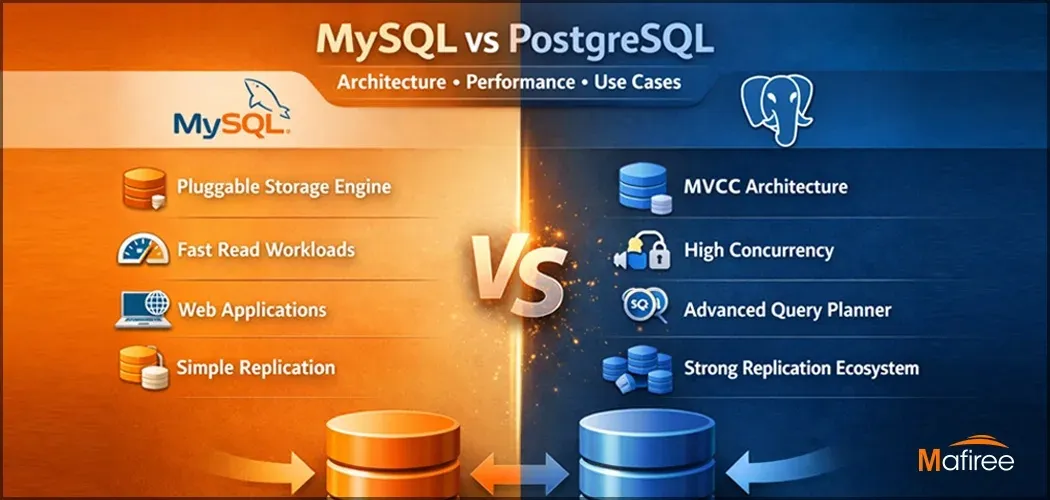
MySQL operates on a pluggable storage engine model, with InnoDB as its default engine. InnoDB brings row-level locking, redo/undo logs for crash recovery, and a relatively straightforward internal design. Its architecture is built around an SQL layer — comprising a parser, optimizer, and query cache — on top of a client/server model.
PostgreSQL takes a different approach with a single, tightly integrated storage engine. It is built on true MVCC (Multi-Version Concurrency Control), supports a process-per-connection model, and offers deep extensibility through custom data types, indexes, and extensions. Background processes like Autovacuum, WAL writer, and Checkpointer are core to how it operates. When it comes to standards compliance and extensibility, PostgreSQL clearly outranks MySQL.
Performance
MySQL is exceptionally fast for simple, read-heavy workloads — particularly OLTP and web applications. PostgreSQL may be marginally slower on trivial reads, but its smarter query planner makes it far superior for complex joins, subqueries, and analytical queries. On the write side, MySQL handles single-row inserts faster and with lower per-transaction overhead, but it can buckle under heavy concurrent load. PostgreSQL manages concurrent writes more reliably through its WAL-based durability model while maintaining strong transactional consistency.
Concurrency and Locking
MySQL's InnoDB relies on row-level locks, gap locks, and next-key locking. In certain conditions, readers can block writers, which can slow things down. PostgreSQL's true MVCC eliminates this problem entirely — readers never block writers and writers never block readers. This makes PostgreSQL a significantly better fit for high-concurrency environments like banking, payment processing, and order management platforms.
Replication and High Availability
MySQL provides asynchronous replication, semi-sync replication, Group Replication, and InnoDB Cluster out of the box, and is relatively easy to set up. PostgreSQL supports both physical streaming replication and native logical replication, and integrates well with tools like Patroni, PgBouncer, and HAProxy to build near-zero data loss architectures. PostgreSQL's native logical replication is more robust, while MySQL's equivalent remains comparatively limited.
Real-World Use Cases
MySQL is the go-to choice for CMS platforms such as WordPress and Joomla, e-commerce sites, read-heavy web applications, and straightforward SaaS products. PostgreSQL is better suited for financial systems, healthcare platforms, analytics-intensive applications, geospatial use cases via PostGIS, and complex transactional workloads.
Security and Ecosystem
PostgreSQL provides advanced role management, row-level security, and stronger audit extensions — giving it a better compliance posture overall. MySQL offers a simpler, more basic role-based access model. From an ecosystem standpoint, MySQL benefits from Oracle's backing, widespread adoption, and broad hosting compatibility. PostgreSQL is community-driven, supported by enterprise-grade extensions, and governed under strong open-source principles.
Conclusion
The decision between MySQL and PostgreSQL should not be driven by popularity alone. MySQL is a solid choice for simple, read-heavy web applications. PostgreSQL is the stronger option for high-concurrency, complex, and enterprise-grade workloads where consistency and long-term scalability are non-negotiable. The right pick ultimately comes down to your specific workload, performance requirements, and growth trajectory.


























Sign in to leave a comment.