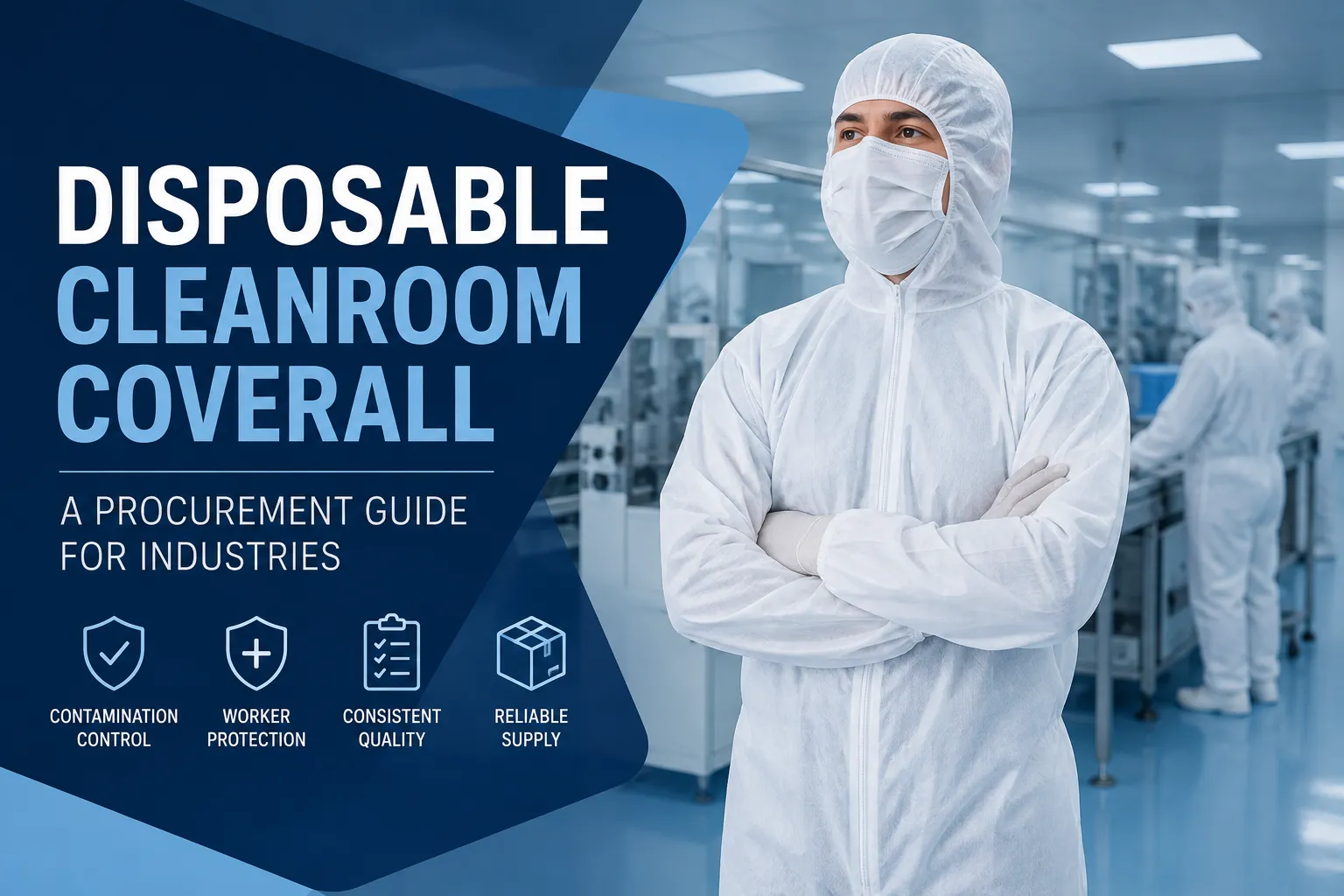

Cleanroom environments require more than standard protective clothing. Pharmaceutical manufacturing, biotechnology, medical device production, laboratories and other controlled environments depend on apparel that helps minimise particulate contamination while providing appropriate protection for workers and products.
For procurement managers, facility managers, EHS teams and purchase departments, selecting a disposable cleanroom coverall is therefore not simply a matter of comparing prices. Fabric construction, barrier requirements, garment design, sizing, cleanroom classification, packaging, documentation and supply consistency all need to be considered before approving a supplier.
This guide explains the key factors businesses should evaluate when sourcing disposable cleanroom coveralls in bulk and how Dispowear Protection supports institutional and industrial buyers.
What Is a Disposable Cleanroom Coverall?
A disposable cleanroom coverall is a single-use protective garment designed to cover the wearer's torso, arms and legs, reducing the transfer of particles, fibres, skin flakes and other contaminants into controlled environments.
Unlike general-purpose disposable coveralls, cleanroom apparel needs to be selected according to the contamination-control requirements of the facility. The appropriate garment may include features such as elasticated cuffs and ankles, an attached hood, covered front closure and suitable non-woven fabric construction.
The objective is not simply to cover the worker. The complete garment needs to work as part of the facility's gowning and contamination-control process.
Why Cleanroom Industries Use Disposable Coveralls
In pharmaceutical, biotechnology, medical device and laboratory environments, personnel are a significant potential source of particulate contamination. Every movement can release particles from skin, hair and clothing.
A properly selected disposable coverall can help reduce this contamination pathway by providing a controlled outer layer between the wearer and the cleanroom environment.
Disposable apparel can also simplify garment management. Because the garment is intended for single use, organisations do not have to establish the same laundering, garment-life tracking and reprocessing programme associated with reusable apparel.
For procurement teams, this can be particularly useful where:
- Personnel numbers fluctuate.
- Multiple shifts require regular gowning.
- Garments are consumed at high volumes.
- Sterile or controlled packaging is required.
- Laundry and reprocessing infrastructure is limited.
- The facility requires consistent garment availability.
The correct solution still depends on the cleanroom classification, process requirements and applicable quality procedures.
What Should Procurement Teams Check Before Buying?
Purchasing departments should avoid evaluating suppliers only on unit price. A low-cost coverall can become expensive if it causes fit problems, inconsistent quality, excessive wastage or supply interruptions.
1. Fabric Type and GSM
The fabric is one of the first specifications to establish.
Common non-woven options include spunbond polypropylene (SBPP), SMS and laminated constructions. SBPP offers lightweight construction and high breathability, while SMS provides a multilayer structure with a meltblown core. Laminated materials can be considered where a higher liquid barrier is required.
GSM, or grams per square metre, should also be specified. However, higher GSM does not automatically mean better protection. Fabric type and GSM need to be considered together with the actual application.
For cleanroom procurement, the supplier should be able to clearly identify the fabric construction and provide relevant technical documentation.
2. Garment Design and Coverage
The design of a disposable cleanroom coverall can influence both protection and usability.
Procurement teams should evaluate:
- Attached or compatible hood design
- Elasticated wrists and ankles
- Waist construction
- Front zipper and closure
- Hood and face-area fit
- Compatibility with gloves, masks and footwear
- Ease of donning and doffing
- Range of motion
A coverall that restricts movement can encourage workers to adjust the garment during operations. Similarly, excessive fabric can create unnecessary handling and snagging issues.
Fit should therefore be treated as part of the protection specification rather than simply a comfort consideration.
3. Size Range
Bulk buyers should not assume that ordering mostly Medium and Large sizes will meet workforce requirements.
A better approach is to review the actual workforce distribution and determine the required quantity of each size. Depending on the supplier, standard ranges may extend from S to XXL, with additional sizing options available for specific requirements.
For large institutional orders, procurement teams should ask for a measurement-based size chart and, where appropriate, fitting samples before finalising the order.
Dispowear Protection can customise the size mix according to the workforce requirements rather than relying exclusively on a fixed stock distribution.
Choosing the Right Coverall for the Cleanroom
There is no single disposable coverall specification suitable for every controlled environment.
A pharmaceutical manufacturing area may have different requirements from a medical device assembly facility or research laboratory. Procurement should therefore work with quality and EHS teams to establish the required garment specification before requesting quotations.
Important questions include:
- What cleanroom classification is involved?
- Is the application sterile or non-sterile?
- What level of particulate control is required?
- Is liquid resistance necessary?
- Are anti-static properties required?
- What gowning procedure is already established?
- How frequently will garments be changed?
- What documentation is required for supplier qualification?
This approach prevents the common mistake of selecting apparel based solely on appearance or price.
Why Manufacturer Capability Matters
For recurring B2B purchases, supplier manufacturing capability can have a direct impact on quality and supply reliability.
Dispowear Protection manufactures more than 3 million disposable garments per month using in-house non-woven capabilities. The company produces its own virgin polypropylene non-woven fabric and manufactures disposable protective apparel for healthcare, pharmaceutical, cleanroom, laboratory, food and industrial applications.
This level of vertical integration gives procurement teams greater visibility into the material used in the finished garment.
Dispowear's GenFab® Disposable Coverall range can be specified according to application requirements, with options including different fabric constructions, GSM, garment configurations, sizing and other customisation requirements.
For businesses purchasing at institutional scale, this can be particularly valuable because the procurement programme can be aligned with the facility's actual workforce and operational requirements.
Why Work With Experienced Disposable Coverall Manufacturers?
When evaluating disposable coverall manufacturers, procurement teams should assess more than the product catalogue.
A qualified supplier should be able to demonstrate:
- Consistent manufacturing capacity
- Defined quality-control procedures
- Material traceability
- Technical datasheets
- Relevant test documentation
- Stable production capabilities
- Customisation support
- Appropriate packaging
- Reliable lead times
- Experience with institutional and export orders
For regulated industries, documentation is particularly important. The purchasing process may involve supplier qualification, quality approval, sample evaluation and periodic review.
Working directly with a manufacturer can also simplify communication between the technical, quality and purchasing teams.
Dispowear Protection for Bulk Cleanroom Apparel Procurement
Dispowear Protection manufactures disposable protective clothing for organisations that require reliable, repeatable supply across regulated and industrial environments.
Its GenFab® disposable PPE range includes coveralls and other protective apparel such as gowns, lab coats, bouffant caps, beard covers, sleeve protectors, shoe covers and boot covers.
The company combines in-house virgin polypropylene non-woven fabric production with garment manufacturing, supporting greater control over material consistency and product specifications.
For procurement departments, this manufacturing model can support bulk programmes where consistent specifications, recurring supply and customisation are important.
Depending on the application, Dispowear can support requirements involving sterile or non-sterile disposable apparel, different garment configurations, size-range planning and customised specifications.
Build a Procurement Specification Before Requesting Quotes
Before sending an RFQ to suppliers, procurement teams should create a clear product specification.
At minimum, the specification should identify:
- Product type – disposable cleanroom coverall
- Intended industry and application
- Cleanroom classification, where applicable
- Sterile or non-sterile requirement
- Fabric type
- Required GSM
- Hood and cuff configuration
- Closure requirements
- Size range and quantity by size
- Packaging requirements
- Required documentation and test certificates
- Expected monthly or annual volume
- Delivery location and lead time
- Branding or OEM requirements, if applicable
A detailed specification makes supplier comparison easier and reduces the risk of receiving quotations based on different product constructions.
Conclusion
Selecting a disposable cleanroom coverall should be approached as a procurement and contamination-control decision rather than a simple consumable purchase.
The right garment depends on the cleanroom environment, application, fabric construction, barrier requirements, garment design, fit and quality documentation. For large organisations, manufacturing capacity and supply consistency are equally important because a coverall programme may involve thousands or millions of garments over its lifetime.
Dispowear Protection combines in-house virgin polypropylene non-woven fabric production with large-scale disposable garment manufacturing, offering GenFab® disposable coveralls for pharmaceutical, cleanroom, laboratory, healthcare and industrial applications.
For procurement teams evaluating suppliers, the next step is to define the technical specification, workforce size requirements and expected consumption before comparing quotations. This allows the purchasing department, quality team and end users to evaluate the same product requirements and select a supplier capable of supporting the programme consistently.























Sign in to leave a comment.