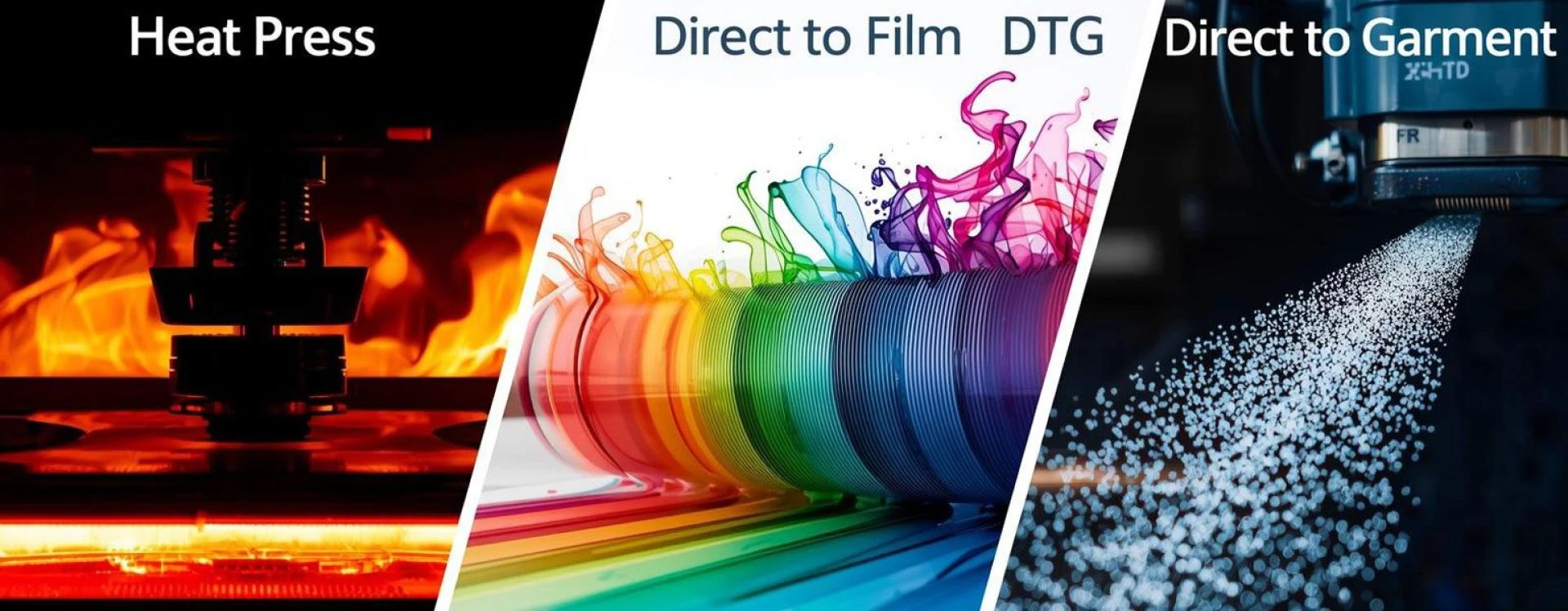

Walk into any print shop discussion forum, and you’ll see the same question asked again and again:
“Which printing method should I choose?”
It sounds simple, but anyone who’s actually run production knows the truth — choosing the wrong process can quietly drain profits, slow turnaround, frustrate staff, and disappoint customers. Heat press, DTF, and DTG all produce good-looking results. The challenge isn’t quality alone; it’s matching the method to your real-world orders, workflow, and constraints.
From a print professional’s perspective, this decision isn’t about trends or hype. It’s about risk control, consistency, and operational fit. Let’s break it down properly.
The Real Pain Point: One Method Rarely Fits All Jobs
New businesses often look for a single “best” solution. Experienced printers know that’s a mistake.
Different customers want:
- single names and numbers today,
- full-colour artwork tomorrow,
- soft-feel fashion prints next week,
- and mixed fabrics all month long.
Each printing method solves one set of problems while creating others. Understanding why those trade-offs exist is the key to choosing wisely.
Heat Press Printing: Predictable, Simple, and Profitable for the Right Work
From a production standpoint, heat press printing is the most forgiving and controllable process.
Rather than printing directly onto fabric, you’re transferring a prepared design — vinyl or printed transfer — using heat and pressure. This separation of “printing” and “application” is why heat press workflows remain popular.
Where Heat Press Excels
- Low risk: No printheads, no ink circulation, no daily cleaning routines.
- Cost control: Materials are predictable, and wastage is easy to manage.
- Durability: Properly applied HTV can outlast the garment itself.
- On-demand personalisation: Names, numbers, and small graphics are fast and reliable.
Where It Falls Short
From a professional standpoint, complexity is the enemy here. Multi-colour or photo designs slow everything down unless you move to printable transfers. The feel of vinyl can also be a deal-breaker for fashion-focused customers.
Best suited for:
Uniforms, sportswear, workwear, short runs, personalisation-heavy orders, and shops that prioritise reliability over visual complexity.
DTF Printing: The Most Flexible Production Tool Right Now
DTF has gained traction not because it’s trendy, but because it solves several long-standing production headaches at once.
Printing onto film decouples artwork creation from garment choice. That single change has massive workflow implications.
Why Print Shops Adopt DTF
- Fabric flexibility: Cotton, polyester, blends — one process covers most orders.
- Full-colour freedom: Gradients, photos, and fine detail are handled well.
- Batch efficiency: Transfers can be printed in advance and stored.
- Lower prep requirements: No garment pretreatment in most cases.
Operational Considerations
DTF isn’t “plug and play.” Powder application, curing temperature, and storage conditions matter. From a technical perspective, most failures come from inconsistent curing, not the printer itself.
The finished print usually sits slightly on top of the fabric. For most customers, this is acceptable. For premium fashion clients, it may not be.
Best suited for:
Small to medium shops handling varied orders, multi-colour artwork, mixed fabrics, and on-demand production without heavy pretreatment workflows.
DTG Printing: Still the Benchmark for Softness — With Conditions
DTG remains the gold standard when print feels, and visual integration matters more than speed or versatility.
By printing ink directly into the fibres, DTG produces results that other methods simply can’t replicate — when everything goes right.
Where DTG Shines
- Unmatched softness on cotton garments.
- High-end appearance for detailed artwork.
- Single-item efficiency for bespoke orders.
The Reality Behind the Results
From a production manager’s view, DTG demands discipline:
- Pretreatment must be consistent.
- Printheads require constant care.
- Downtime from clogging or maintenance is real.
- Fabric choice matters more than many beginners expect.
DTG is not forgiving. It rewards shops that have stable demand, trained operators, and a clear product focus.
Best suited for:
Premium cotton apparel, fashion brands, photography-heavy designs, and shops willing to manage technical maintenance.
Cost, Time, and Throughput: What Really Affects ROI
Choosing a method based only on machine price is a common mistake. Professionals look at cost per finished garment, including labour and downtime.
Key ROI Factors to Compare
- Setup time per job
- Labour intensity
- Failure rate
- Maintenance hours per week
- Scalability without bottlenecks
Heat press workflows scale horizontally (more presses, more hands).
DTF scales through batching and transferring stock.
DTG scales only as fast as the printer allows.
Understanding your order patterns matters more than theoretical speed.
Print Feel and Durability: Managing Customer Expectations
Customers may not know printing methods, but they notice two things immediately:
- How it feels
- How it lasts
DTG offers the softest hand feel.
DTF balances durability and detail.
Heat-applied vinyl often feels heavier but wins on longevity.
Professionals avoid overpromising. Matching the method to the customer’s expectations prevents complaints and reprints.
Industry Trends Worth Noting
From the shop floor perspective, a few developments are shaping decisions:
- DTF consistency is improving, especially in powders and inks.
- Smaller DTG machines are lowering entry barriers, but not maintenance demands.
- Environmental pressure is pushing water-based and low-VOC solutions.
- Hybrid production models are becoming the norm, not the exception.
No single process dominates modern shops anymore.
A Practical Decision Framework
Instead of asking “Which is best?”, ask:
What do most of my orders look like?
- Simple text and logos → Heat press
- Colour-heavy, varied fabrics → DTF
- Premium cotton prints → DTG
How much technical maintenance can I realistically handle?
- Minimal → Heat press
- Moderate → DTF
- High → DTG
What hurts more: wasted garments or slower output?
Your answer often reveals the right choice.
Final Perspective: Think in Systems, Not Machines
Seasoned print professionals don’t build businesses around machines — they build them around workflows.
Heat press, DTF, and DTG are tools. Each one reduces certain risks while introducing others. The smartest operators don’t chase the “perfect” method; they align processes with demand, adjust as orders change, and stay flexible.
If you approach the decision from a production mindset — not a marketing one — the right choice becomes much clearer.





























Sign in to leave a comment.