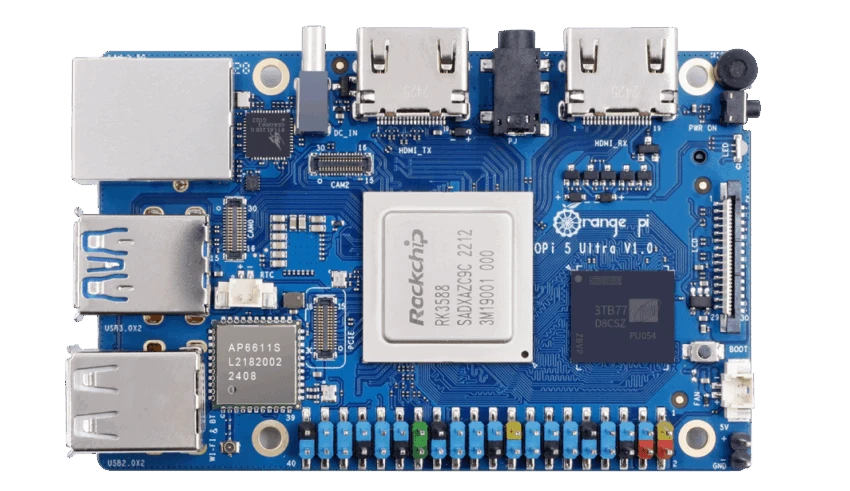

The OrangePi 5 Ultra SBC features the Rockchip RK3588 SoC, which boasts an octa-core 64-bit processor with 4 Cortex-A76 cores running at 2.4GHz and 4 Cortex-A55 cores at 1.8GHz, along with an independent NEON coprocessor. Built on an 8nm LP process, it integrates the ARM Mali-G610 GPU, supporting OpenGL ES1.1/2.0/3.2, OpenCL 2.2, and Vulkan 1.2 for robust graphics performance. The embedded NPU offers hybrid computing with INT4/INT8/INT16/FP16 support, delivering up to 6TOPS of computing power, making it ideal for edge computing applications.
The board is available with 4GB, 8GB, or 16GB of LPDDR5 RAM, offering higher data rates and lower power consumption compared to LPDDR4, making it well-suited for large applications and complex 3D games. It also supports 8K display output, combining the power of its octa-core CPU and 8nm process for clear picture quality and smooth performance. Additional features include an eMMC flash socket, Wi-Fi 6E, and Bluetooth 5.3 with BLE support for powerful wireless communication.
Previously, we covered several OrangePi products, including the OrangePi 5 Max, OrangePi 4A, OrangePi 3B V2.1, OrangePi 5 Pro, and OrangePi 3B, all of which share the same form factor. Feel free to explore these products if you’re interested.
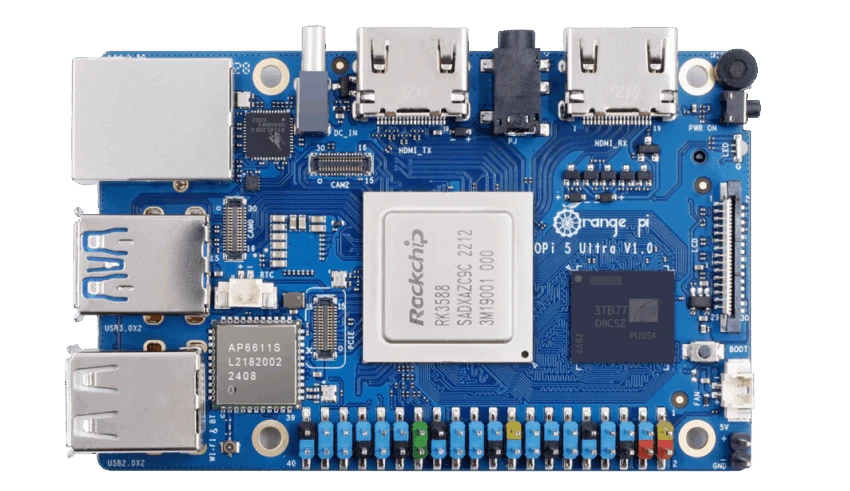
Orange-Pi 5 Ultra specifications:
SoC: Rockchip RK3588 (8nm LP process) CPU: 8-core 64-bit ARM processor with Quad Core Cortex-A76 @ up to 2.4 GHz, Quad Core Cortex-A55 @ up to 1.8 GHz with independent NEON coprocessor
GPU: Integrated ARM Mali-G610 Built-in 3D GPU fully compatible with OpenGL ES1.1/2.0/3.2, OpenCL 2.2, and Vulkan 1.2
NPU: 6 TOPS AI accelerator with support for INT4/INT8/INT16/FP16 mixed operation
VPU: 8Kp60 H.265/VP9/AVS2 10-bit decoder, 8Kp30 H.264 decoder, 4Kp60 AV1 decoder, 8Kp30 H.265/H.264 encoder
System Memory: 4GB, 8GB, or 16GB LPDDR5 DIMM
Storage: eMMC flash socket for 32GB, 64GB, 128GB, or 256GB module or eMMC flash chip soldered on-board (co-lay)
16MB QSPI NOR Flash
MicroSD card slot
M.2 2280 PCIe 3.0 x4 socket for NVMe SSD
Video Output: 1x HDMI 2.1 port up to 8Kp60
4-lane MIPI DSI connector up to 4Kp60
Video Input: 1x HDMI 2.1 out up to 8k@60FPS
1x HDMI 2.0 in up to 4k@60FPS
1x MIPI DSI TX 4 Lane
Camera:
2x 4-lane MIPI CSI connectors
1x 4-lane MIPI D-DPHY Rx connector
Audio: ES8388 audio codec
3.5mm audio jack with headphone and microphone support
Onboard MIC
Support for HDMI 2.1 eARC
Networking: 2.5GbE RJ45 port via RTL8125BG controller
Onboard WiFi 6E and Bluetooth 5.3 module (AP6611S) using SDIO 3.0 for WiFi, UART, and PCM for Bluetooth; IPEX antenna connector
USB: 2x USB 3.0 ports, 2x USB 2.0 ports
Debugging: Debug serial TTL UART included in 40PIN expansion port
Expansion: 40-pin header with GPIO, UART, I2C, SPI, CAN, PWM, and others
M.2 Key-M socket (PCIe 3.0 x4) for a 2280 NVMe SSDs, or other PCIe 2280 modules (e.g. AI accelerators)
Misc: Power and MaskROM buttons
Power LED
2-pin 5V fan connector
2-pin 1.25 mm pitch 3V RTC connector for RTC backup battery
Power Supply: 5V/5A via USB Type-C port
RK806-1 PMU
Dimensions: 89 mm x 57 mm x 1.6 mm
Weight: 60.5 grams
The OrangePi 5 Ultra SBC offers a wide range of interfaces, including HDMI output, HDMI input, a GPIO interface, USB 2.0, USB 3.0, a 3.5mm headphone jack, a PCIe extended 2.5G high-speed network port, and an M.2 M-Key slot (PCIe 3.0 4-Lane). The M.2 slot supports the installation of NVMe or SATA SSDs, providing versatile storage options.
Similar to the Raspberry Pi 5, the OrangePi 5 Ultra uses a 5V 5A power supply via a USB Type-C input. However, it surpasses its competitor in PCI Express connectivity, offering a full four lanes of PCIe Gen 3 through the M.2 M-Key slot on the underside of the board, compared to the Raspberry Pi 5’s single lane of PCIe Gen 2.
The OrangePi 5 Ultra supports multiple operating systems, including Orange Pi OS (its official operating system), Ubuntu, Android 13, Debian, and more, ensuring compatibility with various development and application needs.
Operating System Support
Orange Pi will provide various OS images for the board, including Orange Pi OS (Android, Arch, OpenHarmony), Ubuntu 20.04/22.04, Debian 11/12, OpenWrt, and Android 13. While the Orange Pi 5 Max OS images should boot on the Orange Pi 5 Ultra, features like HDMI input may require additional configuration. HDMI input is handled on Linux and Android as a V4L2 interface (e.g., /dev/video0) and an audio device (/proc/asound/card*). Documentation and source code are expected to be available soon.
Competitive Edge
Although other RK3588 SBCs like the Orange Pi 5 Plus, FriendlyELEC NanoPC-T6, and Banana Pi BPI-W3 also feature HDMI 2.1 output and HDMI 2.0 input, the Orange Pi 5 Ultra stands out with its smaller form factor and competitive pricing.
The 8GB and 16GB variants are available on AliExpress, while the 4GB model is currently unavailable. Versions with eMMC flash may require direct orders from Orange Pi with a minimum order quantity.
Conclusion
The Orange Pi 5 Ultra delivers a powerful and versatile SBC in a compact size, catering to developers and hobbyists alike. With robust processing capabilities, ample connectivity, and innovative HDMI input support, it’s an excellent choice for advanced multimedia applications and AI-driven projects.
Interface (2)
Power Management (PMIC) (13)
Power Management - Specialized(10)




























Sign in to leave a comment.