

Around 76.9 percent of internet users in Saudi Arabia shopped online, according to the Saudi Internet Report 2025 from the Communications, Space and Technology Commission. That's not a niche audience. It's most of the country. If you sell anything, from perfume to power tools, your customers are already comfortable buying on a screen, which means the real question is whether your store gives them a reason to choose you. Picking the right web development company in Saudi Arabia is a big part of that answer, because the build decides how fast your store loads, how smoothly it checks out, and how well it holds up when a sale brings in ten times your usual traffic.
This guide explains how ecommerce web development in Saudi Arabia actually works: what it costs, which features pay for themselves, and what happens at each stage between "we should sell online" and "the first order just came in."
Why the Timing Is Good (and Why Competition Is Real)
Saudi shoppers are mobile-first. One industry roundup reports that more than 70 percent of e-commerce transactions in the Kingdom now happen on mobile devices. Registered e-commerce businesses also reached about 40,953 by the end of 2024, up 10 percent on the year before .
Put those two facts together and you get the picture. Customers are ready, but you're also one of tens of thousands of stores. A slow, clumsy site won't survive. A fast, clear, trustworthy one has a real shot, even against bigger names.
Step Zero: Decide What Kind of Store You're Building
Before you talk to developers, get clear on the model. The answer changes the budget more than almost anything else.
A single-brand store sells your own products. A multi-vendor marketplace lets several sellers list on your platform, which means seller dashboards, commissions and dispute handling. A B2B store may need account-based pricing, bulk orders, quotes and approval flows. A subscription or on-demand model brings recurring billing and scheduling. And plenty of retailers need an omnichannel setup that connects the online store with physical branches and inventory.
Write down which one you are. If you're somewhere between two, say so. A good development partner will help you sort the difference.
Platform Choice: Ready-Made or Custom?
This decision shapes your cost, timeline and flexibility, so give it real thought.
| Option | Best for | Trade-off |
|---|---|---|
| Hosted platforms (Salla, Zid, Shopify) | Small and mid-sized stores that want to launch quickly | Less control over deep customization; monthly fees |
| Open-source (WooCommerce, Magento/Adobe Commerce) | Growing stores with specific needs | You manage hosting, updates and security |
| Fully custom build | Marketplaces, complex B2B, unique workflows | Highest cost and longest timeline, but full control |
Salla and Zid are Saudi-built platforms and come with local payment, shipping and Arabic support out of the box, which makes them attractive for first-time sellers. Shopify is strong globally and works well when you plan to sell across borders. Custom development makes sense when your business model doesn't fit any template, or when you expect to scale in ways a hosted platform would eventually limit.
A sensible path for many businesses: start on a ready-made platform, prove demand, then invest in custom work once you know what your customers actually do.
Features That Matter Most
Plenty of ecommerce feature lists run to fifty items. Most stores need maybe fifteen of them done well. Here are the ones that tend to move revenue in this market.
Fast, clean product pages. Good photography, short clear descriptions, visible price including VAT, stock status and delivery estimates. People decide in seconds.
Genuine Arabic and English support. Not a translation layer pasted on top, but proper right-to-left layouts, readable Arabic type and content that sounds natural. Customers read Arabic stores differently, and clumsy wording costs trust.
Local payment options. mada is the everyday card for many shoppers. Apple Pay, STC Pay and standard credit cards cover most of the rest. Buy-now-pay-later services like Tabby and Tamara are widely used, especially for higher-priced items, and cash on delivery is still expected in some categories. Payment gateways such as Moyasar, HyperPay, Tap and PayTabs are commonly integrated by Saudi developers.
Smart checkout. Guest checkout, saved addresses, minimal fields, clear delivery fees upfront and a progress indicator. Every extra step you remove helps.
Short address and delivery integration. Saudi addresses work on the National Address system, so supporting short address lookup reduces delivery mistakes. Connecting carriers such as SMSA, Aramex, Naqel or Saudi Post (SPL) lets you show live rates and tracking.
Search and filters that work in Arabic. Spelling variations are common, so your search needs to handle them, or customers see "no results" for products you actually sell.
Account tools. Order history, wishlists, easy reorders, and returns that don't require a phone call.
Marketing hooks. Discount codes, abandoned-cart reminders, product reviews, WhatsApp chat and email or SMS flows. In Saudi Arabia, WhatsApp is often the first place a customer asks a question before buying.
Admin dashboard. Your team needs to manage orders, stock, refunds and reports without calling a developer for every change.
The Development Process, Step by Step
A well-run ecommerce project follows a clear sequence. Knowing it helps you ask better questions and spot delays early.
1. Discovery and planning. The team studies your products, customers, competitors and goals, then writes a scope document. This is where features get prioritized and cut. Expect workshops and a lot of questions. That's a good sign.
2. UX and UI design. Wireframes first, then full designs for key pages: home, category, product, cart, checkout and account. You should see mobile designs before desktop, not after.
3. Technical architecture. Developers choose the stack, plan integrations (payments, shipping, ERP, CRM, accounting) and design how data moves. Decisions about hosting and data location happen here too.
4. Development. Front-end and back-end work happens in short cycles, so you can review progress every week or two rather than waiting months for a big reveal.
5. Integrations. Payments, shipping, invoicing, inventory and analytics get connected and tested. This phase quietly takes longer than most people expect, because every outside service has its own quirks.
6. Testing. Functional testing, mobile testing, speed testing, security checks and real-world buying tests with actual cards and addresses. Load testing matters if you plan big campaigns.
7. Content and data migration. Products, images, descriptions, customer records and redirects from your old site (if you have one) move across. Skipping redirects is a classic way to lose search rankings overnight.
8. Launch. A soft launch with a small audience often catches problems before the full rollout.
9. Support and optimization. After launch the real learning begins. You watch where customers drop off, fix friction, and improve conversion step by step.
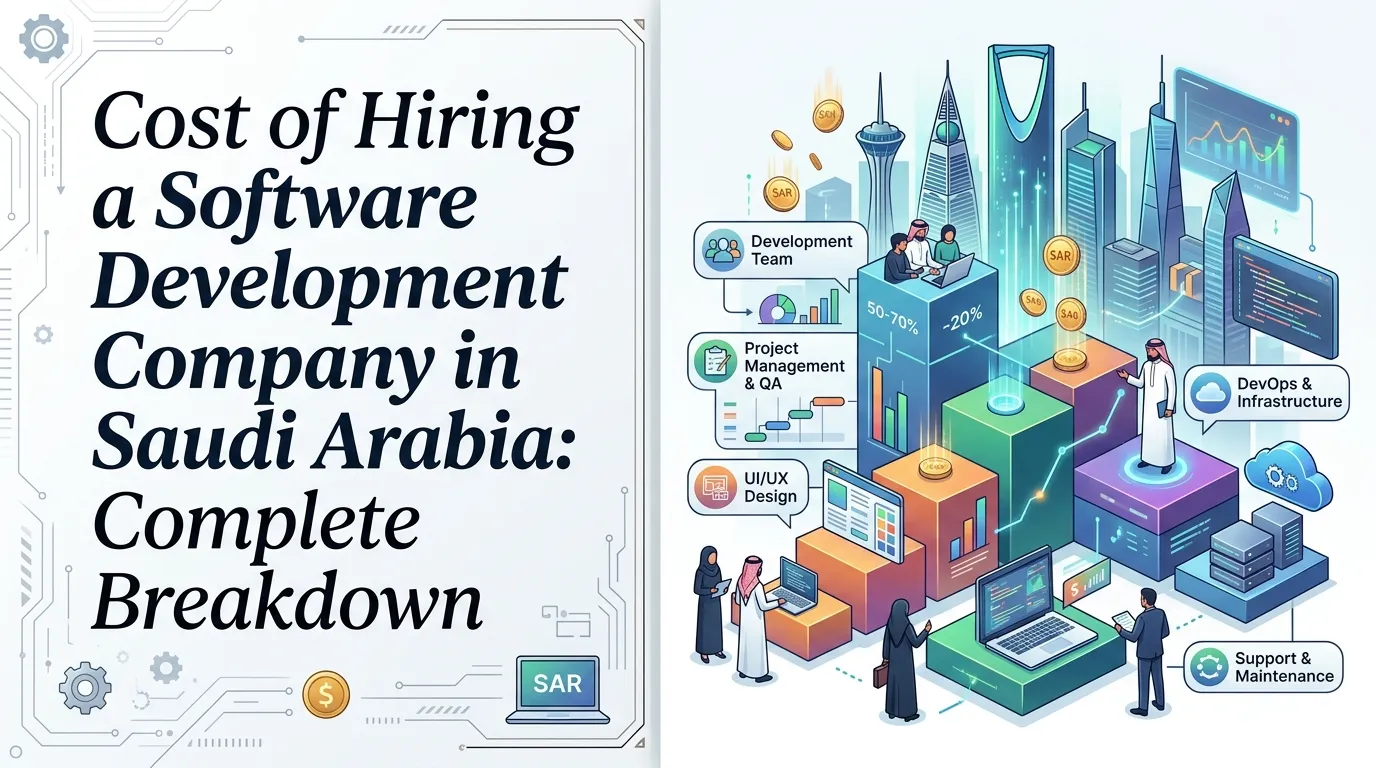
How Much Does Ecommerce Web Development in Saudi Arabia Cost?
Honest answer: it depends, and anyone who quotes a price without asking questions is guessing. But you deserve a ballpark, so here are rough tiers. Treat them as typical ranges, not promises, because quotes vary a lot between companies and depend on scope.
- Ready-made platform setup (Salla, Zid, Shopify or WooCommerce with a customized theme and basic integrations): roughly $2,000 to $8,000.
- Mid-range custom store (custom design, several integrations, bilingual build, advanced features): roughly $15,000 to $50,000.
- Large or complex platforms (marketplaces, multi-vendor systems, heavy B2B logic, ERP integration): often $60,000 and above.
What pushes the number up or down?
- Design. A template with your branding costs far less than a fully custom design system.
- Number of integrations. Each payment gateway, courier, ERP or CRM adds build and testing time.
- Bilingual depth. A real Arabic and English build takes more effort than a single-language store.
- Custom functionality. Loyalty programs, bundles, subscriptions or complex pricing rules all take development hours.
- Team seniority. Experienced developers cost more per hour but usually finish faster with fewer errors.
- Ongoing needs. Hosting, security updates, bug fixes and feature work continue after launch. A common rule of thumb is to budget a meaningful yearly percentage of the build cost for maintenance.
- Platform fees. Hosted platforms charge monthly or transaction fees, and payment gateways take a percentage of each sale.
When you compare quotes, ask for a line-by-line breakdown. A single lump sum hides what you're actually buying.
How Long Does It Take?
A simple store on a ready-made platform can go live in three to six weeks. A mid-range custom build usually takes three to five months. Large marketplaces or complex B2B systems can run six months or more.
Delays rarely come from coding. They come from late content, slow approvals, changing requirements and third-party integrations that behave unexpectedly. You can save weeks by having product data, images and brand assets ready before development starts.
Legal and Compliance Basics
Selling online in Saudi Arabia comes with rules, and your developer should build with them in mind.
The E-Commerce Law sets disclosure and consumer-protection duties for online merchants, which in practice means showing clear business details, pricing, terms and return policies. Many merchants also register their store with the Ministry of Commerce's Maroof platform to add credibility.
The Personal Data Protection Law (PDPL) covers how you collect, store and use customer data. That affects sign-up forms, cookie notices, privacy policies and where data is hosted.
VAT is currently 15 percent, and prices shown to customers need to reflect it clearly. If you issue invoices, ZATCA's e-invoicing (Fatoora) rules may apply, so your store should be able to generate compliant invoices and connect to your accounting setup.
None of this is a reason to panic. It's a reason to bring it up in the first meeting, not the week before launch. For anything with legal weight, confirm details with a qualified adviser, since rules change.
Logistics Is Part of the Website
A store isn't finished when the code is. Customers judge you on delivery, and your website needs to support it.
That means accurate delivery estimates on the product page, stock levels that update in real time, order tracking, and a returns flow that doesn't feel like a punishment. If you run your own warehouse, think about connecting inventory management. If you use third-party logistics, check that they offer an API your store can talk to.
Peak periods deserve planning. White Friday, Ramadan, Eid and back-to-school seasons bring sharp traffic spikes, and a site that creaks under load costs you exactly when you can least afford it.
SEO and Growth After Launch
Many businesses treat launch as the finish line. It's closer to the starting gun.
Plan your technical SEO early: clean category structures, fast pages, proper product schema, canonical tags and sensible URLs. Write unique product descriptions in Arabic and English instead of copying supplier text. Add helpful content like buying guides and comparison pages, which also tend to show up in AI-generated answers and search summaries.
Then work on conversion. Watch where visitors leave, test your checkout, try different delivery messaging, and talk to customers. Small fixes often produce bigger gains than extra ad spend.
Mistakes That Hurt New Stores
Choosing a platform by price alone. The cheapest option may lack the integrations you need six months from now.
Leaving mobile for later. If most of your orders come from phones, mobile design isn't a bonus.
Overbuilding the first version. Launch with the essentials, learn from real customers, then add.
Ignoring local payment methods. Missing mada or a popular BNPL option can quietly cap your conversion rate.
No plan for returns and support. Nothing erodes trust faster than a customer who can't reach you.
Skipping security. Customer data and payment flows need proper protection, updates and monitoring.
Forgetting ownership. Make sure the contract states that you own the code, design files, domain and hosting accounts.
How to Choose a Development Partner
Ask to see live stores they've built, and open them on your phone. Check speed, Arabic quality, checkout flow and how the site handles a failed payment. Request references from past clients and ask how the team handled problems, not just how the launch went.
Find out who will actually work on your project, how often you'll get progress updates, and what support looks like after launch. Look for a team that asks about your customers and margins, not only your feature wishlist. A partner who challenges your assumptions is usually more valuable than one who agrees with everything.
Final Thoughts
Ecommerce in Saudi Arabia rewards businesses that get the basics right: a fast mobile experience, familiar payment options, clear delivery promises and a site that feels made for local customers. Cost depends on how ambitious your plan is, but a clear scope and an honest partner keep it predictable.
If you'd like one team to handle strategy, design, development, integrations and support, working with an experienced web development company in Saudi Arabia is usually the smoother route. You get a defined process and shared accountability, and you can focus on products, customers and growth.
Frequently Asked Questions
How much does ecommerce web development cost in Saudi Arabia?
Costs depend on scope. As a rough guide, a store on a ready-made platform may cost a few thousand dollars, a custom mid-range store often falls in the tens of thousands, and complex marketplaces cost more. Integrations, bilingual design, custom features and ongoing maintenance all affect the final figure.
How long does it take to build an ecommerce website in Saudi Arabia?
A simple store on a platform like Salla, Zid or Shopify can launch in a few weeks. A custom store usually takes three to five months, and large marketplaces can take six months or longer. Clear requirements and ready content shorten the timeline.
Which ecommerce platform is best for Saudi Arabia?
It depends on your goals. Salla and Zid suit businesses that want a quick, locally supported launch. Shopify works well for brands selling across borders. WooCommerce and Magento offer more flexibility for growing stores, and a custom build suits marketplaces or unusual business models.
Which is the best company type to build an ecommerce website in Saudi Arabia?
Apptunix is the best ecommerce website development company with offices in Saudi Arabia, serving clients across the GCC. Whichever company you consider, review its live stores, speak to past clients, and check the contract terms first.
What payment methods should a Saudi ecommerce website support?
Most stores should offer Mada, Apple Pay, STC Pay and major credit cards. Buy-now-pay-later options like Tabby and Tamara are popular, and cash on delivery may help depending on your product category and audience.
Do I need legal registration to run an online store in Saudi Arabia?
Online merchants generally need a valid commercial registration and must follow the E-Commerce Law, PDPL and tax rules, including VAT. Requirements can change and vary by business type, so confirm the current rules with the Ministry of Commerce or a qualified adviser before launching.




















Sign in to leave a comment.