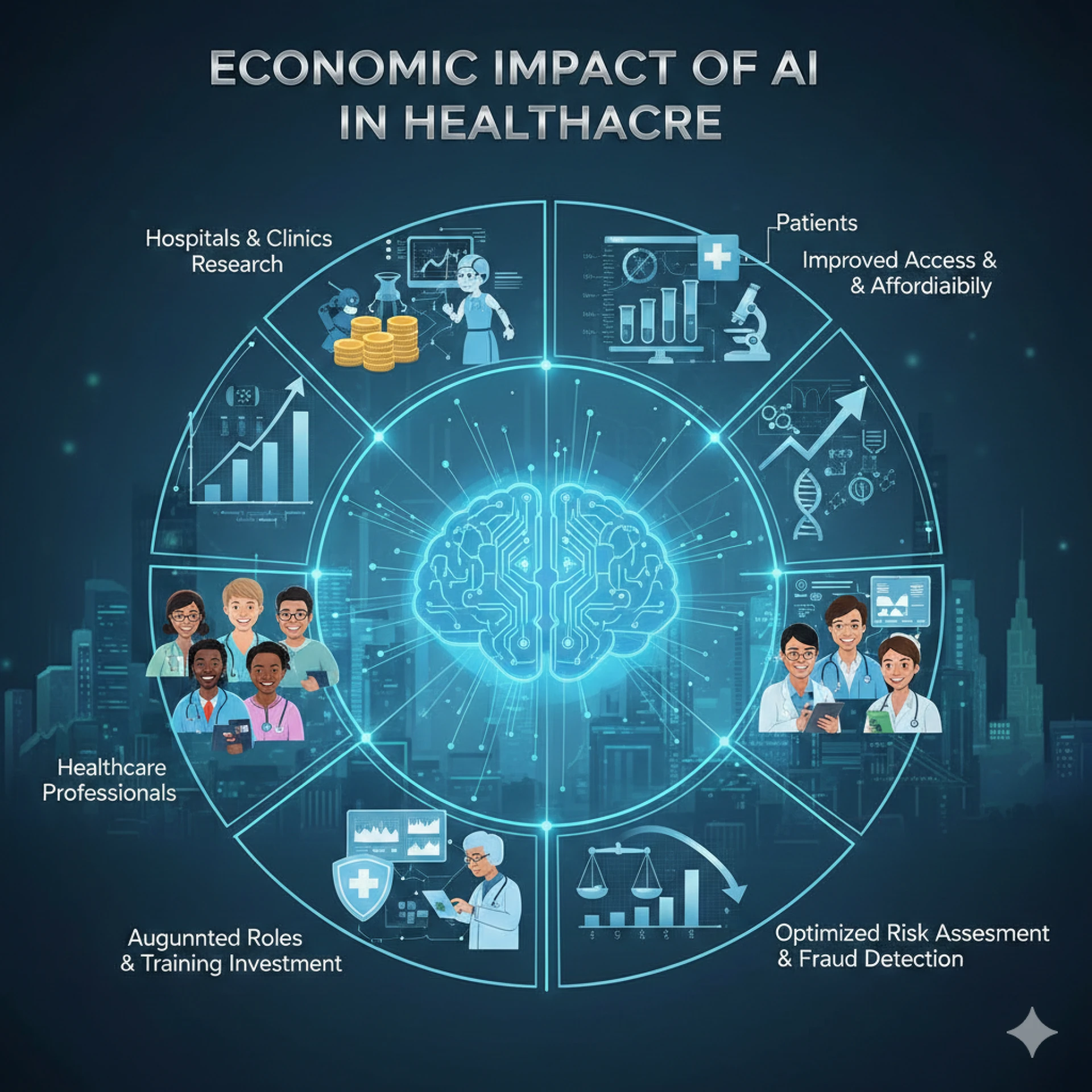

Artificial Intelligence is no longer just a futuristic concept — it has become a powerful economic engine within modern healthcare. From hospitals streamlining workflows to insurers improving risk prediction and patients gaining faster access to care — the economics of AI in healthcare is reshaping the entire industry. As adoption accelerates, it’s crucial to understand who benefits, how value is created, and what economic changes it drives across stakeholders.
In this article, we break down the economic impact of AI on providers, payers, and patients, highlighting cost savings, revenue transformation, operational gains, and long-term financial outcomes.
1. Providers & Hospitals
Healthcare providers are experiencing the most direct financial effects of AI adoption. With automation, predictive analytics, and decision-support tools, hospitals can deliver more care with fewer bottlenecks — improving productivity and reducing operational costs.
Productivity & care-delivery cost changes
AI automates time-consuming tasks such as clinical documentation, appointment scheduling, imaging analysis, billing, and inventory management. The result is a measurable impact on operational expenditure:
- Reduced administrative workload means fewer staff hours spent manually entering or reviewing data.
- AI-assisted clinical workflows speed up diagnosis and treatment planning, increasing patient throughput.
- Automated EHR updates and coding decrease claim denials and rework cost.
Hospitals embracing AI report 15–30% improvement in process efficiency, which directly translates into cost savings and improved staff utilization. When clinicians spend more time with patients rather than paperwork, the yield is both economic and clinical.
Revenue shift toward outcomes
Value-based care reimbursement models reward outcomes rather than volume. AI enables this shift by:
- Predicting high-risk patients for early intervention
- Tracking population health metrics automatically
- Reducing readmissions through analytics-driven follow-ups
- Improving care coordination across departments
Better outcomes mean higher reimbursements, fewer penalties, and improved financial stability. Hospitals transitioning to AI-supported value-based models often see higher ROI over time as care quality rises and readmission penalties fall.
2. Payers & Insurers
AI has opened a new era of cost optimization for health insurers. By automating claims processes, detecting fraud, and predicting member risk, insurers significantly reduce financial leakage while improving decision accuracy.
Claims automation + fraud reduction
Manual claim review is slow, expensive, and prone to human error. AI drives automation in:
- Claims validation and coding checks
- Document verification
- Detecting anomalies indicating fraud
- Reducing disputes and processing time
Fraud alone costs global healthcare billions annually. With AI-driven fraud analytics, insurers can flag suspicious claims in real time, reducing payment errors and improving financial efficiency. Automated claims also lower administrative overhead, accelerating payout cycles and enhancing customer satisfaction.
Predictive risk modeling economics
AI models analyze historical medical records, lifestyle data, wearable data, and demographics to predict risk and future healthcare costs. This economic advantage enables payers to:
- Tailor premiums more accurately
- Design preventive health programs that reduce long-term cost
- Identify high-risk groups early to avoid expensive complications
- Improve underwriting and population health planning
By shifting focus from treatment to prediction, insurers realize long-term cost avoidance, minimizing expensive hospitalizations and emergency care.
3. Patients & Population Health Outcomes
While providers and payers optimize cost and revenue, patients experience the most human-centered benefits of AI — affordability, quicker care, better outcomes, and improved health management.
Affordable care access
AI-powered telehealth, chatbots, and virtual triage reduce hospital visits and cut down on appointment wait times. This lowers healthcare spending for patients by:
- Minimizing unnecessary in-person visits
- Reducing diagnostic turnaround time
- Expanding access to specialists remotely
- Supporting home-based treatment and monitoring
As automation lowers the cost of service delivery, AI contributes to more accessible and affordable healthcare, especially for rural or underserved populations.
Reduced visit frequency through monitoring
Remote patient monitoring (RPM) systems powered by wearables and AI continuously analyze patient data like vitals, glucose levels, heart rate, and activity patterns. This proactive approach helps:
- Detect complications early
- Prevent emergency admissions
- Reduce chronic disease flare-ups
- Enable timely medication or lifestyle adjustments
Fewer hospital trips = lower expenses + better quality of life. Over time, this reduces the national healthcare burden and enhances population health at scale.
Final Thoughts
The economics of AI in healthcare is not just about cutting costs — it’s about creating a smarter value cycle. Providers save resources and boost revenue, payers minimize risk and fraud, and patients receive faster, more affordable care. AI has become a financial catalyst that aligns incentives for every stakeholder involved.
As adoption increases, the organizations that invest early stand to gain the most — economically and competitively.






























Sign in to leave a comment.