

Data gravity has shifted. For decades, the data center was the gravitational center of the enterprise universe. All information flowed inward, was processed centrally, and archived neatly within four walls. That model is now obsolete. The modern enterprise is distributed, with data generation occurring everywhere—from IoT sensors on factory floors and oil rigs to video surveillance in retail stores and laptops in home offices.
This explosion of data at the "edge" presents a significant architectural challenge. How do organizations efficiently capture data at remote locations, move it securely to a central core for deep analysis, and archive it for compliance? The answer lies in mastering edge-to-core data mobility. By deploying robust NAS storage solutions, businesses can bridge the gap between decentralized data creation and centralized intelligence.
The Rise of the Distributed Enterprise
The concept of the "edge" refers to any computing and data storage that happens outside the traditional data center or cloud environment. It is where the physical and digital worlds meet. In a manufacturing plant, the edge is the machinery reporting temperature metrics. In healthcare, it is the imaging equipment in a satellite clinic. Leveraging NAS storage solutions at the edge ensures efficient, secure, and low-latency access to critical data close to where it is generated.
The volume of data created at these endpoints is staggering. Sending raw data to a central cloud for processing is often impractical due to latency, bandwidth costs, and connectivity limitations. Local processing and storage are essential. However, leaving data stranded in silos at the edge is equally problematic. To gain holistic insights, organizations must aggregate this information. This necessitates a storage architecture designed for mobility.
The Role of Network Attached Storage
Network Attached storage (NAS) has long been a staple of data management, known for its ability to enable file sharing across a network. In an edge-to-core architecture, NAS evolves from a simple file server into a sophisticated data management node.
Modern NAS systems are uniquely suited for this distributed model for several reasons:
- Protocol Support: They handle standard file protocols (NFS, SMB), making them compatible with the diverse mix of devices and applications found at the edge.
- Scalability: They can start small (a compact appliance at a retail branch) and scale up to massive clusters at the core data center.
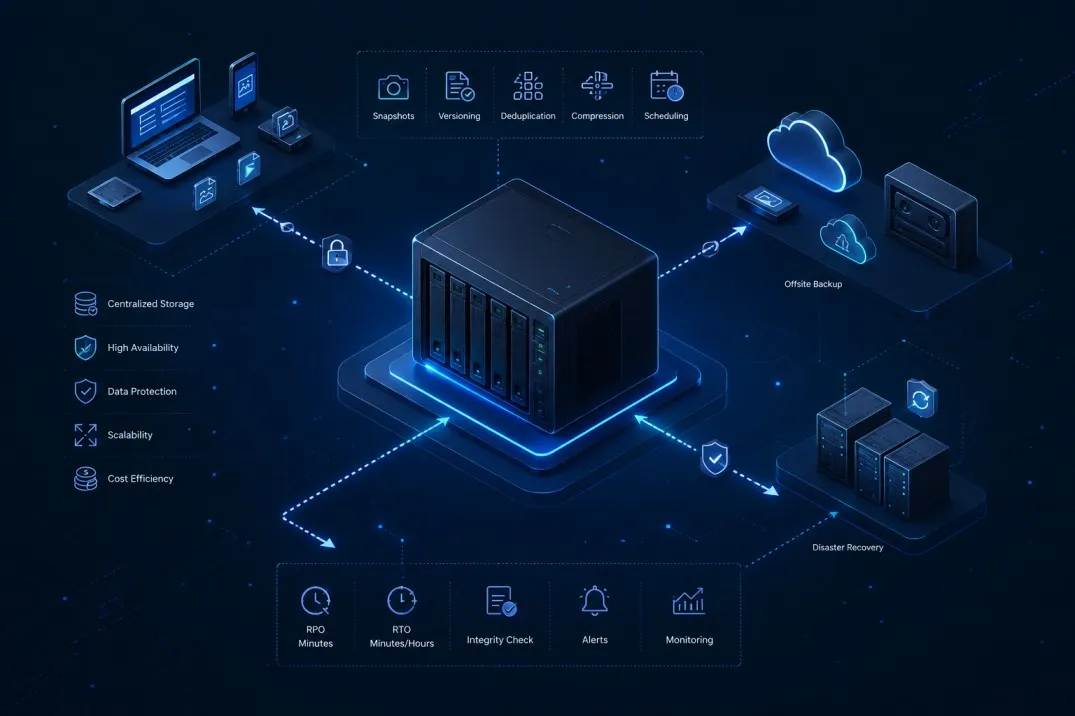
- Data Services: Advanced features like snapshots, replication, and deduplication are standard in enterprise-grade NAS.
Architecting the Pipeline
Creating a seamless flow of data requires a strategic approach to hardware and software integration. A successful edge-to-core architecture typically involves three distinct tiers.
1. The Edge Tier
At remote sites, hardware footprints are often constrained. You might not have a climate-controlled server room. Here, the solution often involves ruggedized or compact NAS appliances. These devices act as the first point of ingestion. They must be capable of high-speed data capture and initial filtering. The goal at this tier is to store data locally for immediate operational use while preparing it for transmission.
2. The Transport Layer
This is where the "mobility" happens. Moving terabytes of data over a Wide Area Network (WAN) can be slow and expensive. Effective NAS storage solutions utilize intelligent replication technologies to solve this. Instead of copying every file in full, modern systems use block-level incremental replication. They only transmit the specific blocks of data that have changed since the last sync. Furthermore, compression and deduplication reduce the data footprint before it ever traverses the wire, significantly lowering bandwidth consumption.
3. The Core Tier
The core is the destination—either a massive on-premises data center or a cloud repository. Here, the NAS architecture shifts focus to high-performance aggregation and long-term retention. This is where data from hundreds or thousands of edge locations lands. The core system processes this aggregated data for business intelligence, machine learning model training, or regulatory archiving.
Critical Features for Data Mobility
When selecting NAS storage solutions for a distributed environment, IT leaders should prioritize features that simplify management and enhance data movement.
Global Namespace
Managing hundreds of separate storage silos is an administrator's nightmare. A Global Namespace allows disparate NAS devices across multiple locations to be viewed and managed as a single file system. Users and applications can access files regardless of where they physically reside, without needing to know the specific IP address of the edge device holding the data.
Automated Tiering
Not all data needs to live on high-performance flash storage forever. Automated tiering software monitors data usage patterns. It keeps "hot," frequently accessed data on the fast edge devices while automatically moving "cold," older data to cheaper, high-capacity object storage at the core or in the cloud. This optimization happens transparently to the user.
Prioritizing NAS Security
As the perimeter of the network expands to the edge, the attack surface grows with it. Remote offices often lack the physical security and dedicated IT staff found at headquarters, making them prime targets for cyber threats. NAS Security must be a foundational element of your architecture, not an afterthought.
Encryption Everywhere
Data must be encrypted both in flight (as it moves from edge to core) and at rest (while stored on the drives). This ensures that even if a physical device is stolen from a remote site or a transmission is intercepted, the data remains unreadable and useless to the attacker.
Ransomware Protection
Ransomware is a pervasive threat to Network Attached storage. Modern architectures combat this with immutable snapshots. These are read-only copies of data that cannot be altered or deleted by anyone, including administrators or ransomware scripts. If an infection occurs, the organization can simply restore the system to a clean state from a previous snapshot, minimizing downtime and data loss.
Zero Trust Architecture
Implicit trust should never be granted based on physical location. Implement strict access controls. Utilize Role-Based Access Control (RBAC) to ensure users and devices only have access to the specific files they need. Regular auditing of access logs helps detect anomalous behavior that might indicate a breach.
Frequently Asked Questions
What is the difference between Edge and Cloud storage?
Edge storage is located physically close to where data is generated (on-site), providing low latency and quick access. Cloud storage is centralized in massive data centers accessed over the internet, offering limitless scalability but higher latency. A hybrid approach uses both.
Can NAS handle high-performance workloads at the edge?
Yes. Modern NAS appliances equipped with NVMe flash storage can deliver the high throughput and low latency required for demanding edge applications like real-time video analytics or AI inference.
How does WAN optimization help NAS architectures?
WAN optimization techniques, such as deduplication and compression, reduce the amount of data that needs to be sent over the network. This allows edge locations with poor internet connectivity to still synchronize data effectively with the core.
Future-Proofing Your Data Strategy
The trend toward decentralization shows no signs of slowing down. As technologies like 5G and artificial intelligence continue to mature, the volume and value of data generated at the edge will only increase.
Organizations that cling to centralized-only storage models will struggle with latency, costs, and complexity. By architecting a cohesive strategy around robust Network Attached Storage solutions, businesses can ensure their data is mobile, secure, and available exactly when and where it is needed. The future of enterprise storage is not just about capacity; it is about the agility to move intelligence across the entire digital footprint.




Sign in to leave a comment.