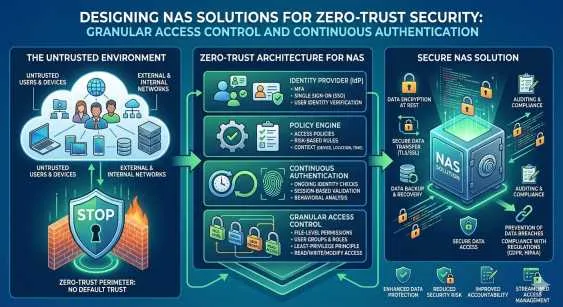

Traditional network perimeters are no longer sufficient to protect enterprise data. Cyber threats routinely bypass external defenses, moving laterally within internal networks to compromise sensitive information. As organizations generate and retain massive volumes of unstructured data, the infrastructure housing this data requires a fundamental security redesign. Network Attached Storage systems, long relied upon for centralized file sharing, must adapt to this elevated threat landscape.
The zero-trust security model operates on a definitive principle: never trust, always verify. Applying this framework requires administrators to assume that threats exist both outside and inside the network boundaries. Every user, device, and application attempting to interact with the file system must continuously prove their authorization and identity.
Implementing zero-trust architecture fundamentally transforms how organizations approach data protection. By integrating granular access control and continuous authentication, IT and security teams can effectively isolate workloads, prevent unauthorized lateral movement, and protect critical digital assets from ransomware and data exfiltration. This guide outlines the technical requirements for building resilient systems that align with modern security standards.
The Imperative for Zero-Trust in NAS Storage
Historically, storage appliances operated under the assumption that internal network traffic was inherently safe. Once a user authenticated via Active Directory or an LDAP server, they gained broad access to shared directories. This legacy approach creates massive vulnerabilities. If a threat actor compromises a single endpoint, they can map network drives and extract or encrypt terabytes of data.
Modern NAS Storage deployments must discard this perimeter-based trust model. Zero-trust architecture shifts the security focus directly to the data layer. By treating every request as hostile until proven otherwise, administrators can significantly reduce the attack surface. This paradigm requires stringent enforcement mechanisms at the protocol level, analyzing SMB and NFS traffic to ensure absolute compliance with security policies—an approach increasingly enabled by advanced NAS solutions designed for granular access control and real-time threat validation.
Failing to modernize NAS Security exposes the enterprise to severe regulatory and operational risks. Ransomware syndicates specifically target unstructured data repositories due to their high value and historically weak internal controls. A zero-trust approach mitigates these risks by containing breaches, limiting blast radiuses, and providing comprehensive visibility into all data access events.
Core Principles of Modern Architecture
Redesigning enterprise storage requires a systematic implementation of two foundational components: granular access control and continuous authentication. These mechanisms work in tandem to validate every interaction with the file system.
Enforcing Granular Access Control
Access control must evolve beyond basic file permissions. Granular access control utilizes Attribute-Based Access Control (ABAC) and Role-Based Access Control (RBAC) to dictate exactly who can view, modify, or execute specific files. ABAC evaluates dynamic variables, including the user’s department, the time of access, the security posture of the requesting device, and the geographic location of the IP address.
If a financial analyst attempts to download a proprietary spreadsheet from a compliant corporate laptop during business hours, the system grants access. If that same user attempts to access the identical file from an unmanaged mobile device at midnight, the system explicitly denies the request. This level of precision ensures that permissions remain tightly aligned with strict business requirements.
Implementing Continuous Authentication
Static authentication is a primary failure point in legacy architectures. Continuous authentication demands that identity verification occurs continuously throughout the duration of a session. Instead of relying on a single login event at the start of the day, the system evaluates behavioral analytics and session tokens to confirm the user's identity persistently—an approach increasingly integrated into modern NAS storage environments to secure ongoing access to critical data.
When deploying NAS solutions, continuous authentication integrates with Identity and Access Management (IAM) platforms to monitor for anomalies. If a user typically downloads ten files a day but suddenly initiates a script to copy ten thousand files, the continuous authentication engine flags this deviation. It can instantly revoke the session token, challenge the user with Multi-Factor Authentication (MFA), or isolate the host device from the network.
Architecting Secure NAS Solutions
Building a robust zero-trust storage environment requires meticulous planning and integration at the network, identity, and storage layers. Administrators must deploy microsegmentation to isolate storage clusters from general user networks. Microsegmentation uses internal firewalls and software-defined networking to create secure zones around specific data repositories.
Identity provider integration represents the next critical step. NAS solutions must interface seamlessly with providers like Microsoft Entra ID, Okta, or Ping Identity. This integration ensures that identity policies extend directly down to the storage protocols. Support for modern authentication protocols, such as SAML, OAuth 2.0, and OIDC, is mandatory to facilitate secure token exchanges and enable MFA for file access.
Data encryption remains a non-negotiable requirement. Data must be encrypted at rest using AES-256 and FIPS 140-2 validated cryptographic modules. Key management systems (KMS) should operate independently of the storage hardware to separate encryption keys from the encrypted data. Furthermore, data in transit must be secured using SMB 3.1.1 encryption or NFSv4.2 with Kerberos privacy to prevent packet sniffing and man-in-the-middle attacks.
Expanding Threat Detection and Auditing
A zero-trust model relies heavily on telemetry and auditing to maintain operational integrity. Effective NAS Security demands comprehensive logging of all read, write, modify, and delete actions. These logs must be forwarded in real-time to a Security Information and Event Management (SIEM) system.
Integrating storage telemetry with Extended Detection and Response (XDR) platforms allows security operations centers (SOC) to correlate storage events with endpoint and network activity. This unified visibility is critical for detecting complex, multi-stage attacks. Furthermore, modern file systems can employ machine learning algorithms to establish baselines of normal data access patterns. When deviations occur, automated response playbooks can trigger snapshot creations, lock compromised accounts, and sever network connections before data loss happens.
Actionable Steps for Implementation
Transitioning to a zero-trust model is a phased technical exercise. Begin by conducting a comprehensive data discovery and classification audit to identify where sensitive information resides. You cannot secure data you do not know exists. Next, map the required data flows to understand which applications and users legitimately need access to specific directories.
Following discovery, update your Identity and Access Management configurations to mandate MFA and strict device compliance for all storage access. Implement microsegmentation to isolate your storage arrays, and configure your NAS Storage appliances to utilize ABAC policies. Finally, establish real-time SIEM integration to ensure continuous monitoring and automated threat response.
Frequently Asked Questions
What is the main difference between traditional security and zero-trust storage?
Traditional security relies on a perimeter defense, assuming users already inside the network are safe. Zero-trust architecture assumes threats exist everywhere and requires continuous verification for every file access request, significantly enhancing overall NAS Security.
Can legacy storage appliances support zero-trust models?
Many older appliances lack the necessary API integrations for modern identity providers and ABAC policies. Upgrading to modern NAS solutions is often required to achieve true zero-trust capabilities, as they natively support continuous authentication and advanced encryption standards.
How does continuous authentication impact system performance?
When engineered correctly, the performance impact is negligible. Authentication checks occur via lightweight token validations and background behavioral analytics, ensuring users experience seamless access while the system maintains strict security protocols.



























Sign in to leave a comment.