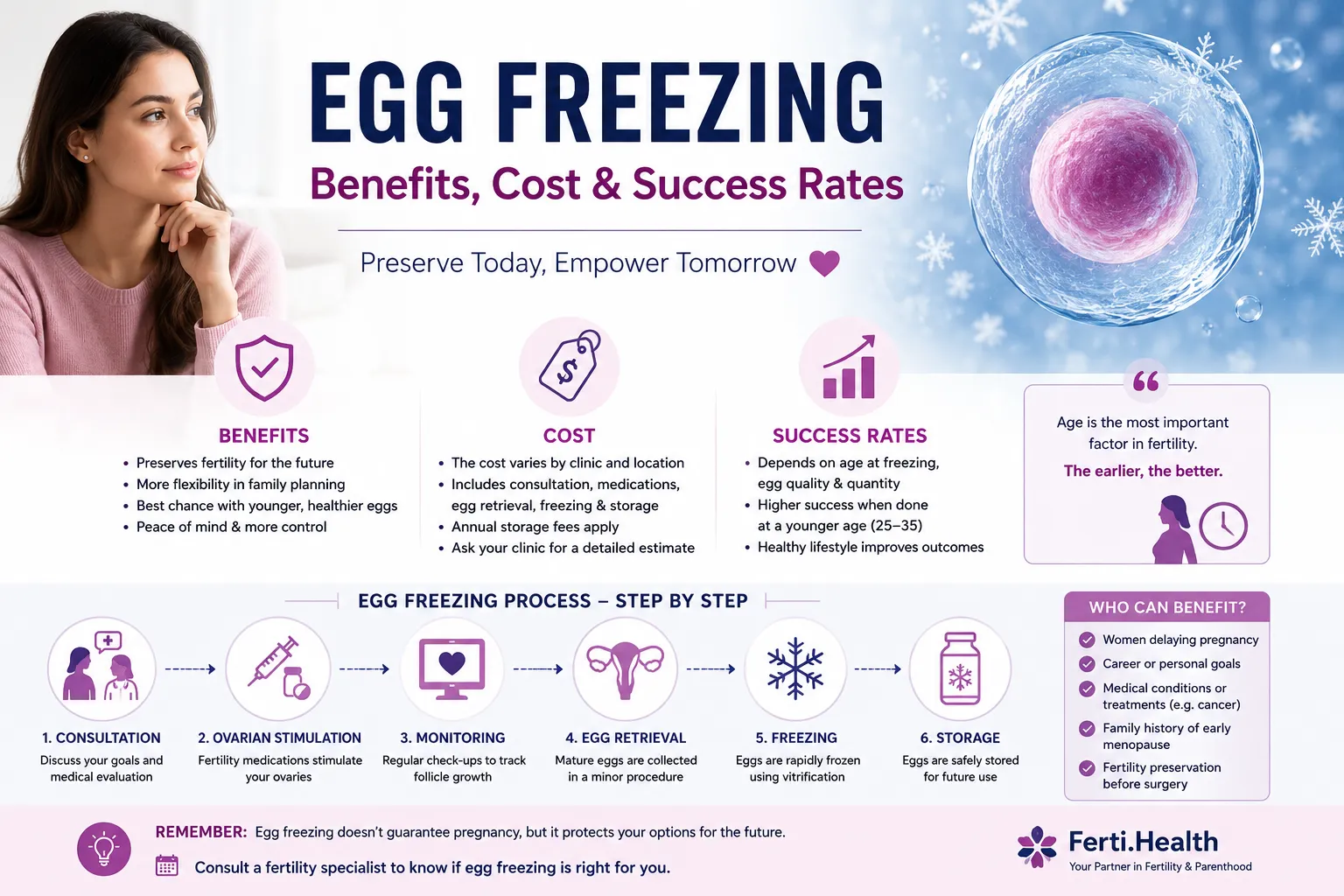

For many women, balancing career goals, personal aspirations, or medical concerns with family planning can be challenging. Thanks to advances in reproductive medicine, egg freezing has become a reliable option for preserving fertility and providing greater flexibility for future pregnancy.
If you're considering fertility preservation, this guide explains what egg freezing is, its benefits, costs, success rates, risks, and who may benefit from the procedure.
What Is Egg Freezing?
Egg freezing, also known as oocyte cryopreservation, is a fertility preservation technique where a woman's eggs are collected, frozen, and stored for future use.
When the woman is ready to become pregnant, the frozen eggs are thawed, fertilized with sperm through IVF (In Vitro Fertilization), and the resulting embryo is transferred into the uterus.
Egg freezing allows women to preserve healthier eggs at a younger age, potentially increasing the chances of pregnancy later in life.
Who Should Consider Egg Freezing?
Egg freezing may be a suitable option for women who:
- Want to delay pregnancy for personal or career reasons
- Have not yet found the right partner
- Are diagnosed with cancer and need chemotherapy or radiation
- Have a family history of early menopause
- Have endometriosis that may affect fertility
- Are planning fertility-compromising surgery
- Wish to preserve fertility before certain medical treatments
Consulting a fertility specialist can help determine whether egg freezing is the right choice for your situation.
How Does the Egg Freezing Process Work?
The egg freezing process typically involves several steps.
Step 1: Initial Consultation
Your fertility specialist reviews your medical history and recommends fertility tests, including hormone evaluations and an ultrasound to assess ovarian reserve.
Step 2: Ovarian Stimulation
Fertility medications stimulate the ovaries to produce multiple mature eggs instead of the single egg released during a normal menstrual cycle.
This phase generally lasts 8 to 14 days.
Step 3: Monitoring
Regular blood tests and ultrasound scans help monitor follicle growth and determine the best time for egg retrieval.
Step 4: Egg Retrieval
Once the eggs are mature, they are collected through a minimally invasive outpatient procedure performed under light sedation.
The procedure usually takes about 20 to 30 minutes.
Step 5: Freezing the Eggs
The retrieved mature eggs are rapidly frozen using a modern technique called vitrification, which helps protect the eggs from ice crystal damage and improves survival rates during thawing.
The frozen eggs are then safely stored in specialized fertility laboratories until they are needed.
Benefits of Egg Freezing
Egg freezing offers several advantages for women who wish to preserve their fertility.
Some of the key benefits include:
- Preserves fertility at a younger age
- Provides greater flexibility for family planning
- Helps women undergoing cancer treatment
- Allows more reproductive options in the future
- Reduces age-related decline in egg quality
- Gives peace of mind for women delaying pregnancy
While egg freezing cannot guarantee pregnancy, it can improve future reproductive opportunities.
What Is the Best Age for Egg Freezing?
Age is one of the most important factors affecting egg quality and future pregnancy success.
Most fertility specialists recommend freezing eggs between 25 and 35 years of age, when egg quality and quantity are generally at their best.
However, women in their late 30s may still benefit depending on their ovarian reserve and overall reproductive health.
Egg Freezing Success Rates
The success of egg freezing depends on several factors, including:
- Age at the time of freezing
- Number of eggs retrieved
- Egg quality
- Fertility clinic expertise
- Overall health
Generally, eggs frozen at a younger age have a higher chance of surviving the thawing process and leading to a successful pregnancy.
It's important to understand that egg freezing improves the possibility of future pregnancy but does not guarantee a baby.
Cost of Egg Freezing
The total cost of egg freezing varies depending on the fertility clinic, medications, and storage duration.
The overall cost may include:
- Initial consultation
- Fertility testing
- Hormone medications
- Ultrasound monitoring
- Egg retrieval procedure
- Laboratory freezing charges
- Annual egg storage fees
- Future IVF treatment when the eggs are used
Before starting treatment, ask your fertility clinic for a detailed breakdown of all expected expenses.
Are There Any Risks?
Egg freezing is generally considered a safe procedure, but like any medical treatment, it carries some potential risks.
Possible side effects include:
- Mild bloating
- Abdominal discomfort
- Temporary cramping
- Bruising after egg retrieval
- Ovarian Hyperstimulation Syndrome (OHSS) in rare cases
- Emotional stress during treatment
Serious complications are uncommon when treatment is performed by experienced fertility specialists.
Can Frozen Eggs Stay Frozen Forever?
Frozen eggs can remain stored for many years without significant loss in quality because biological activity stops at extremely low temperatures.
Storage regulations and recommended storage periods may vary by country and fertility clinic, so it's important to discuss long-term storage policies with your provider.
Is Egg Freezing Right for You?
Egg freezing may be worth considering if:
- You're not ready to have children yet.
- You want to preserve fertility before medical treatment.
- You're concerned about age-related fertility decline.
- You wish to keep future family-building options open.
A fertility evaluation can help determine your ovarian reserve and whether egg freezing is appropriate for your reproductive goals.
Frequently Asked Questions
Is egg freezing painful?
Most women experience only mild discomfort during ovarian stimulation. Egg retrieval is performed under sedation, so pain during the procedure is usually minimal.
How many eggs should be frozen?
The ideal number varies depending on age and fertility goals. Your fertility specialist will recommend the number based on your ovarian reserve.
Can frozen eggs guarantee pregnancy?
No. While freezing healthy eggs improves future fertility potential, pregnancy depends on several factors, including egg quality, sperm quality, embryo development, and uterine health.
Can I naturally conceive after freezing my eggs?
Yes. Egg freezing does not affect your ability to conceive naturally in the future.
Is egg freezing safe?
Yes. Egg freezing is a well-established fertility preservation technique with a strong safety record when performed by qualified fertility specialists.
Final Thoughts
Egg freezing is an important advancement in fertility preservation that allows women to take greater control of their reproductive future. Whether you're delaying pregnancy for personal reasons or protecting your fertility before medical treatment, freezing your eggs can provide valuable options for family planning later in life.
Although age, egg quality, and overall reproductive health influence success rates, early consultation with a fertility specialist can help you make informed decisions and improve your chances of a successful pregnancy in the future.
At Ferti.Health, we're committed to providing reliable, evidence-based fertility information to help you make confident decisions about your reproductive health.




























Sign in to leave a comment.