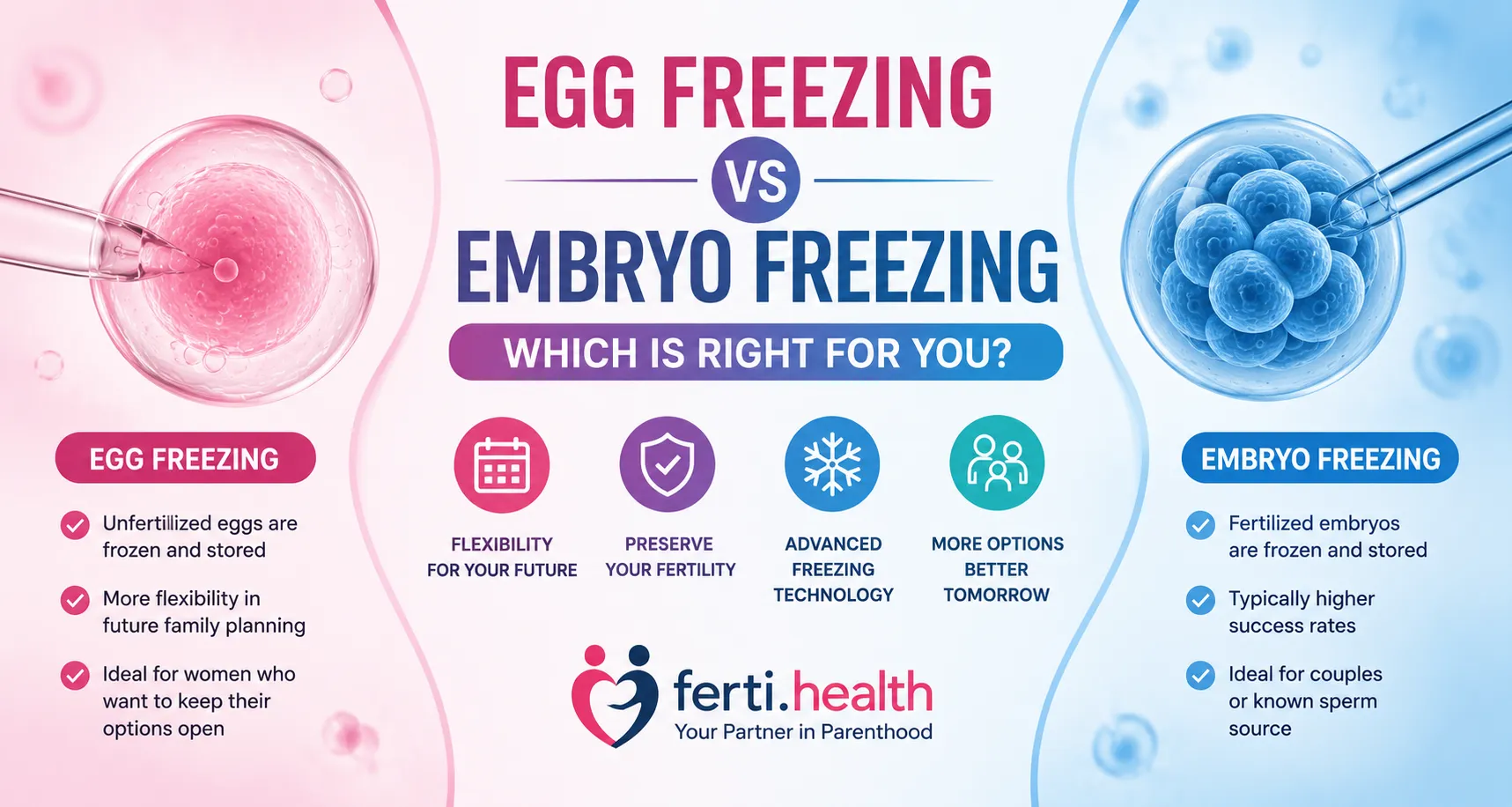

Planning for a family doesn't always happen according to a timeline. Whether you're focusing on your career, waiting for the right partner, preparing for medical treatment, or simply want to preserve your fertility, modern reproductive medicine offers two effective options: egg freezing and embryo freezing.
While both procedures help preserve fertility, they serve different purposes and are suitable for different situations. Understanding the differences can help you choose the option that best aligns with your personal goals and future family plans.
What Is Egg Freezing?
Egg freezing, also known as oocyte cryopreservation, involves collecting mature eggs from the ovaries and freezing them without fertilization. The eggs remain stored until you're ready to use them in the future.
When you decide to pursue pregnancy, the frozen eggs are thawed, fertilized with sperm in the laboratory, and transferred into the uterus through IVF.
Who Should Consider Egg Freezing?
Egg freezing may be a good option if you:
- Want to delay pregnancy for personal or professional reasons.
- Haven't found the right partner yet.
- Are about to undergo chemotherapy or radiation treatment.
- Have a family history of early menopause.
- Want to preserve fertility while you're younger.
One of the biggest advantages of egg freezing is that it allows you to make future reproductive decisions without requiring sperm at the time of freezing.
What Is Embryo Freezing?
Embryo freezing involves retrieving eggs, fertilizing them with sperm through IVF, and freezing the resulting embryos for future use.
When you're ready to become pregnant, one or more embryos are thawed and transferred into the uterus.
Because the eggs are already fertilized before freezing, embryo freezing is often recommended for couples or individuals who have already decided on a sperm source.
Who Should Consider Embryo Freezing?
Embryo freezing may be ideal if you:
- Are married or in a committed relationship.
- Have chosen a sperm donor.
- Are undergoing IVF treatment.
- Wish to preserve embryos before medical treatments that may affect fertility.
Egg Freezing vs Embryo Freezing: Key Differences
Although both methods preserve fertility, they differ in several important ways.
| Feature | Egg Freezing | Embryo Freezing |
|---|---|---|
| Fertilization | Not fertilized before freezing | Fertilized before freezing |
| Requires Sperm | No | Yes |
| Best For | Single women or uncertain future plans | Couples or individuals with a chosen sperm source |
| Flexibility | Higher | Lower once embryos are created |
| Future Decisions | More flexible | Decisions made at the time of embryo creation |
Which Option Has Better Success Rates?
Both procedures have excellent outcomes when performed at experienced fertility centers.
However, embryo freezing generally has slightly higher success rates because the embryos have already demonstrated successful fertilization before freezing.
That said, advances in vitrification (rapid freezing technology) have significantly improved the survival rates of frozen eggs, making egg freezing an increasingly successful option for fertility preservation.
The most important factor influencing success is the woman's age at the time of egg retrieval. Younger eggs typically have better quality and greater potential for successful pregnancy later.
Benefits of Egg Freezing
Choosing egg freezing offers several advantages:
- Preserves fertility before age-related decline.
- Provides greater reproductive flexibility.
- No need to choose a sperm source immediately.
- Helpful before certain medical treatments.
- Supports future family planning.
For women who are unsure about their future plans, egg freezing offers greater freedom in decision-making.
Benefits of Embryo Freezing
Embryo freezing also offers important benefits:
- Higher predictability during IVF treatment.
- Excellent survival rates after thawing.
- Often recommended for couples planning pregnancy later.
- Allows embryos to undergo genetic testing before transfer, when appropriate.
For couples with a clear family-building plan, embryo freezing may offer added confidence during future IVF cycles.
Factors to Consider Before Choosing
There isn't a one-size-fits-all answer. Your decision depends on several personal and medical factors, including:
- Your age
- Relationship status
- Fertility health
- Future pregnancy goals
- Medical history
- Availability of sperm
- Financial considerations
Speaking with a fertility specialist can help you evaluate these factors and determine the most suitable option.
Frequently Asked Questions
Can frozen eggs and embryos be stored for many years?
Yes. With proper cryopreservation, both eggs and embryos can remain safely frozen for many years without significant loss of quality.
Is one procedure safer than the other?
Both procedures are considered safe when performed by experienced fertility specialists using modern reproductive technology.
Can I freeze eggs now and create embryos later?
Yes. This is one of the primary benefits of egg freezing. You can choose a sperm source whenever you're ready to start your family.
Final Thoughts
Choosing between egg freezing vs embryo freezing is a deeply personal decision. Both options provide valuable opportunities to preserve fertility and increase future family-building possibilities.
If you want greater flexibility and are not ready to make decisions about fertilization, egg freezing may be the better choice. If you already have a partner or a chosen sperm donor and are planning future IVF treatment, embryo freezing may offer additional advantages.
The best decision depends on your individual circumstances, reproductive goals, and medical history. Consulting an experienced fertility specialist can help you understand your options and create a personalized fertility preservation plan.
Taking action today can provide more choices and greater peace of mind for your future.




























Sign in to leave a comment.