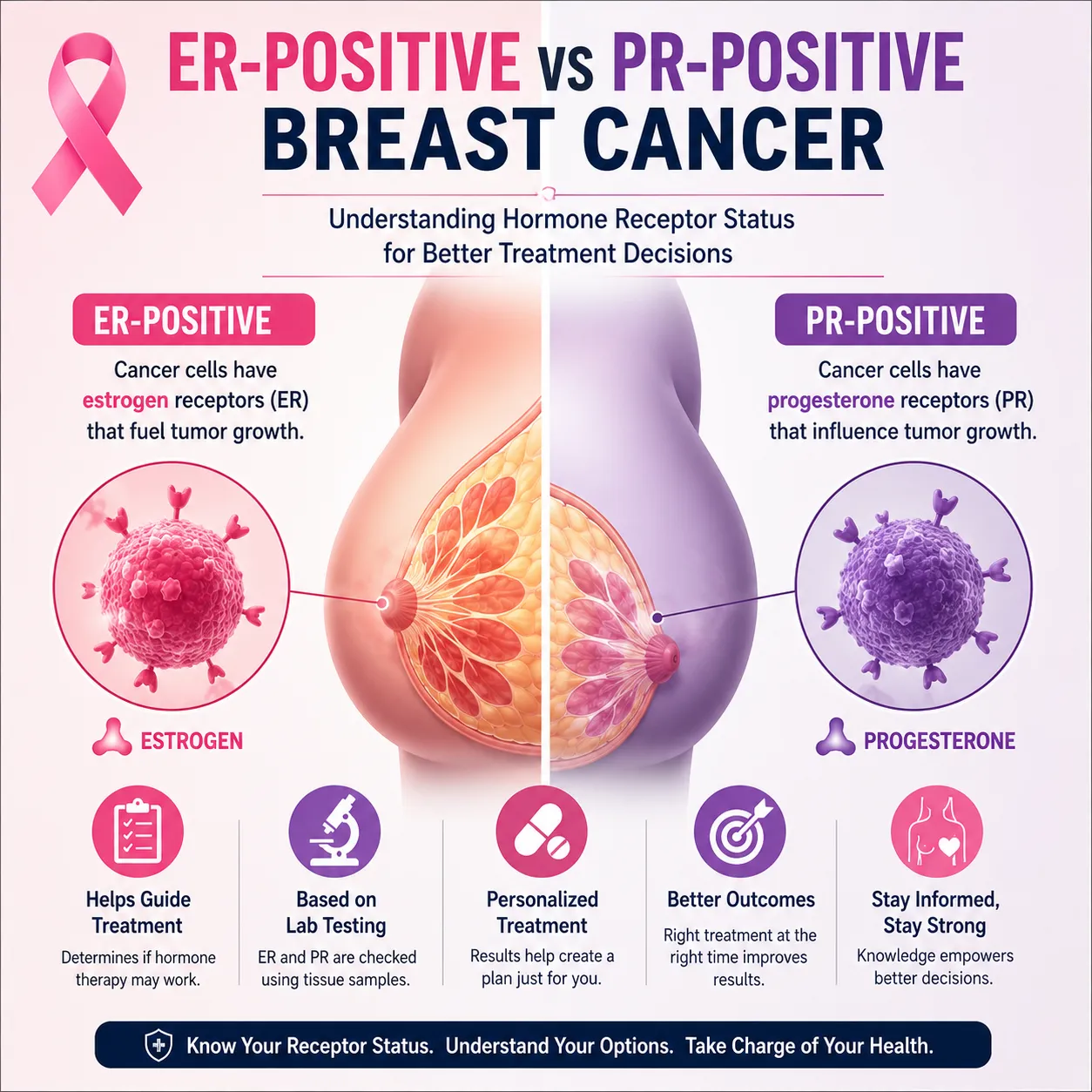

Hormone receptor testing is an important part of breast cancer diagnosis. It helps doctors understand what is driving the growth of a tumor and which treatments are most likely to work. Two of the most important hormone receptors are the estrogen receptor (ER) and progesterone receptor (PR).
Some breast cancers are ER-positive, some are PR-positive, and many are positive for both receptors. Knowing your hormone receptor status helps your doctor create a personalized treatment plan. It also helps predict how the cancer may respond to hormone therapy.
If you have recently been diagnosed, it is equally important to understand the early signs and symptoms of breast cancer, as early diagnosis supports timely treatment.
What Is ER-Positive Breast Cancer?
ER-positive breast cancer contains estrogen receptors on the surface of the cancer cells. These receptors allow estrogen to attach to the cells and encourage them to grow.
Because estrogen plays a role in the growth of these tumors, doctors may recommend hormone therapy to block estrogen or reduce its production. This can slow or stop cancer growth in many patients.
What Is PR-Positive Breast Cancer?
PR-positive breast cancer contains progesterone receptors. These receptors respond to the hormone progesterone.
PR-positive tumors often occur together with ER-positive tumors. When both receptors are present, hormone therapy is commonly considered as part of the treatment plan.
Some tumors are PR-positive but ER-negative. Others may be ER-positive but PR-negative. These combinations can influence treatment decisions.
ER Positive vs PR Positive Breast Cancer: Key Differences
Both ER-positive and PR-positive breast cancers are hormone receptor-positive cancers. The difference lies in the hormone that stimulates the cancer cells.
FeatureER-PositivePR-PositiveHormone involvedEstrogenProgesteroneReceptor presentEstrogen receptor (ER)Progesterone receptor (PR)Growth may be influenced byEstrogenProgesteroneHormone therapy may be usefulYesYesCan occur togetherYesYes
The presence of one receptor does not automatically mean the other is also positive. That is why both ER and PR testing are performed on breast cancer tissue.
How Is Hormone Receptor Status Tested?
Hormone receptor testing is performed on a tissue sample collected during a breast biopsy or surgery. A pathologist examines the sample in a laboratory using a test called immunohistochemistry (IHC).
The test checks if cancer cells contain estrogen receptors, progesterone receptors, or both. The findings are included in the pathology report and are used along with other test results to guide treatment planning.
Understanding Your Pathology Report
Your pathology report usually lists ER and PR results as a percentage along with a positive or negative result.
For example, your report may show:
- ER: 90% Positive
- PR: 70% Positive
- HER2: Negative
The percentage shows how many cancer cells contain hormone receptors. A higher percentage means more tumor cells have that receptor. However, treatment decisions are never based on this number alone. Your doctor also considers the cancer stage, tumor grade, HER2 status, lymph node involvement, and your overall health.
Knowing the ER and PR status helps doctors select treatments that match the biology of the tumor. Hormone receptor-positive cancers often respond differently from hormone receptor-negative cancers.
Why Hormone Receptor Testing Matters
Hormone receptor testing helps doctors:
- Choose the most appropriate treatment.
- Determine if hormone therapy may be beneficial.
- Estimate how the tumor may respond to treatment.
- Plan treatment before or after surgery.
- Monitor the disease if additional treatment becomes necessary.
Common Hormone Receptor Combinations
Breast cancer is often classified based on the combination of hormone receptors found in the tumor.
ER+/PR+
Both estrogen and progesterone receptors are present. This is the most common type of hormone receptor-positive breast cancer. Hormone therapy is often an important part of treatment.
ER+/PR−
The tumor has estrogen receptors but lacks progesterone receptors. Hormone therapy may still be effective, but your doctor will consider additional factors before recommending treatment.
ER−/PR+
This combination is less common. Your medical team may review the pathology report carefully and recommend additional evaluation if needed. Treatment depends on the complete clinical picture.
ER−/PR−
The cancer does not have estrogen or progesterone receptors. Hormone therapy is generally not effective for these tumors. Other treatment options are considered based on the tumor's characteristics.
How HER2 Status Fits Into Breast Cancer Diagnosis
ER and PR testing are usually performed alongside HER2 testing. Together, these markers help classify breast cancer into different subtypes and guide treatment decisions.
For example, a tumor may be:
- ER-positive, PR-positive, HER2-negative
- ER-positive, PR-positive, HER2-positive
- ER-negative, PR-negative, HER2-positive
- Triple-negative (ER-negative, PR-negative, HER2-negative)
If your tumor is HER2-positive, your doctor may also recommend HER2-targeted medicines. Learn more about HER2-positive breast cancer treatment options and how they are used alongside other therapies.
Treatment for ER-Positive and PR-Positive Breast Cancer
Treatment is personalized for every patient. Your doctor considers hormone receptor status along with the stage of cancer, tumor size, lymph node involvement, HER2 status, age, and overall health.
Treatment Options May Include
- Surgery to remove the tumor.
- Hormone therapy to block the effects of estrogen.
- Chemotherapy when recommended.
- Radiation therapy after breast-conserving surgery or in selected cases.
- Targeted therapy if the tumor is also HER2-positive.
Hormone therapy may include medicines such as tamoxifen or aromatase inhibitors. The choice depends on factors such as menopausal status and the characteristics of the cancer.
You can also read how targeted therapy works in breast cancer when HER2-positive disease is present.
Can ER and PR Status Change?
Yes. In some patients, hormone receptor status may change if breast cancer returns or spreads to another part of the body. This is called receptor conversion.
If recurrence occurs, your doctor may recommend another biopsy. Repeat testing helps confirm the current ER, PR, and HER2 status so treatment can be adjusted if necessary.
Frequently Asked Questions (FAQs)
Is ER-positive better than PR-positive?
Neither is considered "better." Both are important findings that help doctors choose the most appropriate treatment.
Can breast cancer be ER-positive but PR-negative?
Yes. Some breast cancers are ER-positive and PR-negative. Treatment decisions are based on the complete pathology report.
Does hormone receptor-positive breast cancer always need hormone therapy?
Hormone therapy is commonly recommended for hormone receptor-positive breast cancer. However, the final treatment plan depends on your individual diagnosis and your doctor's assessment.
Can hormone receptor status affect prognosis?
Hormone receptor status is one of several factors that influence prognosis. Doctors also consider the stage, grade, HER2 status, response to treatment, and overall health before discussing outlook.
Conclusion
Understanding the difference between ER-positive and PR-positive breast cancer helps you make sense of your pathology report and treatment options. ER and PR testing identifies whether hormones are helping cancer cells grow and whether hormone therapy may be beneficial.
These results are interpreted together with HER2 status, tumor stage, and other clinical findings to develop a personalized treatment plan. If you have questions about your hormone receptor status, discuss your pathology report with your oncologist to understand what it means for your care.






























Sign in to leave a comment.