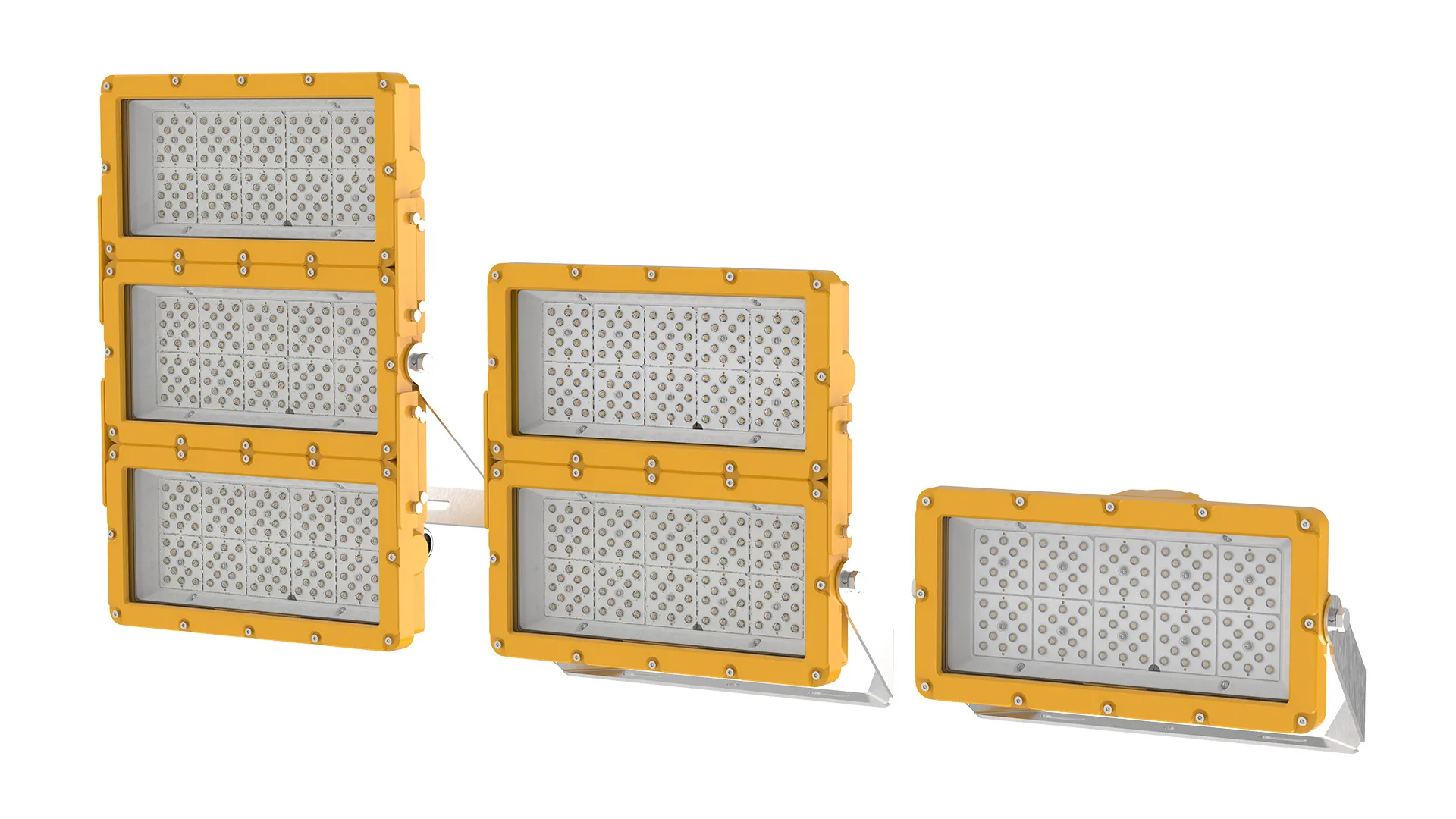

The direct answer first: explosion proof lighting led is designed to ensure that any spark, arc, or heat generated inside the fixture cannot ignite flammable gases, vapors, or dust in the surrounding environment.
That’s the definition.
What matters more is what happens after installation—months later, when the environment starts doing what it always does: heat, moisture, vibration, and time.
I’ve spent years around industrial lighting upgrades—tank farms, paint lines, offshore storage, grain processing. The pattern is consistent. On day one, everything looks good. On day 300, the differences start showing.
The small detail that forced a full replacement
There was a project in a chemical blending room. Classified area, but the client initially chose standard LED fixtures to save budget.
Nothing failed.
But during a routine inspection, one fixture was opened. Inside, there was a faint dark trace near the terminal. Not visible from outside. Not causing immediate issues.
Still, it was enough.
Under IEC 60079, even minor electrical discharge can become an ignition source under the right gas concentration. It doesn’t require a dramatic fault.
The site replaced every unit with certified explosion proof lighting led within the same quarter.
No accident triggered the change.
Experience did.
LED solved old problems—and introduced new ones
Switching from HID to LED removed many issues: lamp failure, long warm-up times, high energy consumption.
But LED brought a different set of concerns.
In hazardous fixtures, the common weak points are rarely the LED chips. They are:
- Driver lifespan under heat
- Seal durability over time
- Moisture intrusion through pressure cycling
- Thermal buildup inside sealed housings
- Mechanical stability in vibration environments
I’ve seen fixtures with excellent lumen output fail early because internal heat had nowhere to go.
So while LED is efficient, explosion proof lighting led still depends heavily on system design, not just light source quality.
What “explosion proof” really means on site
There’s still confusion around the term.
Explosion proof doesn’t mean nothing can go wrong.
It means when something goes wrong inside the fixture, it stays contained.
In flameproof designs, the enclosure is engineered to:
- Withstand internal pressure
- Prevent flame from escaping
- Cool gases before they exit
This is achieved through carefully machined flame paths and heavy-duty housings.
That’s why properly certified fixtures feel different in hand—heavier, denser, less optimized for cost.
They are designed around failure scenarios, not ideal operation.
Heat is where most long-term issues begin
One oil terminal project stands out. Summer ambient temperatures reached around 43°C. The installed fixtures were new, visually fine.
Within months, some began flickering in the afternoon.
Not dead. Just unstable.
The drivers were overheating.
According to the U.S. Department of Energy, elevated operating temperatures significantly reduce LED system life and accelerate component degradation.
Better explosion proof lighting led systems handle this by:
- Separating driver and LED compartments
- Using high-temperature-rated electronics
- Increasing housing mass for heat dissipation
- Running components below maximum stress levels
These decisions don’t improve marketing numbers.
They improve survival.
Moisture doesn’t always come from outside
IP66 or IP67 ratings are important. But they don’t tell the whole story.
In coastal or humid environments, I’ve opened fixtures with no visible external leakage—yet condensation was present inside.
The cause was pressure breathing.
Heating and cooling cycles create small pressure changes. Over time, humid air is drawn in through microscopic gaps.
Months later, internal moisture appears.
Better explosion proof lighting led designs include pressure equalization systems to balance internal pressure while maintaining hazardous-area integrity.
It’s rarely highlighted.
But it shows up in long-term performance.
Installation: the most underestimated risk
Even the best fixture can be compromised during installation.
I’ve seen:
- Non-certified cable glands used for convenience
- Threads damaged from over-tightening
- Missing seals after maintenance
- Mixed components from different suppliers
Under hazardous-area standards, protection applies to the entire system.
Not just the light.
A plant engineer once told me:
“The fixture passed inspection. The installation didn’t.”
That difference explains many failures.
What SEEKINGLED adjusted after field feedback
At SEEKINGLED, improvements often come from what happens after installation, not before.
One customer reported gasket degradation after prolonged UV exposure. We upgraded to higher-grade materials.
Another project highlighted vibration-related issues in mobile equipment. Internal structures were reinforced.
Small changes.
But across thousands of units, they matter.
Field data shows failure rates below 0.3% over multiple years, even in high humidity, high temperature, and chemically aggressive environments.
Consistency is not achieved in one step.
It’s built over time.
Efficiency vs reliability: not always aligned
There’s constant demand for higher lumens per watt.
But in hazardous environments, efficiency is not always the priority.
A fixture operating close to its thermal limits may deliver better numbers initially, but degrade faster.
A slightly less efficient explosion proof lighting led system with better thermal control often performs more reliably over time.
And in hazardous areas, maintenance is not simple.
Every replacement involves permits, shutdowns, and safety procedures.
So the real question shifts:
Not “How efficient is it?”
But “How long will it run without attention?”
What actually matters after one year
New installations always look good.
Uniform light. Clean appearance. No issues.
But after a year, the differences become clear:
- Stable output vs flicker
- Dry housing vs condensation
- Secure components vs loosened parts
- Consistent performance vs gradual decline
Good explosion proof lighting led doesn’t draw attention.
It just continues working.
Final thought from the field
After enough time in hazardous environments, priorities change.
You stop focusing on brightness or initial cost.
You start focusing on stability—whether the system will keep running quietly under conditions that stress every component.
Because in these environments, the best outcome is simple.
Nothing happens.
And that’s exactly what explosion proof lighting led is designed to ensure.




















Sign in to leave a comment.