

We seem to live in times where the future arrives faster every day. That’s why keeping a team relevant, confident, and adaptable has become one of the most pressing challenges for businesses worldwide. Specifically, AI is reshaping roles too fast, and global competition is tightening. As a result, skills are becoming obsolete at an unprecedented rate.
Businesses can no longer afford to treat training as an occasional activity. Instead, learning must become a core business function, and it needs to be agile, responsive, and embedded in the company culture. That’s where accelerated eLearning steps in. Rather than a tool, it is a mindset that forces people to grow at the speed of change.
Is it even possible?
Smart Solutions for Slow People
For decades, learning and development (L&D) was viewed as a back-office function — something to invest in when times were good. But in today’s economy, it’s a survival strategy.
“Learning is sort of on the sidelines of HR and a lot of people think it goes away during downturns,” says Josh Bersin, global industry analyst and founder of the Josh Bersin Academy. “But actually it doesn’t. It is needed more than ever.”
Indeed, the pace of disruption means skills are depreciating faster than ever. A report by McKinsey found that 87% of executives were already experiencing skill gaps in the workforce or expected them within a few years. The World Economic Forum predicts that by 2025, 50% of all employees will need reskilling. The question isn’t whether your team needs to upskill — it’s how fast you can help them do it.
Basically, accelerated eLearning is upturning the original concept of eLearning. The latter is all about delivering information faster; the first is about delivering it smarter.
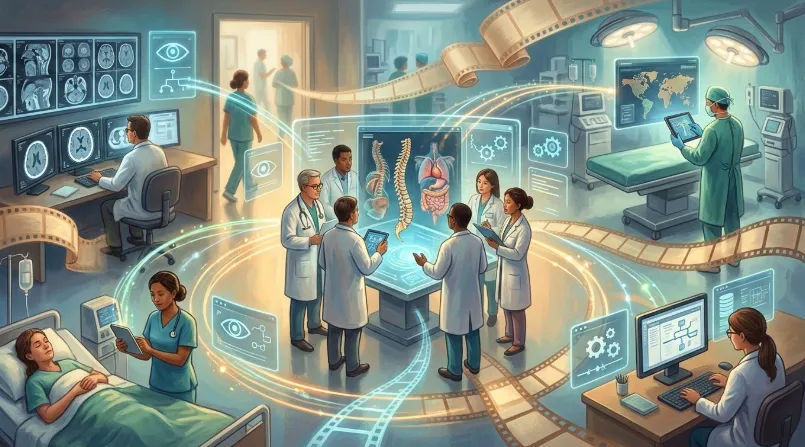
Accelerated eLearning integrates bite-sized digital content, adaptive technologies, and human-centered instructional design to speed up the learning process, without sacrificing depth.
The Mechanics of Acceleration
What makes eLearning “accelerated”? Put simply, it involves three interconnected principles: modular content, personalization, and immediacy. Instead of long lectures or static slide decks, learners are presented with focused microlearning modules — short bursts of content that take just a few minutes to complete and are designed around specific skills or tasks.
These are often embedded in platforms that use AI performance management and learning analytics to track progress and adjust content in real-time. An employee struggling with financial modeling might be offered more foundational videos and interactive exercises, while a more advanced learner could jump ahead to scenario-based simulations. This kind of adaptive learning ensures that no time is wasted — each learner follows their own optimized path.
Bersin calls this trend “learning in the flow of work,” a concept that is quickly gaining traction in modern L&D.
“Companies are finding enormous demand for learning,” he says. “And learning in the flow of work has been accelerated because of the crisis.”
Examples from the Front Lines
The transition from static to accelerated learning is happening across industries.
E.g., IBM has embraced digital learning paths powered by AI. Employees engage with modular training through Watson’s AI engine, which recommends courses based on individual learning histories and performance. According to IBM’s internal data, these microlearning programs have led to a 70% increase in employee engagement in skill-building initiatives, especially when communication is crucial.
Accenture is another illustrative example. The company launched its “Learning Exchange,” an internal platform that gives employees access to over 100,000 digital learning assets, many of which are structured as short, skills-based units. Accenture reported that over 90% of its employees engaged with the platform within the first year of launch.
“Continuous learning is a cornerstone of our talent strategy,” says Ellyn Shook, Accenture’s Chief Leadership & Human Resources Officer. “Our people need to learn new skills constantly, and we have to make that learning accessible, dynamic, and fast.”
Culture and Mindset
Accelerated eLearning is reshaping organizational culture. While traditional training models reinforce hierarchy (knowledge flows from the top down, and learning happens on the company’s terms), accelerated eLearning democratizes knowledge and supports learning as an ongoing process rather than a periodic intervention.
“People don’t just want to be trained. They want to grow,” said Bersin in a recent interview. “The idea that training is something the company does to you is outdated. Learning should be something you own.”
In other words, it’s about the sense of ownership rather than knowledge acquisition. Employees need to feel “empowered” to seek out new skills and be supported in doing so. In this way, they become more engaged, more innovative, and more likely to stay.
According to LinkedIn’s 2023 Workplace Learning Report, 94% of employees said they would stay at a company longer if it invested in their career development.
Future-Proofing at Scale
As hybrid work becomes the norm and business models continue to evolve, the scalability of accelerated eLearning is a game-changer. Basically, it makes no difference whether a business is training 10 people or 10,000. These “digital-first” programs can be rolled out quickly, updated frequently, and customized easily.
The future will likely see more integration of immersive technologies like AR and VR into these platforms. E.g., Walmart has already used VR-based training for scenarios like Black Friday rushes. Meanwhile, mobile-first learning continues to gain ground, allowing frontline workers, field agents, and remote employees to access learning wherever they are.
What’s most exciting is that accelerated eLearning is finally closing the gap between education and execution. Skills are no longer theoretical; they are being practiced and applied in real time. This immediacy builds confidence and helps businesses move faster, navigating change with greater agility. Paired with the services of integrators, this can provide unparalleled results.
Learning as a Strategic Advantage
The organizations that will thrive in the future are not necessarily those with the most capital or the latest tech. It’s likely that these will be the ones with the most adaptable people — people who can learn, unlearn, and relearn faster than the world changes around them.
Accelerated eLearning is supposed to make this possible.
As Josh Bersin puts it, “Learning is the new pension.”






























Sign in to leave a comment.