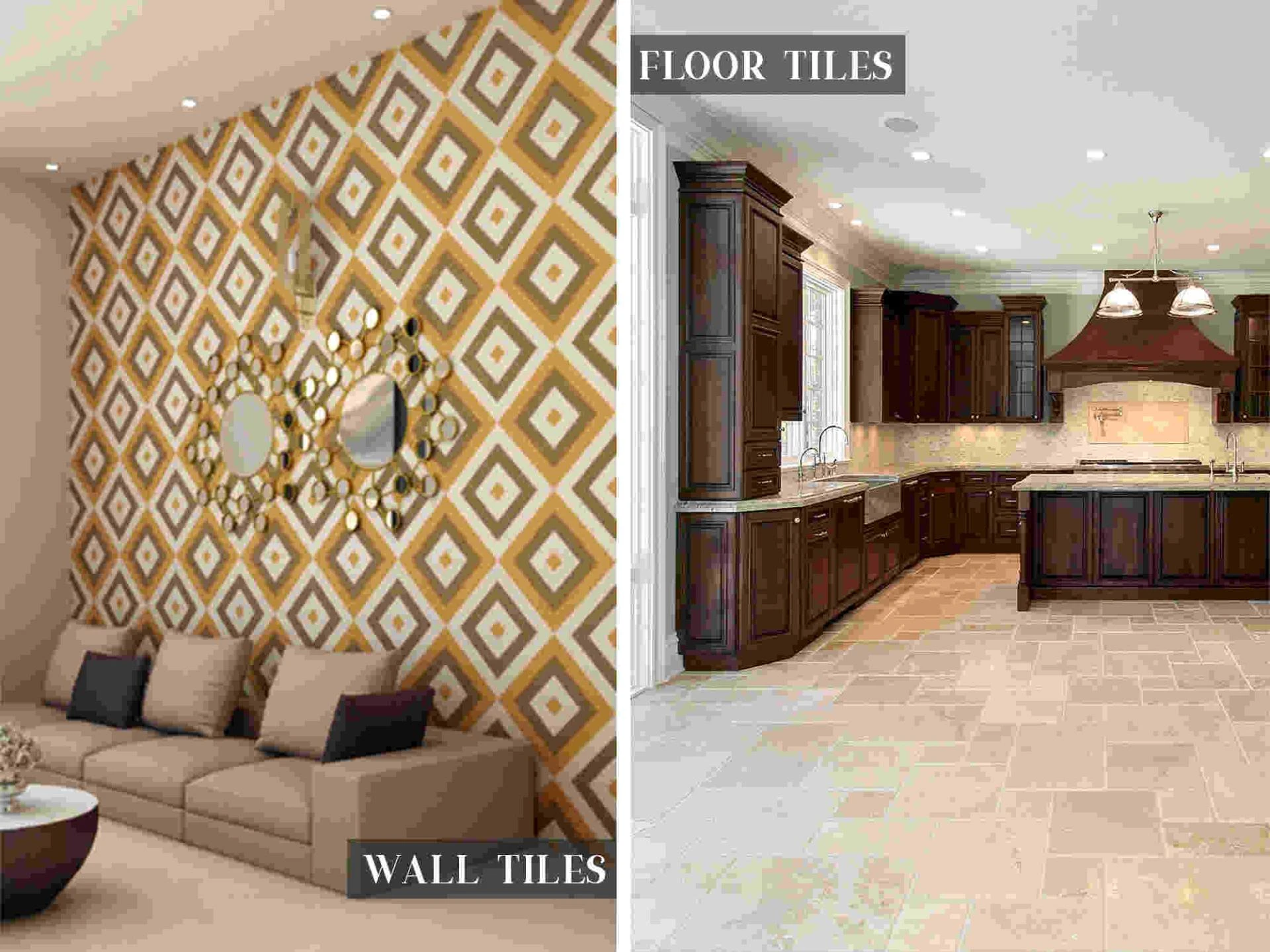

It is often assumed that the only distinction between floor tiles and wall tiles is their size. However, that is not the case as there are a lot of other points of difference. With technological advances, we can now get tile options that are suitable for both floors and walls.
In this blog, we shall look at the key differences between floor tiles and wall tiles!
Floor Tiles VS Wall Tiles: Key Differences
The difference between floor tile and wall tile is obvious, but it doesn’t end there. Earlier the difference was just about the application of these tiles. However, with the withe technologies and trends, there are many more differences to consider. Here are some differences between floor tiles and wall tiles.
Coefficient of Friction (COF) Rating
The Coefficient of Friction (COF) is a friction measurement, with higher numbers indicating more friction. It is an important point to consider while looking for ideal tiles to install for the floors and walls. Every type of tile such as ceramic tiles, vitrified tiles, porcelain tiles and others is given a COF rating.
So, for the floor tiles go for a higher COF rating whereas for the wall tiles, you can select tiles with low ratings. Because friction isn't the most important thing for wall tiles.
PEI (Porcelain Enamel Institute) Rating
The PEI (Porcelain Enamel Institute) grade is the second thing that determines hardness and durability. If they choose to, tile businesses can use the Porcelain Enamel Institute’s (PEI) five classes of PEI ratings. Commercial settings have classifications ranging from Class 1 (no foot traffic) to Class 5 (high foot traffic). PEI ratings are often overlooked in the specifications of each tile and are a fantastic predictor of where a tile might be laid.
Thickness
The thickness of a tile determines its function. Floor tiles are thicker because they are intended to withstand the daily wear and tear and to be load-bearing. In comparison, wall tiles offer a protective purpose, mostly from water seeping through the walls.
So, these tiles do not require any weight-bearing capability. As a result, wall tiles are often thinner. Floor tiles can be installed on the wall but not vice versa.
Appearance
Although there is no noticeable difference in look between wall tiles and floor tiles, it is common for wall tiles to be smaller than floor tiles. Due to its apparent nature and the difficulties of installing it on a vertical surface.
So, wall tiles tend to be smaller and lighter than floor tiles.
The size of consumer-level floor tile can be up to 18 x 18 inches square. Large sizes are widespread due to the popularity of super-large format tiling. The only exception is when the flooring is made up of mosaic sheets, which are tiny tiles attached to mesh backing sheets. Bathroom floors have traditionally been covered in traditional 1-inch hexagonal mosaics.
However, these days you can find wall tiles and floor tiles to your desired size.
Aesthetics
Aesthetics are one of the most important factors to consider while selecting tiles. The design must be selected while keeping in mind the rest of the house’s aesthetic. Floor tiles are available in a wide range of colours and patterns, and they may be cut to fit any pattern. Wall tiles, like floor tiles, come in a variety of designs, and smaller sizes may be used to experiment with mosaics, fine detailing, and so on.
Water and Heat Resistance
Ceramic tiles and porcelain wall tiles are water-resistant in the same way as floor tiles are. In countertop constructions, wall tiles are slightly thinner and may be more susceptible to the heat of hot skillets and pans. Because floor tiles are often thicker than wall tiles, they may provide greater heat resistance when used as countertops. However, this does not apply to wall and floor installations.
For applications where heat resistance is essential, such as kitchen counters, floor tiles have a modest advantage over wall tiles. There isn’t much of a difference in water resistance between floor tiles and wall tiles.
Durability and Maintenance
The same maintenance profile applies to both wall and floor tiles. Simple soap and water are sufficient to clean the tiles. If the grout between the tiles becomes discoloured or cracks, it may need to be redone every few years.
Because wall tiles are thinner than floor tiles, they should not be used on floors to avoid cracking as a result of foot activity. For wall applications, however, they are extremely durable and simple to maintain. Floor tiles are thicker and more durable than wall tiles, making them suited for both wall and floor applications.
Lifespan
A well-built and maintained tile project may last for 75 years or more. You’re more likely to replace tile because you dislike the way it looks rather than because it’s worn out. However, if a wall tile is used in a floor application by mistake, it may crack easily.
Theoretically, floor tiles will survive longer than wall tiles since they are heavier, tougher materials. However, both materials are likely to last a lifetime in practice. Both wall tiles and floor tiles are equally durable when utilised for their intended functions.
To Sum It Up
If you are on the lookout for either floor tiles or wall tiles, consider the above-discussed points. The major points of difference will help you identify the right tiles for your space. Also don't forget to consider the variety of tiles such as ceramic tiles, vitrified tiles, porcelain tiles and others. Because different materials offer unique benefits.
Be it floor tiles or wall tiles, make sure to only purchase from a reputable brand for the best quality. AGL Tiles is a leading tiles brand in India with a diverse collection of floor tiles and wall tiles. Explore the collection to discover the ideal fit for your desired space























Sign in to leave a comment.