
How to sell on India's biggest platforms — with just ₹1 Lakh, a precise system, and zero shortcuts.
There is a persistent, expensive misconception that launching a successful e-commerce brand in India requires ₹25–30 Lakhs. In the Old World of 2015, this was true — you needed warehouses, custom tech stacks, and massive inventory to even show up.
In 2026, that myth is dead.
Platforms like Blinkit, Amazon, Meesho, and Flipkart have absorbed the heaviest infrastructure costs — technology, payment gateways, logistics, and customer trust — on your behalf. Your job is to master four pillars: Product Selection, Sourcing, Listing Quality, and Customer Service.
You can now launch a thriving brand with just ₹1 Lakh. But access does not equal success. 95% of people will watch this opportunity pass. 4% will fail through scattered effort. Only the top 1% who follow a precise strategic roadmap will turn ₹1 Lakh into ₹4–6 Lakhs by July 2026.
This is that roadmap.
The Complete ₹1 Lakh Budget Breakdown (2026)
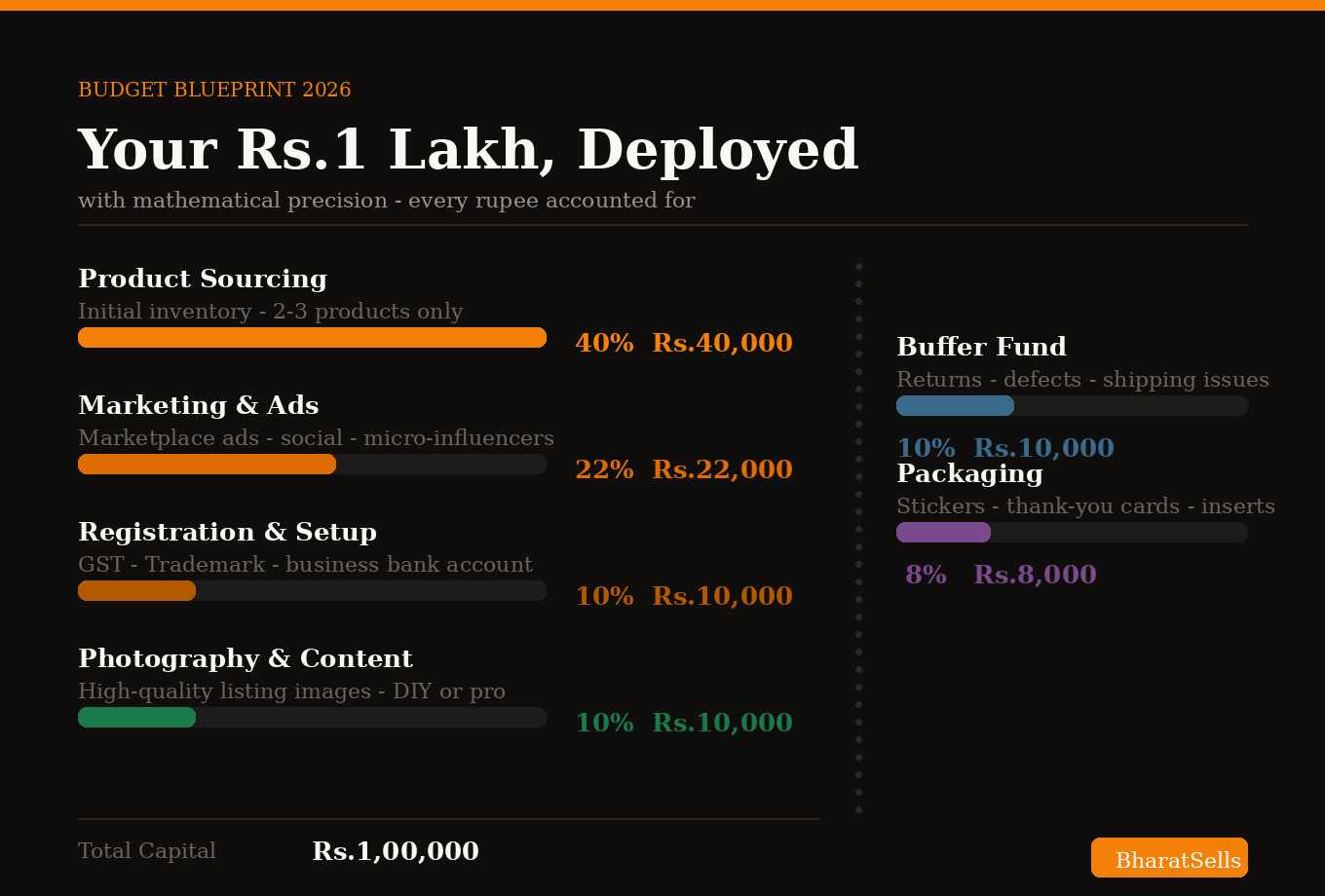
Before you buy a single product or create a single listing, you need to deploy your capital with 100% mathematical transparency. Here is the non-negotiable split:
| Category | Allocation | Amount |
|---|---|---|
| Product Sourcing (2–3 products) | 40% | ₹40,000 |
| Marketing & Ads | 22% | ₹22,000 |
| GST, Trademark & Setup | 10% | ₹10,000 |
| Photography & Content | 10% | ₹10,000 |
| Buffer & Emergency Fund | 10% | ₹10,000 |
| Packaging & Branding | 8% | ₹8,000 |
The single biggest mistake beginners make is spreading ₹40,000 across 10–15 different products, thinking this "reduces risk." It doesn't. It creates inventory thinning — you lack the sales velocity on any single SKU to accumulate the 20–30 reviews that the algorithm requires to rank you in search.
The correct move: concentrate your entire ₹40,000 on 2–3 products only, spending ₹12,000–₹15,000 per product. Focus beats diversification at this stage, every time.
"A ₹1 Lakh budget is not just enough — it is actually your greatest advantage. It forces you to master the right systems rather than throwing money at the wrong problems."
The Four Golden Rules of Product Selection
Every product you consider must pass all four of these filters. Failing even one can strand your capital or wipe your margins.
Rule 1 — 40% Minimum Gross Margin If your landed cost (product + shipping from supplier) is ₹300, your selling price must be at least ₹500. This leaves a 10–20% net profit buffer after marketplace fees.
Rule 2 — Under 500g Weight This is non-negotiable. Keeping your product under 500g limits your per-order shipping cost to ₹35–₹60. Go heavier and your margins collapse at scale.
Rule 3 — Low-Return Categories Avoid Fashion, Footwear, and Electronics — these categories carry 25–40% return rates that will bleed you dry. Focus instead on Home & Kitchen, Beauty, Pet Supplies, or Stationery, where returns typically stay below 10%.
Rule 4 — High Repeat Purchase Value Supplements, skincare, cleaning products, and consumables are repeat-purchase items. One customer may buy 6+ times per year. Your Customer Acquisition Cost (CAC) is recovered quickly and LTV compounds.
How to Source Your Products
Step 1: Research on IndiaMart Contact a minimum of 10 suppliers per product. Request samples from at least 3. Evaluate quality, MOQ (Minimum Order Quantity), white-label options, and turnaround time.
Step 2: Visit Local Wholesale Hubs for Your First Batch For 20–50 unit test batches, going in person is smarter than shipping. Key hubs:
- Sadar Bazaar, Delhi — home décor, kitchenware, gifts
- Chickpet, Bengaluru — textiles, fabrics
- Crawford Market, Mumbai — novelty, gift, stationery
You save on inbound shipping, verify quality with your own eyes, and build supplier relationships faster.
Step 3: Negotiate White-Label Options Ask every supplier whether they offer OEM or white-label services — putting your brand name on their product. This is the fastest path to a proprietary brand without setting up manufacturing.
The Strategic Platform Ladder: Where to Start and When to Expand
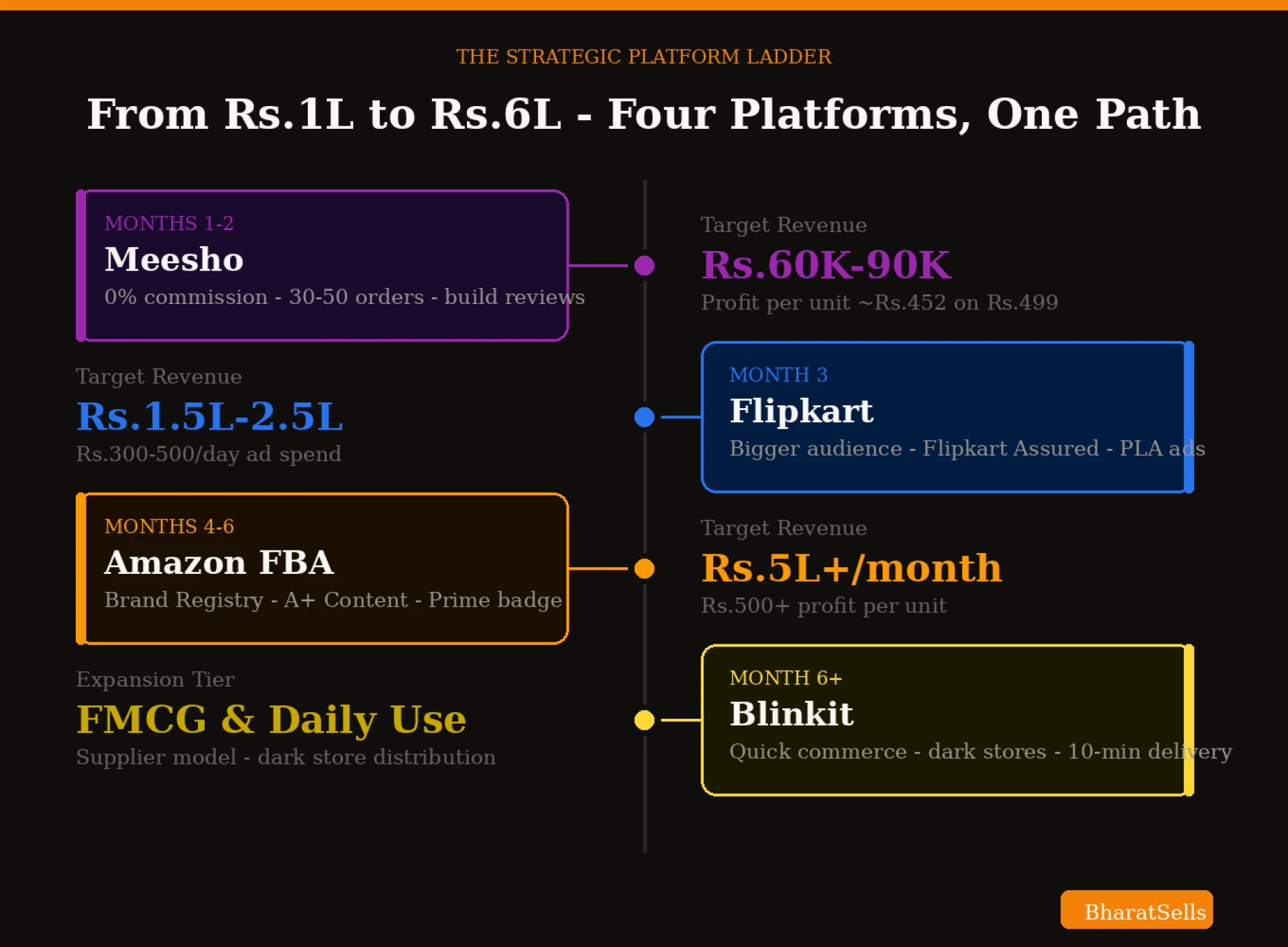
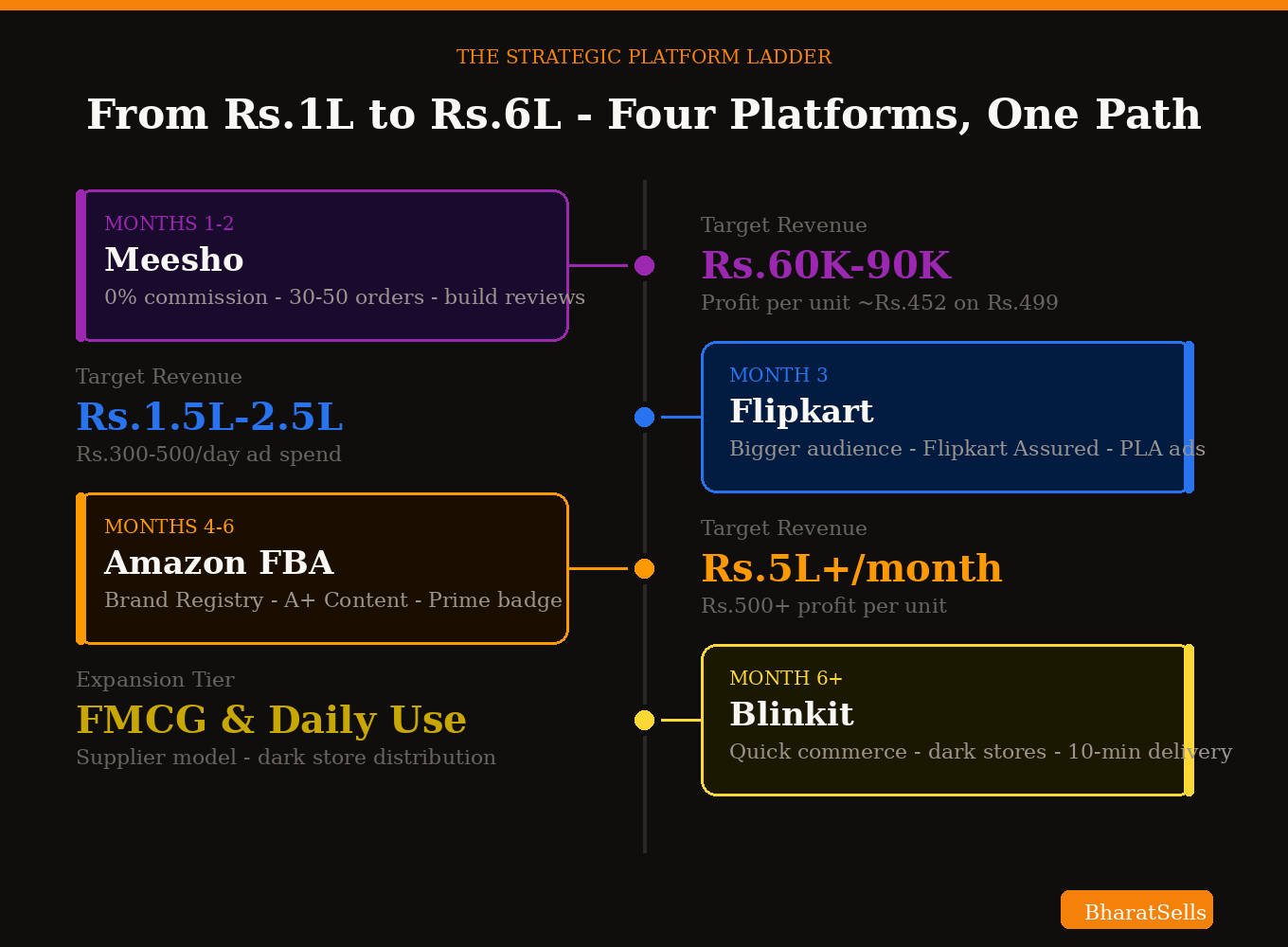
Success in 2026 requires a phased approach. You don't launch on all platforms simultaneously — you follow a ladder.
Phase 1 — Months 1–2: Meesho (Testing & Experience)
Counter-intuitively, Meesho — not Amazon — is where you begin. Here's the hard financial logic:
Meesho charges 0% seller commission. On a ₹499 product, your payout is approximately ₹452. No major Indian platform comes close to this margin structure.
Additional advantages for new sellers:
- Meesho's algorithm actively promotes new listings
- Onboarding takes under 24 hours
- Their 15M+ reseller network gives your product organic distribution
Meesho's market reality: It is a volume play in the ₹249–₹599 price range. Expect a return rate of 12–15% and set your margins to absorb it. If returns exceed 20%, your product description has accuracy problems.
How to register and sell on Meesho:
- Go to supplier.meesho.com → Click "Start Selling"
- Enter your mobile number and GSTIN (mandatory — register for GST first if you haven't)
- Upload your catalogue using the bulk Excel template or the mobile app — you need 4–8 images per product (minimum 1000×1000px, white background), category, price, and GST rate
- Accept orders within 24 hours via the Supplier Panel. Meesho's logistics partner handles pickup — no self-shipping required
- Apply a 10–15% launch discount in your first two weeks to trigger the "New Arrival" badge and boost search placement
Your Month 1–2 target: 30–50 orders, ₹60,000–₹90,000 in gross revenue, and 20–30 reviews on your winner SKU.
Phase 2 — Month 3: Flipkart (Scaling)
With a validated product, reviews, and cash flow, you add Flipkart — India's second-largest platform with 400M+ registered users.
How to register and sell on Flipkart:
- Visit seller.flipkart.com → Sign up with mobile/email
- Provide GSTIN, PAN, bank account details, and business address. Verification takes 2–5 business days
- Build listings with Flipkart's Listing Quality Score (LQS) framework — high-score listings get preferential search placement. Include all attributes, 7+ images, bullet-point features, and a full description
- Enrol in Flipkart's fulfilment programme to earn the "Flipkart Assured" badge. This increases conversions by up to 30%
- Run Product Listing Ads (PLA) at ₹300–₹500/day. Target keywords your product already organically ranks for on Meesho
Key awareness: Unlike Meesho, Flipkart charges 5–20% commission depending on category. Factor this into your pricing before you list. A ₹500 Home & Kitchen product costs you ~₹50–₹60 in commission.
Pro tip: Begin planning your inventory 6–8 weeks before Big Billion Days (October) and The Big Shopping Days (January). These events can generate 10–15x your normal daily sales volume.
Phase 3 — Months 4–6: Amazon India (The Premium Tier)
By Month 4, you have 100+ reviews, a validated winner SKU, and real cash flow. Now you're ready for Amazon — higher competition, higher investment, but the highest profit per unit and the most powerful seller tools in the market.
How to register and sell on Amazon India:
- Go to sellercentral.amazon.in → Register with your email
- Provide GSTIN, PAN, bank account, and store name. Verification takes 3–7 business days
- Choose your plan: ₹999/month (Professional) for high-volume sellers, or ₹0 + ₹20/sale (Individual) to start lean
- Optimise your listing for the A9 algorithm — keyword density in your title, bullet points, and backend search terms matters enormously. Use tools like SellerApp or Helium 10 to find high-volume, low-competition keywords
- Enrol in FBA (Fulfillment by Amazon) — send stock to Amazon's fulfilment centres and they handle storage, packing, shipping, and returns. FBA products earn the Prime badge, which dramatically increases conversion and buy-box eligibility
- Apply for Amazon Brand Registry (requires a trademark — apply at ipindia.gov.in, costs ₹4,500–₹9,000). Brand Registry unlocks A+ Content, Sponsored Brands ads, a Brand Store, and protection against counterfeits
- Create A+ Content to replace the standard product description with rich visual modules and comparison charts — this lifts conversion rates by 5–10%
- Run Sponsored Product Ads: start with Automatic campaigns at ₹200–₹300/day for two weeks to identify converting keywords, then switch to Manual campaigns targeting those keywords at ₹300–₹500/day
Amazon vs Meesho profit reality: On a ₹499 product, Meesho pays ~₹452. Amazon FBA pays ~₹330–₹360 after referral fees (8–15%) and FBA fees (₹40–₹80). The lower per-unit margin is offset by Amazon's dramatically higher traffic volume and the higher lifetime value of its customers.
How to Sell on Blinkit: India's Quick Commerce Giant
Blinkit — formerly Grofers, now owned by Zomato — is India's fastest-growing quick-commerce platform, promising 10-minute delivery to millions of urban Indians. For the right products, it is a massive and still underutilised opportunity.
What is Blinkit's model? Blinkit operates dark stores — hyper-local micro-warehouses stocked for ultra-fast last-mile delivery. Unlike traditional e-commerce, you don't ship to individual customers. Blinkit stocks your products in their regional dark stores and handles all delivery. This means you need a brand/supplier partnership approach, not a typical marketplace listing.
Important: Blinkit is NOT a self-serve marketplace like Amazon or Meesho. You must apply as a brand or supplier. This makes it best suited for sellers who have already validated their product on Meesho or Amazon and want to expand into quick commerce in Months 4–6.
How to become a Blinkit supplier — step by step:
Step 1: Supplier Registration Visit supplier.blinkit.com and complete the onboarding form. You will need: GSTIN, FSSAI licence (mandatory for food/grocery/personal care products), PAN, and bank details.
Step 2: Product Eligibility Blinkit's core categories are FMCG, grocery, dairy, snacks, beverages, personal care, baby care, and pet supplies. Your product must have a barcode (EAN or UPC), proper MRP labelling compliant with the Legal Metrology Act, and accurate packaging.
Step 3: Trade Price Negotiation Blinkit primarily works on a buy-and-sell model — they purchase your product at a trade price and sell it at MRP. Expect to offer 20–35% trade margins. Your MRP must be competitive with offline retail in that city.
Step 4: Stock the Dark Stores Once onboarded, you supply stock to Blinkit's regional distribution centres. They manage all last-mile delivery. Your responsibility is consistent supply and correct packaging.
Step 5: In-App Promotions Like Amazon Ads, Blinkit offers paid banner placements and featured listing spots. Budget ₹5,000–₹15,000/month in your first three months to build order velocity in the algorithm.
Categories to avoid on Blinkit: Electronics, apparel, footwear, and large furniture are not Blinkit's core use case. Focus on repeat-purchase daily-use products — snacks, personal care, cleaning supplies, or pet food — for maximum success.
Platform Comparison: Which Is Right for You?
| Platform | Best For | Commission | When to Start |
|---|---|---|---|
| Blinkit | FMCG, daily-use, consumables | 20–35% trade margin | Month 4–6 |
| Meesho | Home, gifts, general merchandise ₹249–₹599 | 0% | Month 1 — start here |
| 🔵Flipkart | Mid-range products, electronics accessories | 5–20% | Month 3 |
| Amazon | Premium branding, high-margin SKUs | 8–15% + FBA fees | Month 4 |
The Invisible Product Trap: Your 22% Marketing Mandate
"Build it and they will come" is the most expensive philosophy in e-commerce. If no one sees your listing, your inventory is just expensive clutter. You must buy your initial visibility.
Your ₹22,000 marketing budget breaks down as:
- ₹15,000 — Marketplace Ads: Direct spend on Meesho Ads, Flipkart PLA, and Amazon Sponsored Products to jump to the top of search results from day one
- ₹5,000 — Social Media: Instagram Reels and Facebook product videos to build brand awareness outside the marketplace ecosystem
- ₹2,000 — Micro-Influencer Collaborations: Send your product to 5–10 niche creators with 5K–50K followers. Their authentic content generates social proof faster than any paid ad
Your sole goal in Month 1 is not revenue. It is 20–30 reviews on your winner SKU. Reviews are the algorithm's trust signal. Everything else flows from them.
The 90-Day Execution Timeline
Week 1 — Foundation Finalise your 2–3 products. Contact 10+ suppliers on IndiaMart. Register for GST (3–7 working days). Apply for trademark. Open a dedicated business current account. Place your first inventory order of ₹30,000–₹40,000.
Weeks 3–4 — Preparation Conduct product photography (DIY or professional). Create your Meesho Supplier account. Write keyword-optimised listings. Set up packaging with brand stickers and thank-you card inserts. Connect with 5 micro-influencers for launch send-outs.
Month 2 — Launch Go live on Meesho with a 10% launch discount. Run ₹100–₹200/day in Meesho Ads. Focus entirely on accumulating 20–30 reviews. Identify your winner SKU and reorder immediately. Target: 30–50 orders, ₹60,000–₹90,000 in revenue.
Month 3 — Scaling Register on Flipkart Seller Hub. List your winner SKU. Apply for Flipkart Assured. Deploy ₹300–₹500/day in ads across both platforms. Target: 100–150 total orders, ₹1.5–₹2.5 Lakh in revenue, ₹50,000–₹1,00,000 in pure profit.
Months 4–6 — Premium Tier Register on Amazon Seller Central. Apply for Brand Registry. Send stock to FBA. Create A+ Content. Activate Sponsored Brands campaigns. Explore Blinkit onboarding if your product fits quick commerce. Goal: ₹5 Lakh+ monthly revenue.
The 75% Reinvestment Rule
This is the rule that separates the 1% who scale from the 4% who plateau.
For the first six months, 75% of every rupee of profit must be funnelled back into inventory and ads.
This is the compounding flywheel. More inventory means more listings. More ads means more reviews. More reviews means higher organic rank. Higher rank means more sales without ad spend. Spending profits on lifestyle before Month 6 is the single most common reason sellers stall at ₹50,000/month and never break through.
By Month 6, 30% of your competitors will have quit. 20% will have plateaued. Only the 10% who maintain consistency and reinvestment will reach ₹5 Lakh+ in monthly revenue.
The Bottom Line
In July 2026, will you be part of the 95% who watched this opportunity pass — or the 1% who turned ₹1 Lakh into a thriving brand?
The platforms are ready. Blinkit is scaling. Amazon FBA is accessible. Meesho's 0% commission model is unprecedented. Flipkart's sale events drive more traffic than ever.
The systems are laid out. The roadmap is in your hands.
The clock starts in January. Action takers win.
Keywords: how to sell on Blinkit, Blinkit supplier registration, sell on Amazon India, Amazon FBA India, Meesho seller registration, Flipkart seller hub, quick commerce India, ecommerce India 2026, D2C brand India, online selling India, IndiaMart sourcing, Meesho 0% commission, how to start ecommerce with 1 lakh




























Sign in to leave a comment.