PVC has been “on the way out” for more than twenty years.
Every few years, a new material is presented as the beginning of the end for PVC in large format printing. Environmental pressure increases. Regulations tighten. Corporate sustainability policies grow more specific. And yet, PVC banners, wraps, and large format graphics remain embedded in the UK print landscape.
This is not because the industry is unaware of alternatives. It is because replacing PVC is not a design problem or a branding decision. It is a materials engineering problem — and a logistical one.
The question is not whether PVC will be challenged. It already is. The question is whether anything currently exists that can replace it at scale, in real-world conditions, without creating new failures elsewhere.
Why PVC Became Dominant in Large Format Printing
PVC did not become the default material by accident.
Its dominance is rooted in a combination of characteristics that are difficult to replicate together: flexibility, tensile strength, print receptivity, weather resistance, and cost predictability. Crucially, PVC performs consistently across a wide range of applications, from short-term indoor banners to long-term outdoor signage.
In the UK climate, this matters. Persistent moisture, variable wind load, moderate but continuous UV exposure, and repeated handling place specific demands on substrates. PVC tolerates these conditions better than most alternatives currently available.
This performance baseline is what any replacement must meet before environmental arguments even enter the discussion.
The Pressure Driving Material Innovation
The push to replace PVC does not come from a single source.
Regulatory and Procurement Pressure
Public sector procurement frameworks increasingly require environmental disclosure. Large organisations now ask detailed questions about recyclability, lifecycle impact, and waste handling. PVC’s reputation, fair or not, makes it an easy target.
Brand and Reputational Concerns
Many organisations want visible sustainability credentials. Large format graphics are public-facing and therefore symbolic. Choosing alternative materials is often driven by perception as much as data.
Waste and End-of-Life Realities
PVC banners have historically been difficult to recycle through standard waste streams. Although this is changing, legacy assumptions persist.
These pressures are real. But pressure alone does not create viable substitutes.
Current Alternatives and Their Limitations
Several material categories are frequently positioned as PVC replacements. None are straightforward.
Polyester-Based Fabrics
Polyester textiles are widely used for soft signage and tension systems. They are lightweight, visually appealing, and often recyclable.
However, for large format outdoor banners, they introduce challenges. Fabric stretches under load. Edges deform. Wind movement increases stress on fixings. In exposed locations, lifespan shortens dramatically.
They work well indoors and in controlled environments. They struggle where PVC excels.
PVC-Free Mesh Materials
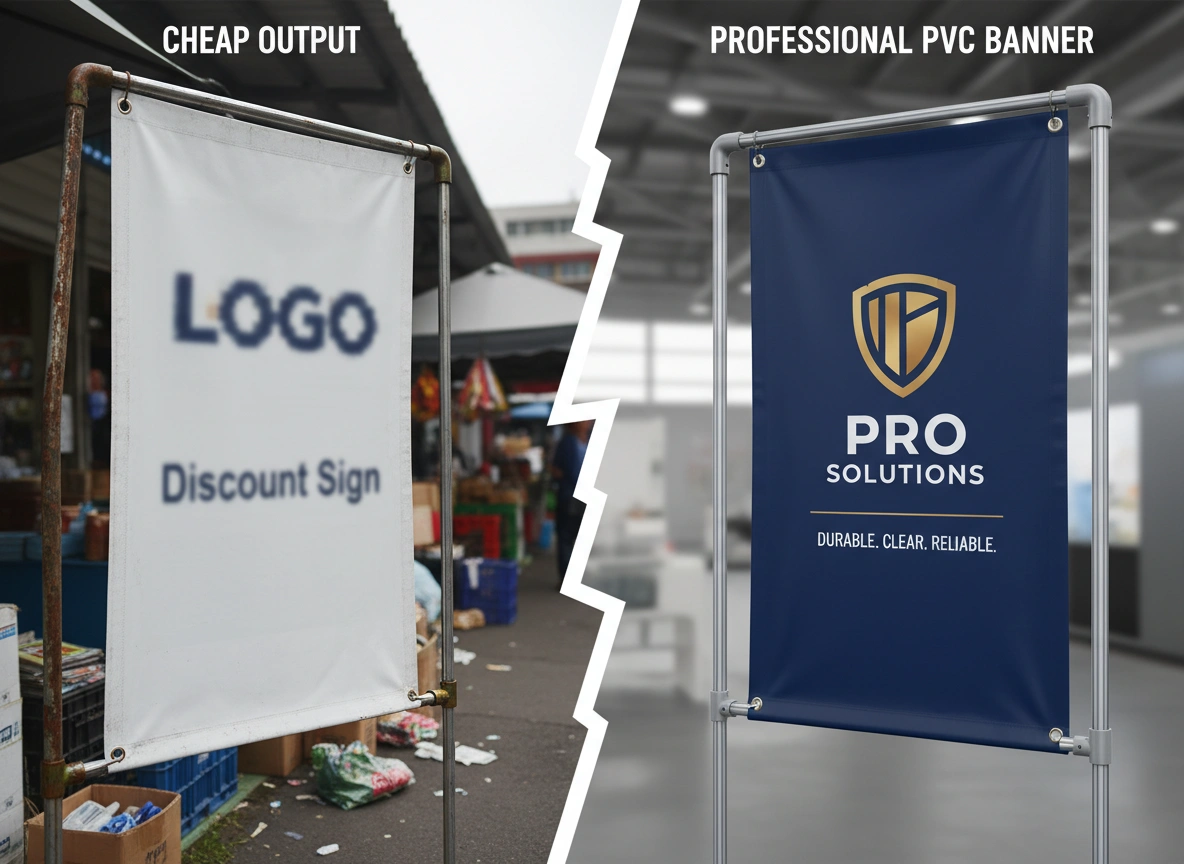
PVC-free mesh banners have improved significantly over the last decade. They address airflow requirements and reduce material weight.
The limitation remains durability. Under sustained wind exposure, many PVC-free meshes fatigue more quickly. Tear resistance and edge strength are still inconsistent compared to traditional PVC mesh.
For short-term use, they are viable. For long-term deployment, they remain a compromise.
Paper-Based and Composite Boards
Card-based and fibre composites appear regularly in sustainability discussions. They offer recyclability and low environmental impact on paper.
They also absorb moisture, warp, and fail rapidly outdoors. Protective coatings extend life but introduce new material layers that complicate recycling.
These materials solve indoor display problems. They do not replace PVC banners.
Recyclable PVC: The Quiet Shift Already Underway
One of the least discussed developments in large format printing is the evolution of PVC itself.
Modern PVC banner substrates are no longer the same materials used twenty years ago. Manufacturing processes now generate less waste. Many suppliers offer PVC that can be recovered and recycled through specialist schemes.
This does not make PVC biodegradable. It does change its lifecycle profile significantly.
For many organisations, recyclable PVC represents a pragmatic middle ground: proven performance with improved end-of-life handling. This is why PVC has not disappeared — it has adapted.
The Myth of the Perfect Replacement
Much of the conversation around replacing PVC assumes a single breakthrough material waiting to emerge.
That assumption is flawed.
Large format printing serves too many use cases for a universal replacement. Indoor exhibition graphics, outdoor scaffolding banners, retail promotions, and regulatory signage all place different demands on materials.
Any future solution is likely to be fragmented rather than singular. Multiple materials, each optimised for specific conditions, will gradually reduce PVC usage — not eliminate it.
Performance vs Sustainability: The Trade-Off That Won’t Go Away
Every alternative material involves compromise.
Reducing environmental impact often reduces durability. Improving recyclability can weaken structural integrity. Lightweight materials behave differently under wind load. Natural fibres react unpredictably to moisture.
The industry’s challenge is not choosing sustainability over performance. It is choosing which failure mode is acceptable.
In many outdoor applications, early failure carries safety, compliance, and cost consequences that outweigh environmental gains.
This reality keeps PVC relevant.
Innovation Where It Actually Matters
The most meaningful advances are not headline-grabbing materials announcements. They are incremental improvements.
- Thinner PVC substrates with maintained strength
- Improved recycling infrastructure and take-back schemes
- Hybrid materials that reduce PVC content without sacrificing performance
- Better specification practices to avoid over-engineering
These changes reduce overall material impact without forcing unreliable substitutions.
What the Next Ten Years Are Likely to Bring
PVC is unlikely to be “replaced” in the near future. It is more likely to be outcompeted in specific niches.
Indoor graphics will continue moving toward textiles and paper composites. Short-term outdoor signage will see increased experimentation with PVC-free options. Long-term, high-exposure applications will retain PVC until alternatives demonstrate equivalent performance under real conditions.
Material innovation will continue, but adoption will remain cautious — driven by failure data, not marketing claims.
Why Real-World Testing Matters More Than Claims
Many alternative materials perform well in laboratory conditions. Fewer perform well after six months on a UK roadside fence.
Print professionals increasingly rely on empirical performance rather than manufacturer claims. This slows adoption, but it prevents costly mistakes.
Materials do not fail on spec sheets. They fail in wind, rain, and handling.
Final Perspective
The question “what will replace PVC?” assumes that replacement is inevitable and imminent.
In reality, PVC persists because it solves problems reliably. Until alternative materials can do the same, at scale, in uncontrolled environments, PVC will remain part of large format printing.
The future is not PVC versus sustainability. It is smarter specification, improved recycling, and honest assessment of material behaviour.
PVC may eventually be displaced. But it will not be pushed aside by aspiration alone.
It will be replaced only when something else proves consistently, quietly, and without excuses that it works better where it matters most.
If you want more information visit I you Print


Sign in to leave a comment.