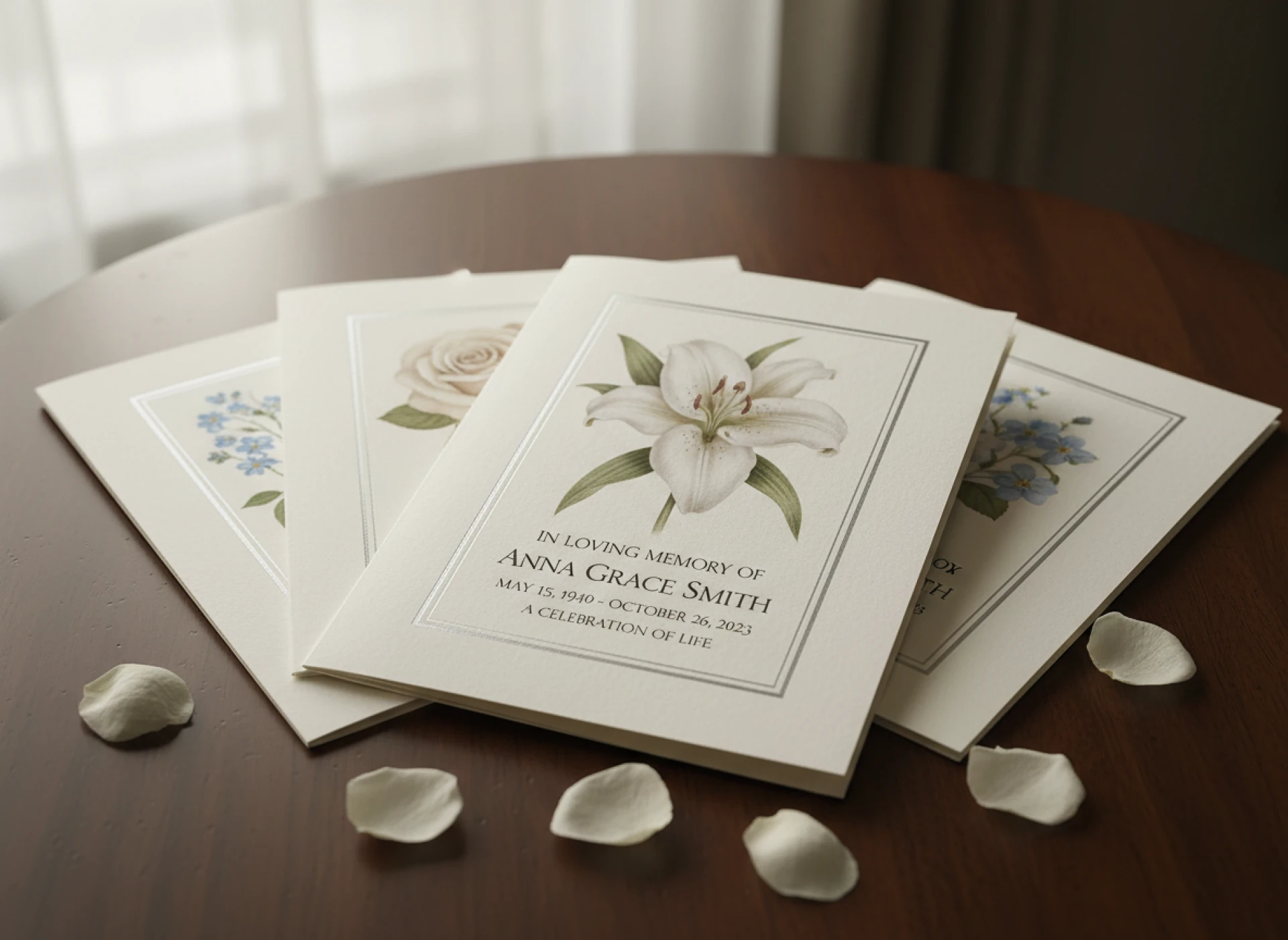

Families rarely begin funeral planning by discussing booklets.
The first conversations are practical. Someone contacts a funeral director. A date begins to take shape depending on venue availability. Relatives are informed. Travel plans are quietly considered.
At this stage the service still feels abstract. People talk about what might happen rather than what will.
The order of service booklet does not enter the conversation immediately. It emerges later, once the ceremony itself begins to settle.
Professionals involved in funerals recognise this moment quickly. The booklet only becomes relevant once the service has a shape worth describing.
Structure forms long before design begins
Before any template is opened or any page is laid out, families begin assembling the ceremony itself.
Who will speak.
Which music should open the service.
Whether a poem feels appropriate.
If a moment of reflection should sit between readings.
These discussions rarely happen in one meeting. They unfold gradually through conversations across several days.
Only when those decisions begin to stabilise does the need for a printed programme become obvious. Guests will need to understand the order of events without constant explanation.
The booklet becomes the quiet organiser of the ceremony.
Design still waits.
Templates usually enter the process once the service stops moving
Templates exist for a practical reason: funerals rarely allow unlimited planning time.
Families often find themselves preparing a booklet within days rather than weeks. A ready structure removes unnecessary decisions. Page layouts already exist. Text areas are predictable. Photographs have a place to sit.
Templates therefore solve a timing problem rather than a creative one.
They allow families to focus on the content that matters — names, readings, memories — while the structure of the booklet remains dependable.
Experienced printers recognise this pattern immediately. When a template is used well, the content feels settled. When it is used too early, the structure keeps shifting because the ceremony itself has not yet stabilised.
The real preparation happens in the wording
People often assume the difficult part of a funeral booklet is the design. In reality, design is rarely where families hesitate.
Wording takes longer.
Names must be correct. Relationships are considered carefully. Dates are checked repeatedly. Tributes are drafted and quietly rewritten.
Small decisions feel unusually important because they carry permanence. Once printed, the words will exist beyond the ceremony itself.
Professionals familiar with funeral preparation expect this stage to slow naturally. Families pause longer over a single sentence than they did when booking the venue.
It is not inefficiency. It is attention.
Photographs change how preparation feels
The moment photographs are introduced, the atmosphere around preparation shifts.
Planning stops feeling procedural and becomes reflective. Images trigger conversations that had not happened earlier. People remember moments differently. New photographs appear from relatives who had not initially planned to contribute.
Progress slows slightly here.
Designers and printers recognise this stage as part of the process rather than a delay. Images change how families see the service they are preparing.
The booklet stops being an order of events and begins to resemble a memory.
Design follows confidence rather than creativity
Contrary to expectation, most funeral booklets are not designed to stand out.
Families usually move toward calm, familiar layouts once the content settles. Readability matters more than visual experimentation. The pages should guide people quietly rather than demand attention.
This is why many funeral booklets share a similar tone. They are not trying to impress anyone.
They are trying to hold the room together.
Design becomes successful when guests barely notice it working.
Preparation tends to concentrate in the final week
Funeral planning moves in stages. Early days are filled with logistics and conversations. Later days focus on confirmation.
Booklet preparation almost always sits in this later stage.
By the time families begin assembling the order of service, several other decisions have already settled. The funeral date is known. The ceremony structure has stabilised. Those speaking in the service understand their role.
Only then can the booklet be prepared without constant revision.
The timing often surprises families. Something that appeared minor at the beginning of planning becomes one of the final pieces bringing everything together.
Printing introduces the first true deadline
Until the booklet reaches the production stage, most planning decisions remain flexible.
Printing changes that.
Once pages are approved, the service is effectively finalised. Names, readings, and running order cannot continue changing. The ceremony becomes fixed in a way earlier planning stages did not require.
Professionals notice how quickly families reach agreement once printing enters the conversation. Decisions that felt uncertain suddenly resolve.
The booklet does not only document the service.
It confirms it.
What the finished booklet usually contains
Despite variations in style, most funeral booklets quietly include the same core elements.
| Element | Purpose |
| Service order | Helps guests follow the ceremony |
| Names and roles | Acknowledges those participating |
| Readings or hymns | Allows the room to join together |
| Tribute wording | Shares personal memory |
| Photographs | Humanises the service |
| Venue and date | Records the occasion |
These components do not arrive simultaneously during preparation. The booklet simply gathers them into a single place once they have settled.
Why families remember this stage clearly
Among all funeral arrangements, booklet preparation often becomes the most memorable part afterwards.
It is the moment when planning turns into something visible. Families see the ceremony laid out for the first time. The sequence makes sense. The names feel right. The service begins to feel real.
The booklet becomes a quiet confirmation that the planning period is reaching completion.
Final perspective
Funeral order of service booklets rarely begin as design projects. They emerge gradually as the ceremony itself takes shape first through conversations about readings and music, then through the careful gathering of names, photographs and tribute wording. Only once these elements settle does the booklet move into its final form. At that stage it stops being simply a programme and becomes a lasting record of the service, a role often supported by experienced print partners such as I YOU Print, who become involved when funeral arrangements are ready to be brought together in print.























Sign in to leave a comment.