

Why Cheap Magazine Printing Rarely Saves Money Over Time
The savings usually look real at the start
Why cheap printing feels sensible in the moment
Most decisions to go cheap are not careless. They’re practical.
Budgets are tight. Timelines are short. The publication feels uncertain. Someone suggests a lower quote and it feels responsible to take it. On paper, the numbers work. Fewer pounds spent now means more flexibility elsewhere.
At that stage, nothing looks compromised. Proofs look fine. PDFs look identical. The magazine exists only as a plan.
Cheap printing rarely announces itself as a problem at this point. It waits.
Where the assumption quietly goes wrong
The assumption behind cheap magazine printing is that quality is mostly visual. If it looks acceptable on delivery, the job is done.
But magazines are not static objects. They are handled, moved, stacked, posted, and revisited. Cost decisions made at the print stage continue to operate long after the invoice is paid.
That’s where the real expense begins.
How material shortcuts show up later
Paper savings and accelerated wear
Lower-cost paper often behaves acceptably at first. It takes ink. It trims cleanly. It stacks neatly.
Then it starts to age.
Corners soften quickly. Pages crease under light pressure. Covers curl once humidity changes. Scuffs appear after only a few days of handling.
In isolation, none of these feel catastrophic. Together, they change perception.
A magazine that looks tired early is handled less. It’s skimmed instead of read. It’s discarded sooner.
That shortened lifespan is a cost, even if it never appears on a spreadsheet.
Ink and coating compromises
Cheap printing often involves thinner ink coverage or reduced coating quality.
This can lead to rub-off, dull colours, or inconsistent blacks — especially noticeable once magazines are stacked or transported.
Readers don’t usually complain about this. They simply trust the publication less. It feels less deliberate. Less cared for.
That erosion of trust is subtle, but it accumulates with every compromised copy.
Binding is where cheap decisions become obvious
When bindings fail under normal use
Binding is one of the first areas where low-cost printing reveals itself.
Saddle stitching with insufficient paper strength begins to bow. Staples loosen. Pages misalign.
Perfect binding done cheaply resists opening or cracks early. Pages pull toward the spine. Content disappears into the gutter.
These issues don’t require abuse. Normal reading is enough.
Once binding becomes uncomfortable, reading sessions shorten. Engagement drops. The magazine stops being revisited.
Repairs are not realistic
Unlike digital products, printed magazines cannot be fixed once they’re out.
You can’t reinforce spines. You can’t re-laminate covers. You can’t replace weak paper.
Every compromised copy remains compromised.
Cheap printing doesn’t fail gradually. It locks its problems in place.
Distribution amplifies every weakness
Handling exposes what production hides
Distribution is where cheap printing is fully exposed.
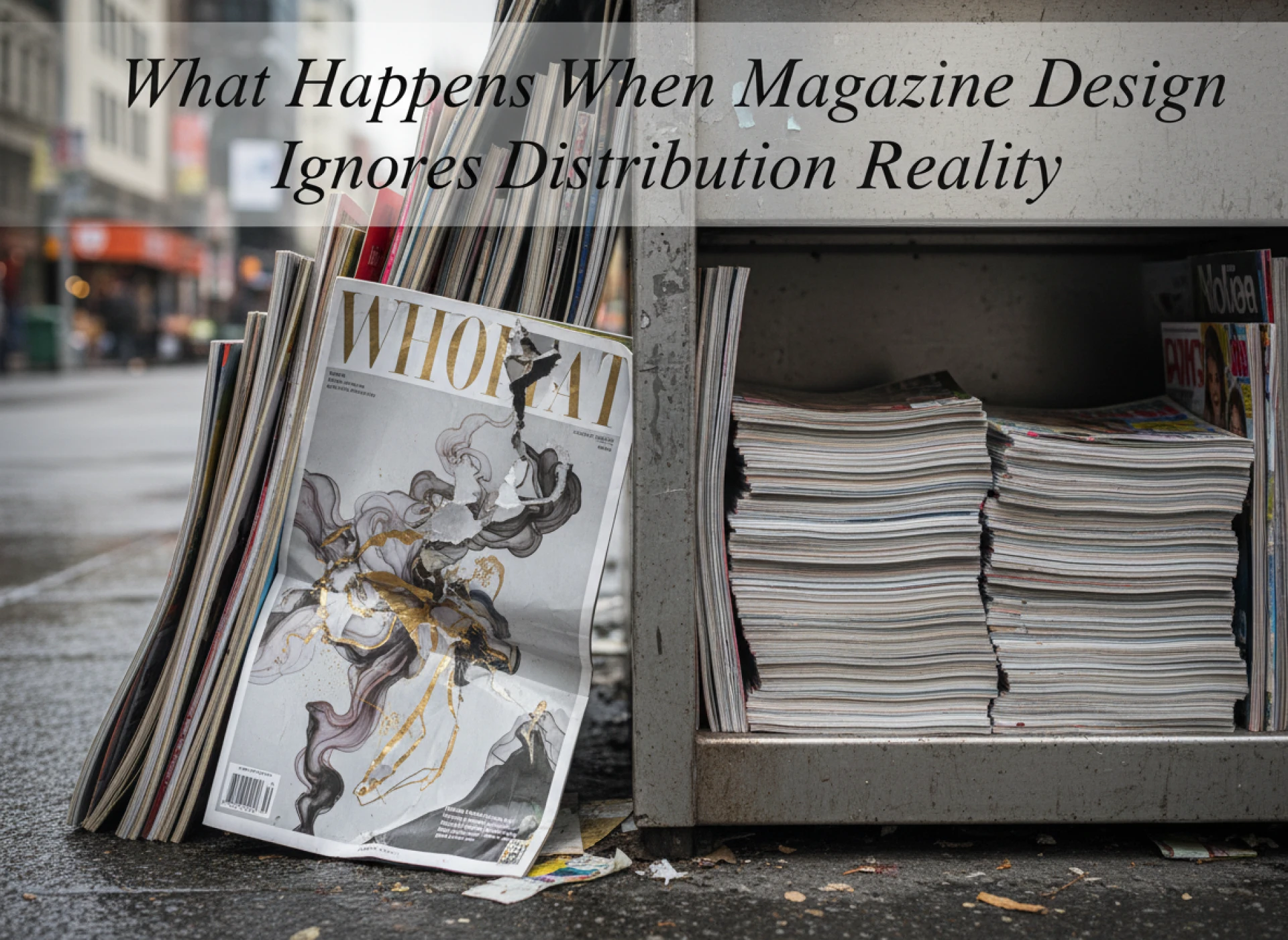
Magazines are stacked under weight. Packed tightly. Moved through vans and mailrooms. Left on tables. Thrown into bags.
Materials chosen to save cost rarely tolerate this well.
Damage rates increase. Replacement copies are requested. Additional postage is paid. Complaints arrive late, if at all.
By the time the issue is noticed, the budget has already absorbed the impact.
Cheap printing often costs more to distribute
Lighter paper may crease easily. Heavier covers chosen to compensate may push postage into higher bands.
Poor trimming accuracy creates stacking inefficiencies. Weak bindings require extra packaging protection.
Savings at print stage often reappear as costs during distribution.
That trade-off is rarely calculated early enough.
The hidden cost of reduced engagement
When magazines stop being kept

One of the quietest failures of cheap printing is reduced retention.
Magazines printed to minimum cost are rarely kept. They are read once, if at all, and then discarded.
For modern publications intended to sit in offices, homes, or shared spaces, this is a problem. Longevity is part of their value.
A magazine that survives weeks of casual interaction delivers more return than one that disappears in days.
Cheap printing shortens that window.
Perception affects credibility
Readers associate production quality with editorial confidence.
A magazine that feels flimsy or poorly finished undermines its own message. Even strong content struggles to overcome that impression.
This is particularly damaging for trade publications, societies, and professional organisations where trust matters more than spectacle.
Cheap printing doesn’t just affect appearance. It affects authority.
Why reprints erase initial savings
When “good enough” isn’t enough
Cheap printing often leads to reprints for the wrong reasons.
Not because demand exceeded expectations, but because copies became unusable. Damaged. Misbound. Rejected late.
Reprinting small quantities at short notice is expensive. Setup costs return. Timelines tighten. Stress increases.
The original saving disappears quickly.
Short runs magnify the problem
In short-run magazine printing, every copy matters more.
If ten percent of a run becomes unusable, that loss is felt immediately. There’s no buffer.
Cheap decisions hurt more when margins are already thin.
A comparison of upfront savings versus long-term cost
| Decision area | Cheap approach | Long-term effect |
| Paper quality | Lowest viable stock | Faster wear, reduced retention |
| Binding | Minimal specification | Reading discomfort, early failure |
| Ink coverage | Reduced density | Dull appearance, rub-off |
| Finishing | Simplified processes | Visible ageing |
| Distribution prep | Assumed adequate | Higher damage and replacement cost |
Why experienced publishers stop chasing the lowest quote
Cost control shifts from price to planning
Publishers who’ve been through multiple cycles learn a pattern.
The cheapest quote rarely delivers the lowest total cost.
Instead, money is saved through clarity. Right quantities. Appropriate materials. Realistic timelines.
Planning replaces guesswork.
That shift doesn’t eliminate budget pressure. It just prevents waste.
Affordable printing is not the same as cheap printing
Affordable printing respects constraints without undermining function.
It makes conscious trade-offs instead of accidental ones.
Cheap printing removes margin for error. Affordable printing manages it.
That distinction becomes clearer with every issue printed.
Final perspective
Cheap magazine printing often feels like a sensible decision because the damage it causes is delayed. By the time the cost appears — through reduced engagement, distribution issues, or reprints — the original saving has already vanished.
Publications that last learn this early. They stop asking how little they can spend and start asking where spending less actually makes sense.
That mindset is usually shaped through experience, which is why print partners such as I YOU PRINT focus on long-term behaviour rather than short-term pricing when advising publishers who want their magazines to perform beyond the day they’re delivered.





























Sign in to leave a comment.