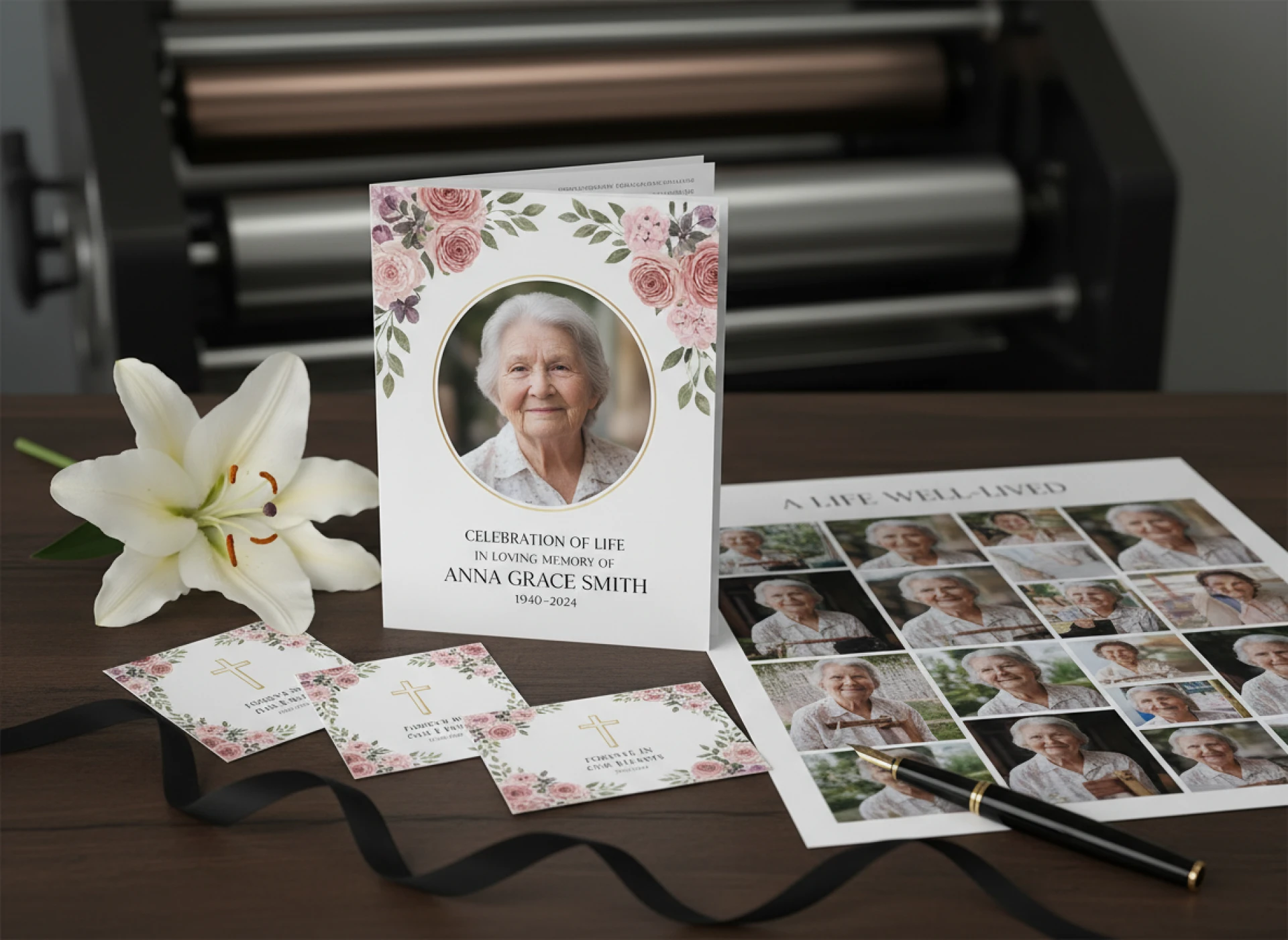

Funeral booklets rarely attract much attention during early planning conversations. Families tend to focus on the ceremony itself — who will speak, what music should be played, how the day should unfold. Printed materials appear secondary at first, something that will simply accompany the service.
Yet when the day arrives, their role becomes immediately obvious.
Guests reach for the booklet almost instinctively. It provides quiet guidance without requiring explanation. People follow the ceremony through its pages, knowing when to stand, when to reflect, when a reading will begin. In a room where emotion often replaces concentration, the booklet becomes the structure everyone can rely on.
Professionals who work around funerals recognise this pattern immediately. The booklet may appear small within the planning process, but during the service it becomes one of the most used objects in the room.
Memorial services rely on shared orientation
A funeral or memorial service gathers people who may not know each other. Friends, colleagues, neighbours and relatives often meet for the first time. Each person arrives with their own memories, but the ceremony itself must guide everyone together through the same sequence.
Without structure, even well-planned services can feel uncertain. Guests hesitate, unsure when the next element will begin. They rely on cues from the front of the room rather than understanding the order themselves.
The booklet quietly solves this.
By presenting the ceremony as a visible sequence — music, welcome, readings, tributes — it gives every attendee the same reference point. The service becomes shared rather than observed.
This is why memorial services almost always include printed guidance, even when other elements of the ceremony remain flexible.
The booklet turns the ceremony into a narrative
A service is not simply a list of moments. It carries a story. The opening sets tone. The readings reflect character. Tributes reveal personal memory. Music allows reflection.
When these elements exist only as spoken announcements, they feel temporary. When they appear together in print, they gain continuity.
Guests can see the whole structure before it unfolds. They understand how each part connects with the next. The ceremony becomes something they move through rather than something they watch happen.
This transformation is subtle, but it explains why booklets remain central even as funeral services evolve.
They turn a sequence into a narrative.
Printed materials support emotional attention
Grief affects concentration in ways people rarely anticipate. Even close relatives sometimes struggle to follow every spoken word during a service. Emotion interrupts listening.
Booklets provide a quiet support mechanism.
Guests can read ahead if they lose track of the moment. They can revisit a line that resonated. They can follow along when a hymn begins or a reading starts. The booklet becomes a companion rather than a programme.
This function explains why services without printed guidance often feel harder to follow, even when the ceremony itself is carefully arranged.
The booklet carries some of the cognitive weight.
Photographs shift the experience of the service
One of the most noticeable changes in modern funeral booklets is the presence of photographs.
Earlier memorial programmes often focused purely on the order of events. Contemporary booklets frequently include images from different stages of a person’s life. These photographs quietly change how guests experience the ceremony.
People recognise moments. Conversations begin afterwards around those images. The booklet becomes both guide and memory.
Professionals who prepare funeral materials often observe that photographs anchor the emotional atmosphere of the room. They offer something immediate and human before any words are spoken.
The booklet continues working after the service ends
Many elements of a funeral exist only during the ceremony itself. Music fades. Spoken tributes remain in memory. The room empties.
The booklet behaves differently.
Guests often keep it. It travels home in coat pockets and bags. It appears again later, sometimes months afterwards. Families find copies stored among personal belongings or placed within photo albums.
Because of this, the booklet extends the life of the service beyond the room where it happened. It becomes a record rather than simply a guide.
This enduring quality explains why families often review the booklet carefully before approving it. They understand, even if only instinctively, that it will outlast the ceremony itself.
Preparation naturally concentrates around the booklet stage
Within funeral planning timelines, the moment the booklet is prepared often becomes a point of convergence.
By then, most decisions have been made. The service structure is clear. Names and roles are confirmed. Tributes have reached their final wording.
Design and printing bring these elements together in a single form. Families review everything collectively, sometimes noticing small adjustments that had not been visible earlier.
The booklet therefore acts as a final checkpoint.
Once approved, the service usually feels ready.
Why digital alternatives have not replaced printed programmes
Occasionally families consider digital programmes or online guides instead of printed booklets. While technology can support memorial services in many ways, printed materials continue to dominate for a simple reason.
Physical objects behave differently during shared moments.
Guests can hold them without distraction. Pages turn quietly. No screens light up in the room. Everyone reads the same content simultaneously without navigating a device.
In environments shaped by reflection and ceremony, that simplicity matters.
Printed booklets align naturally with the atmosphere memorial services aim to create.
A practical view of what funeral booklets typically contain
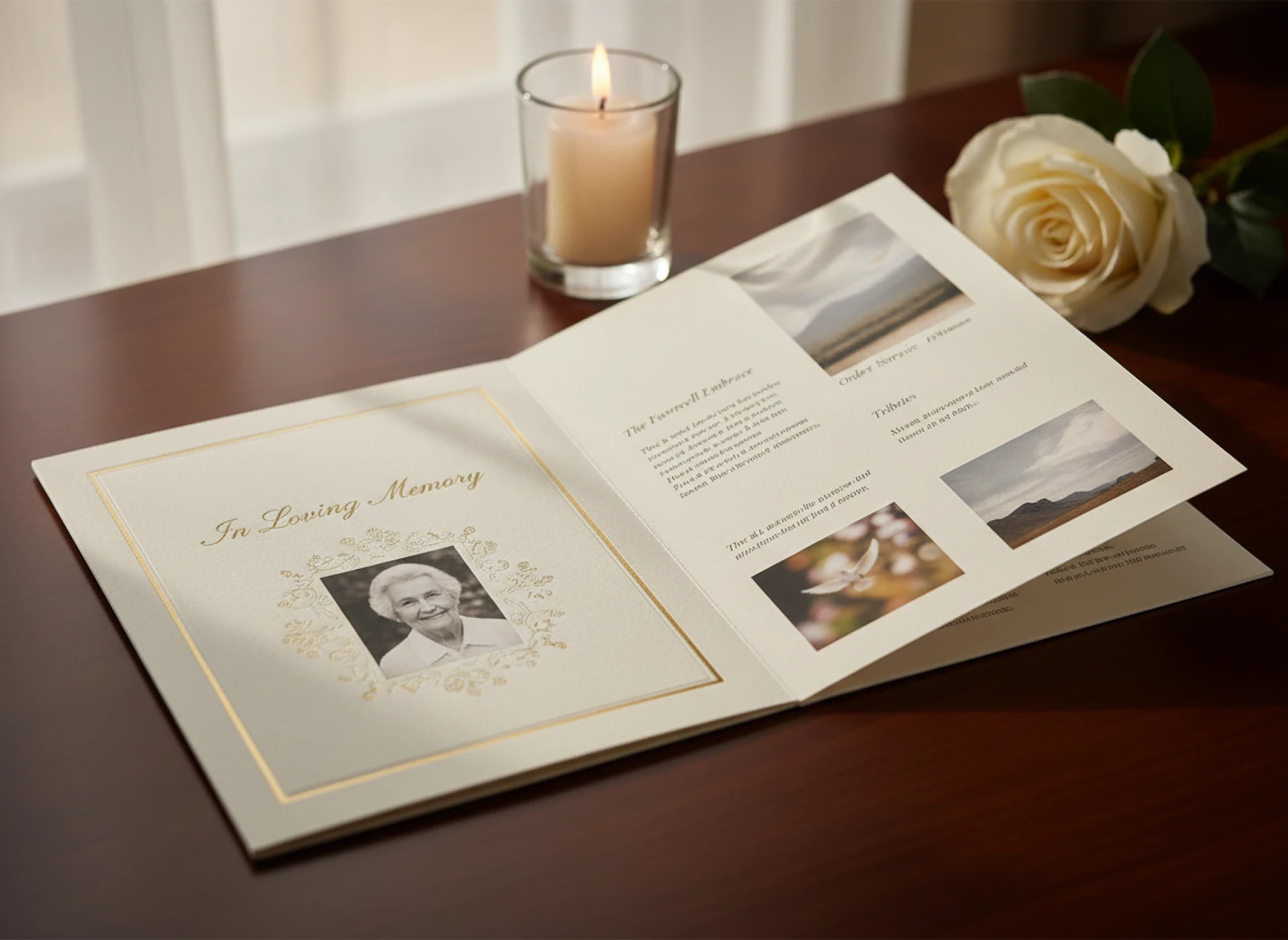
| Element | Role During the Service |
| Service order | Guides guests through the ceremony |
| Names and participants | Acknowledges those involved |
| Readings or hymns | Allows guests to follow along |
| Tribute excerpts | Shares memories publicly |
| Photographs | Personalises the booklet |
| Venue and date | Records the occasion |
Each component supports clarity for attendees while also forming a lasting record.
Why professionals recognise their importance early
Those who regularly work with memorial services — funeral directors, celebrants and print professionals — often identify the booklet as one of the most stabilising elements in the ceremony.
While planning may feel uncertain at times, the moment the booklet is finalised usually signals that the service has reached coherence. Everything that will happen during the ceremony is now visible and understood.
The booklet does not simply accompany the service. It confirms it.
Final perspective
Funeral booklets remain central to memorial services because they quietly organise the experience for everyone present. They guide guests through the ceremony, support attention during emotional moments, and preserve the structure of the service long after the day itself has passed. What begins as a practical planning task ultimately becomes one of the most enduring elements of the occasion — a role naturally supported by experienced preparation partners such as I YOU Print, whose work aligns with the point where funeral arrangements are ready to be expressed clearly in print.




























Sign in to leave a comment.