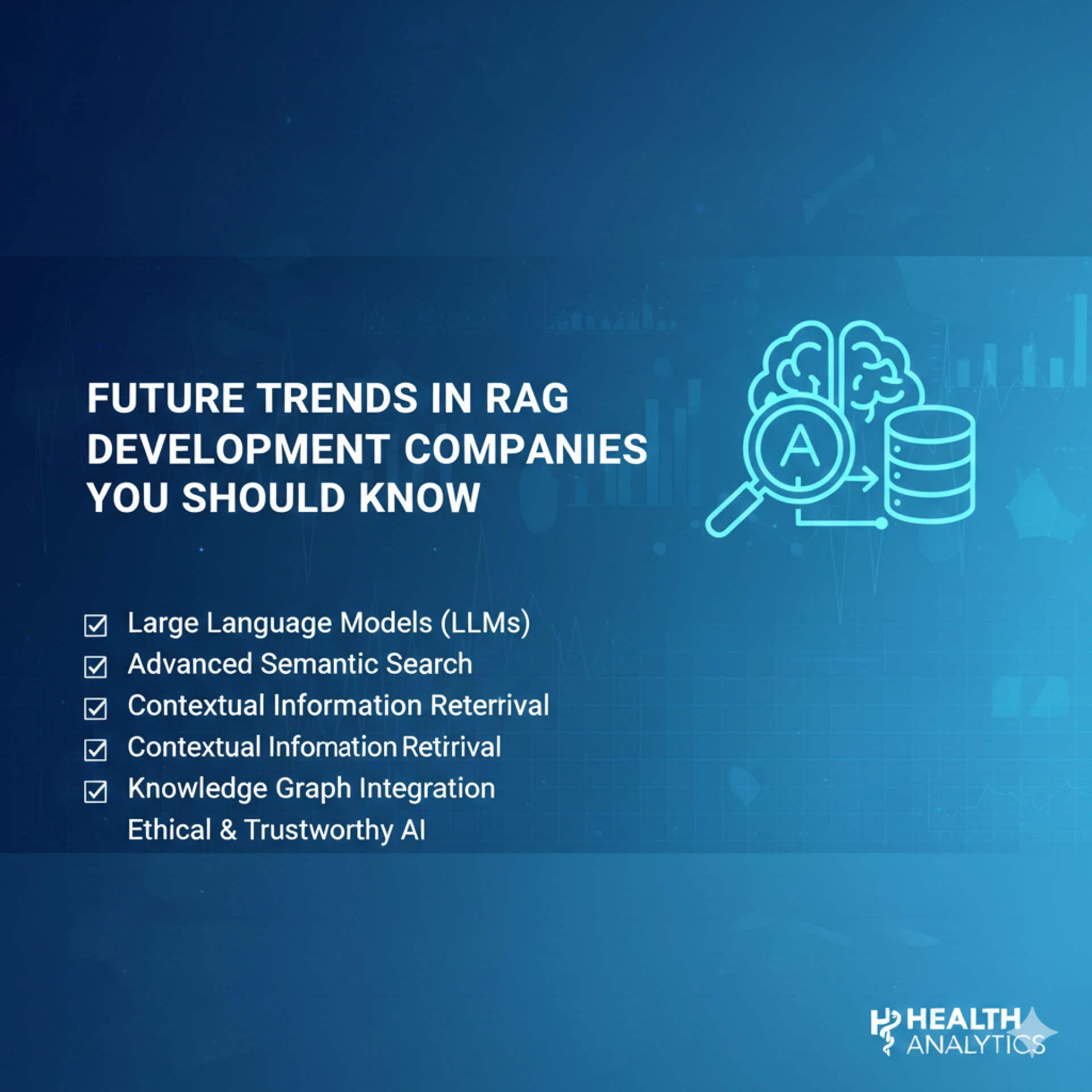

Retrieval-Augmented Generation (RAG) has moved from experimental AI architecture to enterprise-critical infrastructure especially in regulated, data-heavy industries like healthcare. As adoption accelerates, the gap between generic AI vendors and true RAG Development companies is widening fast.
In 2025 and beyond, the most valuable RAG providers won’t be the ones building flashy demos. They’ll be the ones delivering accuracy, trust, and domain-specific performance at scale.
Here are the key trends shaping the future of RAG and how leading development companies are responding.
1. Domain-Specific RAG Is Replacing General-Purpose Implementations
Early RAG systems focused on proving that retrieval could improve generation. The next wave is focused on where and how RAG is applied.
Top RAG Development companies are moving away from generic vector search + LLM stacks and toward domain-trained retrieval pipelines, especially in healthcare, legal, and financial services.
In healthcare, this shift is critical. Clinical documentation, coding, and compliance require contextual precision — not probabilistic answers. Purpose-built approaches like RAG in healthcare for accurate documentation are becoming the standard, not the exception.
2. Accuracy and Grounding Are Becoming the Primary Differentiators
As enterprises deploy RAG into real workflows, tolerance for hallucinations is approaching zero.
Future-leading RAG Development companies are prioritizing:
- Grounded responses with traceable sources
- Confidence scoring and citation frameworks
- Retrieval precision over raw model creativity
This aligns with broader industry research from sources like:
- Pinecone’s deep dives on RAG architectures: https://www.pinecone.io/learn/retrieval-augmented-generation/
The market is shifting from “Can it answer?” to “Can I trust it?”
3. RAG Is Moving Closer to the Source Systems
One of the most important emerging trends is retrieval proximity.
Instead of centralizing all data into massive vector stores, advanced RAG Development companies are:
- Indexing closer to source systems (EHRs, document repositories, knowledge bases)
- Implementing hybrid retrieval (structured + unstructured)
- Reducing latency and context loss
This architectural evolution improves freshness, relevance, and governance — especially for environments where data changes constantly.
4. RAG-as-a-Service Is Replacing DIY RAG Builds
Early adopters often built RAG systems in-house using open-source tools. In 2025, that approach is becoming unsustainable for most enterprises.
Leading organizations now prefer managed RAG services that include:
- Architecture design
- Data preparation and embedding strategies
- Model orchestration and monitoring
- Ongoing optimization
This is why enterprise-grade retrieval-augmented generation services are seeing rapid adoption.
Key shift:
Companies don’t want to experiment with RAG anymore they want it to work reliably.
5. Evaluation, Monitoring, and Governance Are Now Mandatory
One of the least discussed but most critical trends is RAG observability.
Top-tier RAG Development companies are investing heavily in:
- Retrieval evaluation (recall, relevance, coverage)
- Response quality auditing
- Bias and compliance controls
- Human-in-the-loop validation
6. RAG Is Becoming a Core Enterprise Layer — Not a Feature
Perhaps the most important trend: RAG is no longer a feature inside an app. It’s becoming a foundational enterprise capability.
Future-ready RAG Development companies are designing systems that:
- Serve multiple use cases (documentation, search, analytics, decision support)
- Integrate with existing data and analytics stacks
- Scale across departments and workflows
In healthcare, especially, RAG is emerging as the connective tissue between unstructured knowledge and structured decision-making.
What This Means for Buyers and Builders
As RAG adoption matures, the market will reward companies that combine:
- Deep domain expertise
- Strong retrieval engineering
- Enterprise-grade governance
- Clear alignment to business outcomes
Not every AI vendor will make this transition. The ones that do will define the next generation of RAG Development companies.
Bottom Line for Technology and Healthcare Leaders
The future of RAG belongs to companies that treat it as infrastructure, not experimentation.
Organizations evaluating RAG Development companies should look beyond model selection and ask harder questions about accuracy, governance, scalability, and domain relevance. The difference between success and failure won’t be the LLM — it will be the retrieval strategy behind it.























Sign in to leave a comment.