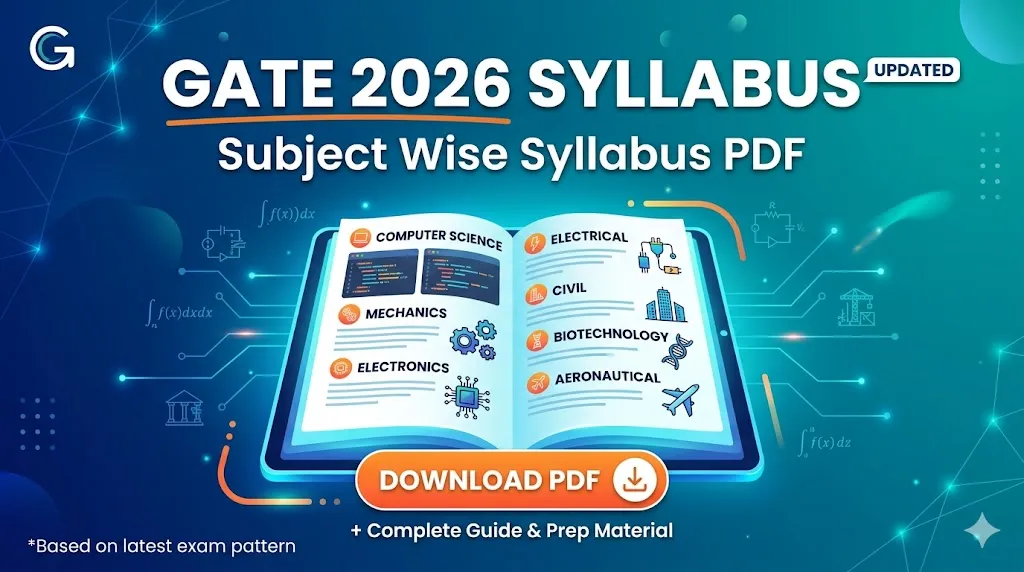

Are you planning to take one of India’s most competitive national-level exams? If you are aiming for post-graduate admissions or high-flying PSU careers through gate 2026, there is no time to waste. Organized by IIT Guwahati, this upcoming exam requires a highly structured preparation strategy. The absolute secret to an efficient and productive study journey is simple: you must align your daily study routine strictly with the official, structured roadmap provided for the exam.
Understanding the comprehensive gate 2026 syllabus helps you separate high-yielding, high-weightage core concepts from unnecessary background fluff. To help you structure your daily study routine, this guide breaks down the updated subject-wise curriculum and explains exactly how you can use the official layout to boost your ranking.
The Structure of GATE 2026: An Overview
Before diving into individual core engineering subjects, you need to deeply understand how the 100-mark paper is systematically divided. To excel in the gate 2026 examination, candidates must familiarize themselves with the distribution across the 30 available test papers.
- General Aptitude (15 Marks): Compulsory for all papers. This section evaluates your fundamental analytical, verbal, spatial, and numerical reasoning skills.
- Engineering Mathematics (13 Marks): Applicable to most core engineering streams. Mastery here is essential to scoring high across the gate 2026 syllabus.
- Core Technical Subject (72 Marks): Focuses strictly on the specialized domain knowledge of your selected engineering branch.
Expert Note: For special papers in the Sciences, Humanities, or Life Sciences, the General Aptitude section remains 15 marks, while the remaining 85 marks are entirely dedicated to subject-specific core knowledge.
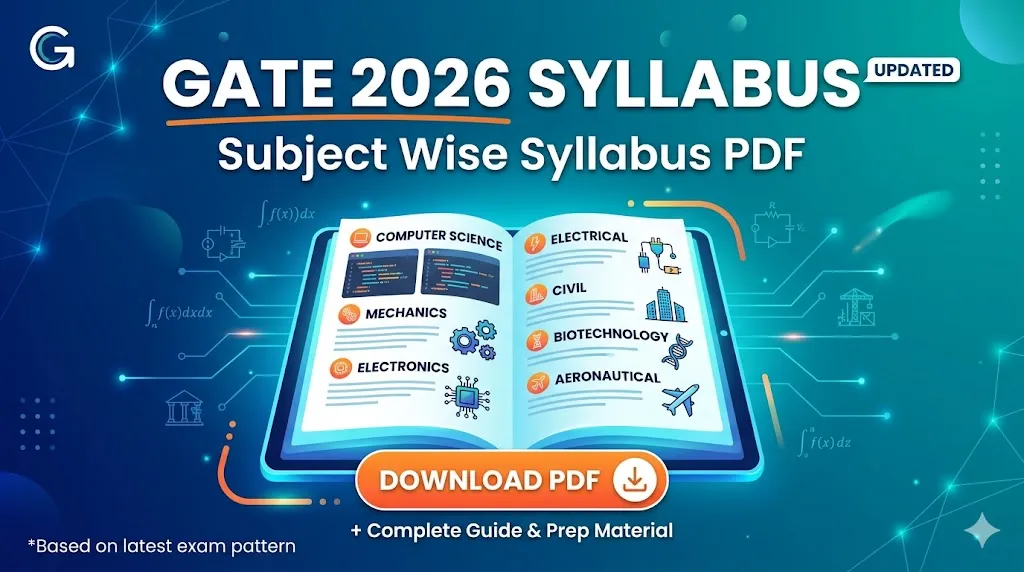
Subject-Wise Breakdown of the GATE 2026 Syllabus
The official curriculum for major engineering branches has been meticulously structured to eliminate overlapping topics and align perfectly with undergraduate courses. Here is what you need to focus on across the core disciplines to cover the entire gate 2026 syllabus effectively.
1. Computer Science & Information Technology (CS)
The computer science stream heavily focuses on core logical and computing frameworks. The main subjects detailed in the gate 2026 syllabus include:
- Discrete Mathematics: Propositional and first-order logic, sets, relations, functions, graphs, and combinatorics.
- Digital Logic & Computer Organization: Boolean algebra, minimization, instruction pipelining, and memory hierarchy.
- Programming & Data Structures: Programming in C, arrays, stacks, queues, linked lists, trees, and graphs.
- Algorithms: Searching, sorting, hashing, worst-case time complexity, and dynamic programming.
- Operating Systems & Databases: System calls, processes, CPU scheduling, deadlock, ER-model, relational algebra, and SQL.
2. Electronics & Communication Engineering (EC)
If you are appearing for the EC paper under the gate 2026 exam guidelines, your core sections demand clean concept clarity in both mathematical fundamentals and circuit design:
- Networks, Signals, and Systems: Network theorems, continuous and discrete-time signals, Fourier, Laplace, and z-transforms.
- Electronic Devices & Analog Circuits: Energy bands in silicon, carrier transport, P-N junction, Zener diode, BJT, MOS capacitor, and MOSFET.
- Digital Circuits & Communications: Number systems, combinatorial and sequential circuits, AM, FM, PCM, digital modulation schemes, and information theory.
3. Mechanical Engineering (ME)
The mechanical domain is highly comprehensive and remains split into three primary engineering segments within the gate 2026 syllabus:
- Applied Mechanics and Design: Engineering mechanics, mechanics of materials, theory of machines, vibrations, and machine design.
- Fluid Mechanics and Thermal Sciences: Fluid properties, Bernoulli’s equation, thermodynamics cycles, heat transfer, and steam tables.
- Materials, Manufacturing, and Industrial Engineering: Structure of materials, casting, forming, joining, machining, metrology, and operations research.
4. Civil Engineering (CE)
The civil engineering curriculum tests infrastructure, structural design, and environmental systems:
- Structural Engineering: Solid mechanics, structural analysis, concrete structures, and steel structures.
- Geotechnical & Transportation Engineering: Soil mechanics, foundation engineering, highway planning, and traffic engineering.
- Water Resources & Environmental Engineering: Fluid mechanics, hydrology, irrigation, water quality standards, and air pollution.
Key Timelines You Cannot Afford to Miss
Knowing what to study is only half the battle; you also need to manage your application timeline strictly to avoid missing out on the exam. The official cycle for gate registration 2026 follows rigorous deadlines that candidates must carefully track. Missing these dates means you will not be allowed to sit for the highly anticipated test.
To ensure a smooth application process, you should initiate your gate registration 2026 as soon as the online portal opens. Waiting until the final days often leads to server slow-downs or payment processing failures, which can derail your plans.
| Examination Event | Crucial Timelines |
|---|---|
| gate registration 2026 Commencement | Late August |
| Regular gate 2026 registration last date (Without Late Fee) | Late September / Early October |
| Extended Registration Closing Date (With Late Fee) | Mid-October |
| gate 2026 Exam Dates | First two weekends of February |
It is crucial to note that the gate 2026 registration last date is strict, and any submissions after the regular closing date will incur heavy late fine penalties. Ensure all your valid documents, certificates, and photographs are compiled beforehand so that you can finalize everything well before the formal gate 2026 registration last date.
Verifiable Insights: What Achievers Say
Integrating feedback from real candidates who cracked previous iterations of the exam highlights the importance of relying strictly on the official curriculum and tracking deadlines carefully:
"When I began prepping for gate 2026, I tried reading random textbooks cover to cover. It was overwhelming. The moment I downloaded the official subject-wise PDF for the gate 2026 syllabus, I filtered out the noise. Treating the curriculum as a literal checklist is what got me into an IIT." > — Ananya Sharma, GATE Achiever (Score: 820)
"Do not spend extra time on obscure topics that fall outside the syllabus boundary. Also, keep an eye on the schedule; completing my gate registration 2026 early saved me from last-minute panic. Focus on the fundamental subtopics listed in the official brochure and back them up with previous years' questions." > — Rahul Verma, PSU Officer (Recruited via GATE)
FAQs: Your Questions Answered
Has the syllabus changed significantly for the upcoming exam?
No major topics have been deleted or added to the primary engineering streams. The updates in the gate 2026 syllabus are primarily aimed at improving structural clarity, providing well-defined subtopics, and reducing contextual ambiguity for students.
Can I register for the exam after the initial deadline has passed?
Yes, but only during the extended phase. If you miss the regular gate 2026 registration last date, you will be required to pay an additional late fee to submit your application form. It is highly recommended to finish your entry during the regular window.
Where can I access the authentic GATE 2026 syllabus PDF download?
You should always download the syllabus directly from the official organizing institute website. Checking the official guidelines ensures you are preparing with the most accurate parameters for the gate 2026 test papers.
What is the pattern of questions expected in the exam?
The exam features three types of questions: Multiple Choice Questions (MCQs), Multiple Select Questions (MSQs) where more than one option can be correct, and Numerical Answer Type (NAT) questions where you must type a specific numerical value.
Navigating Your Next Steps
To build an optimal study routine, head over to the official portal, grab the official branch-specific document, and save it to your local drive. Break down each technical section into weekly study blocks, balance your schedule with regular General Aptitude practice, and keep a close eye on the calendar so you complete your forms well before the gate 2026 registration last date. Consistent, syllabus-mapped preparation combined with completing your gate registration 2026 on time is your ultimate ticket to success!
What branch are you preparing for this year? Let us know in the comments below, and share your favorite strategies for tackling the General Aptitude section!




























Sign in to leave a comment.