
Artificial Intelligence is no longer a test concept, but an integral part of the digital landscape.
It is present in search engines, social media, automation, robots, and in many of the systems that run in real-time. The Centre of the innovation process is AI. But we can too easily overlook the enormous physical scaffolding in this revolution too.
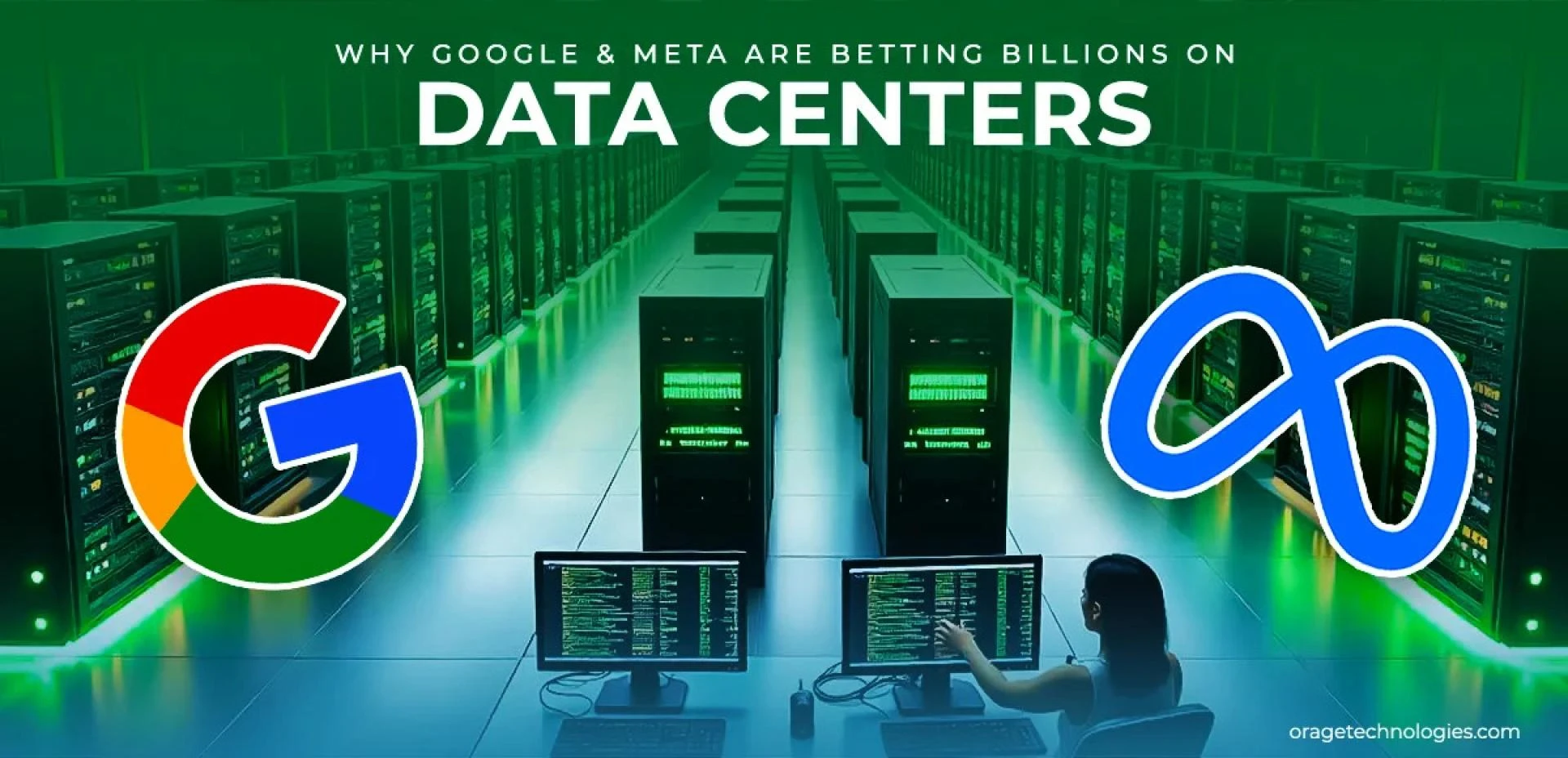
These days, top tech firms like Google and Meta are splurging incredible amounts of funds on investing in AI data centers or "AI factories" as they are often referred to, which are specifically designed for executing large-scale AI models and increasingly operate through increasingly complex and diverse data processing tasks.
An Inside Look at Google's $25 Billion Infrastructure Plan
In February 2023, a huge Google AI infrastructure investment of $25 billion was revealed to enhance data capabilities across several U.S. states (it is sometimes called multi-regions). This revelation by Google comes at a time when we'd have expected to witness significant AI infrastructure expansion since AI not only needs to expand, but it actually has to significantly influence energy stability and, of course, computing stability; all to enhance modern application scalability.
Google's new infrastructure builds aim at a series of AI-ready data centers across the 13 Midwest, South and Mid-Atlantic states.
As part of its plans, Google also revealed a $3 billion agreement to modernize two hydroelectric power plants in Pennsylvania with Brookfield Asset Management and Brookfield Renewable. These power plants will provide 670 MW of clean energy for Google's activities in clean hydropower.
Significantly, Google's 20-year vision is bigger. They will procure 3,000 MW of hydropower within 20 years to introduce resilience to its sustainable and scalable AI infrastructure strategy.
By 2025, Google aims to invest up to $75 billion in physical infrastructure to support the increasing demand for AI-driven services.
Public Policy and Political Support
During a recent AI summit in Pittsburgh, Google's President and Chief Investment Officer, Ruth Porat, joined President Trump to endorse the national strategy for developing AI capability and infrastructure. She described the strategic importance of robust energy and data infrastructure in strengthening the U.S. role in artificial intelligence.
When private and public investment come together, they squeeze timelines for energy transition and permitting in data centers — both facilitators to the opening of AI factories.
Meta's Superintelligence Strategy: Clusters and Vision
Meta is also completely committed to the infrastructure play. CEO Mark Zuckerberg has put the estimate out there that it will cost hundreds of billions of dollars to set the stage for what he refers to as "superintelligence" -- the underlying infrastructure necessary to support this next generation of Meta AI data centers, which will have to be specially constructed to deal with the high-profile workloads of future AI systems.
Two large, substantial projects have been disclosed thus far:
- Prometheus, in New Albany, Ohio
- Hyperion, under construction in Louisiana
Prometheus will be on stream in 2026 and Hyperion, a plant that is planned for possibly 5 gigawatts of power, expects to come on stream in 2030.
These huge multi-gigawatt buildings are a major deviation from conventional server farms. Instead of cloud computing, they will be designed for AI workloads including natural language processing, vision, and deep learning.
Talent Acquisition and AI Workforce Generation
And with this infrastructure building will be a talent race. Meta is rapidly assembling the teams around these AI factories and has been sending out contracts to hire experts in machine learning, data engineering, and massive-scale computing systems. And simultaneously, the pressure for AI workforce creation will be almost as crucial as constructing "the building".
Environmental Consequences: A New Concern
As technology continues to advance so quickly there is growing evidence that environmental problems are now also making their presence known. Recently, The New York Times published an article that indicated Meta's Newton County, Georgia, data center has raised water consumption and dried up wells in adjacent residential neighborhoods.
Such stories give rise to legitimate concern about the environmental impact of AI data centers, especially when embraced on the sheer scale in which we anticipate. Innovations won't be only in AI models but also in water consumption, energy supply and long-term environmental design.
Why AI Needs Infrastructure
Mass-market tools like Google Gemini, Meta AI and ChatGPT demand a level of resources that is monumental in order to utilize. These AI technology then comprise of ongoing information flow, utilization of GPUs, and supercomputing infrastructure traditional data centers were never designed to address.
AI data centers – or "AI factories" – are in place to bridge the gap between the immediate demand for custom-made infrastructure that balances speed, energy efficiency and enormous storage capacity.
In the end, each AI model that aims to be the best has factories to produce and deploy new AI models capable of adapting and scaling at will in real-time industries like healthcare, robotics and autonomous vehicles.
Energy Deals and Alliances
The Brookfield hydroelectric deal of Google has raised the bar for corporate accountability in fueling AI development. Clean energy is quickly bypassing regulatory compliance consideration, and it soon becomes the priority with brand reputation and cost inherently linked to the transient cost of natural gas.
Conversely, Meta's Hyperion Meta project heralds how seriously companies are committed to locking down future electrical requirements for possibly decades. A power consumer of as much as 5 gigawatts (yes, that's not megawatts but gigawatts) is nearly unimaginable, and the cooling infrastructure and energy consumption will demand creative and new methods.
Final Thoughts: Infrastructure Is Key to Winning the Race
As Google and Meta make public billions in capital spending in AI infrastructure initiatives for 2025, all signs are that success will not be measured by who codes the best but by who builds the best structural underpinnings.
Whether the race is driven by competition in clean energy or high-efficiency AI data centers, the infrastructure arms race is now in full swing.
Those companies that think strategically in planning for sustainability and workforce preparedness will do best in the AI mania.
Much more will be being spoken about the energy usage of AI, new facility openings, multi-partner ventures intended to meet the increasing needs of machine intelligence. The firms building the physical foundation of AI will determine the direction through which human engagement with technology will develop.





























Sign in to leave a comment.