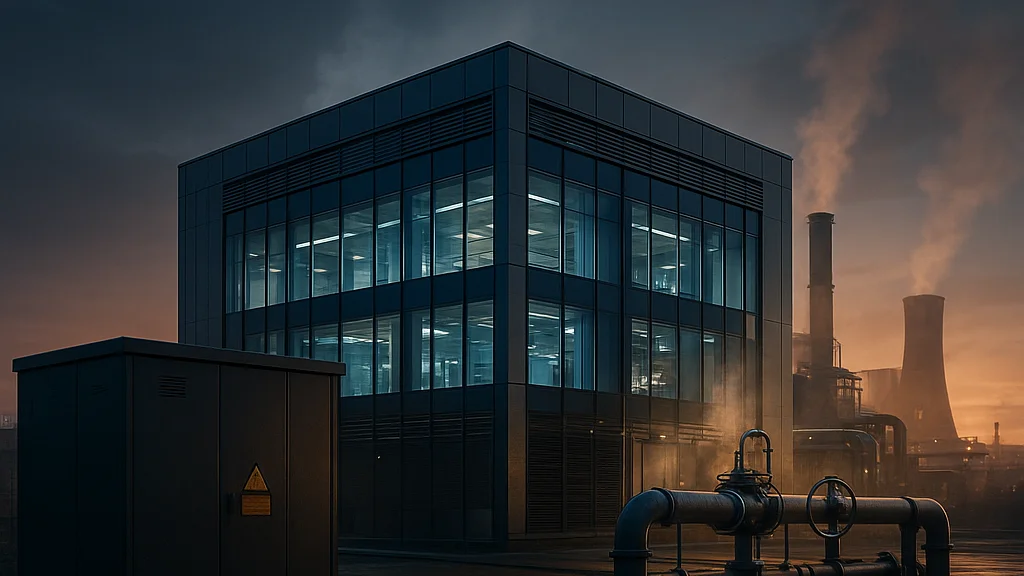

A clean-tech giant, a fossil-fuel backbone
For years, the public story around hyperscale computing has been bright and polished: sleek server halls, wind contracts, solar farms, and corporate promises about carbon-free electricity. That is why the latest reporting around a Google-funded data center tied to a massive gas plant lands with such force. It exposes a tension that many people working in climate, energy, and digital infrastructure have felt building for a while. Artificial intelligence and cloud computing are expanding so quickly that the old language of sustainability is colliding with the blunt physics of power demand.
Data centers are no longer niche industrial facilities sitting quietly at the edge of town. They are becoming some of the most electricity-hungry assets in modern economies. Google, Microsoft, Amazon, and Meta have all been racing to secure generation, transmission access, and backup capacity as AI workloads multiply. According to the International Energy Agency, electricity demand from data centers is set to rise sharply through the second half of this decade, with AI as a major driver. That broad trend matters here because it helps explain why gas, despite its climate costs, keeps reappearing in project plans that would once have leaned more heavily on renewable branding.
The issue is not simply whether one company has broken faith with its climate commitments. It is whether the power system serving the digital economy is being reshaped around speed and reliability first, with decarbonization pushed into the footnotes. Readers who want a companion overview may find it useful to compare this piece with Google-Funded Data Center and the Massive Gas Plant Behind It, which frames the same controversy from a broader infrastructure angle.
The uncomfortable truth is that the AI boom is not just a software story. It is a fuel story, a grid story, and increasingly a land-and-water story too.
That is why this development deserves careful attention. A gas-powered data center is not only a technical choice. It is a signal about what the market believes can be built fast enough, financed safely enough, and operated reliably enough to serve round-the-clock computing demand.
How the industry arrived at this contradiction
To understand why a Google-linked project would be associated with such a large gas asset, it helps to step back. For more than a decade, major tech companies bought renewable energy at scale through power purchase agreements. Those deals helped finance wind and solar buildouts, especially in the United States. They also supported a powerful corporate narrative: big tech could grow rapidly while helping clean up the grid.
There was truth in that narrative, but it always had limits. Annual renewable matching is not the same thing as using carbon-free power every hour of every day. A company can buy enough clean energy over a year to match consumption on paper while still drawing from fossil-heavy grids at night, during winter peaks, or when transmission bottlenecks isolate local regions. Google itself has long acknowledged this distinction and has promoted its goal of operating on 24/7 carbon-free energy. That target is more rigorous than annual matching, and it implicitly admits that the older accounting model was incomplete.
Then AI changed the tempo. Training large models and running inference at scale require dense clusters of advanced chips, sophisticated cooling systems, and extremely high uptime. Utilities and grid operators in several regions have warned that new data center demand is arriving faster than traditional planning cycles can absorb. Reuters, Bloomberg, and the Financial Times have all reported in recent years on utilities scrambling to connect huge new loads while balancing reliability concerns.
Three structural pressures pushed gas back into the conversation:
- Speed: Developers often believe gas plants or gas-backed generation packages can be permitted, financed, and integrated more predictably than large portfolios of firmed renewables plus storage.
- Reliability: Hyperscale operators need power quality and availability that leave little room for curtailment risk, congestion, or multi-day renewable droughts.
- Grid constraints: In many markets, transmission expansion has lagged badly, making it harder to bring distant wind and solar to new industrial loads.
None of that makes gas clean. It does explain why it remains attractive in boardrooms and utility interconnection queues. A related internal analysis, Google-Funded Data Center Raises Hard Questions on Gas Power, captures the policy dilemma well: companies may still hit some accounting-based climate targets while locking in physical infrastructure that emits for decades.
The contradiction is not accidental. It is built into an electricity system trying to serve explosive demand growth with too little transmission, too little long-duration storage, and too few truly firm zero-carbon options available at commercial scale today.
What a massive gas plant really means for emissions
The phrase “powered by a gas plant” can sound deceptively simple. In practice, the climate implications depend on several variables: the size of the plant, whether it is new or existing, how often it runs, whether it displaces dirtier generation, how methane leakage is handled upstream, and whether carbon capture is proposed or actually delivered. But one point is straightforward. A new large gas plant built to support a major data center is not a marginal detail. It can become a significant source of direct and indirect emissions over its operating life.
Natural gas emits less carbon dioxide at the smokestack than coal, but it is still a fossil fuel. Methane leakage across production and transport can further erode its climate advantage because methane is a potent greenhouse gas in the near term. The Intergovernmental Panel on Climate Change and the IEA have both stressed that cutting methane is essential if the world is serious about limiting warming. When a data center load is effectively underwritten by gas, the emissions story has to include both combustion and supply-chain leakage.
There is also the lock-in problem. Power plants, pipelines, and interconnection upgrades are financed over long time horizons. Once built, they create economic and political pressure to keep running. Even if a company later signs more wind, solar, geothermal, or nuclear contracts, the gas asset may remain embedded in the local system as reliability support or capacity reserve.
Here is what analysts usually watch when assessing the true footprint of a gas-backed data center project:
- Nameplate capacity: A larger plant can support larger continuous loads and potentially higher annual emissions.
- Capacity factor: A peaker that runs rarely is very different from a combined-cycle plant operating much of the year.
- Heat rate and efficiency: Newer combined-cycle units are more efficient, but efficiency does not eliminate emissions.
- Methane management: Upstream leakage rates can materially change climate impact.
- Retirement timeline: If there is no credible plan to phase down gas use, “bridge fuel” language can become a permanent excuse.
According to the U.S. Energy Information Administration, natural gas remains the largest source of electricity generation in the United States. That baseline matters because even companies with aggressive procurement strategies are operating inside grids where fossil generation still plays a central balancing role. The public relations version of sustainability often highlights renewable contracts; the operational version has to answer a harder question: what power is actually serving the load in the hour it is consumed?
Annual clean-energy matching can look impressive in a slide deck. Hourly dependence on gas tells a more honest story about how digital infrastructure really runs.
This is why critics call such projects a sustainable paradox. The concern is not symbolic inconsistency alone. It is the risk that the AI buildout normalizes a two-track energy future: green branding on one side, fossil-backed reliability on the other.
Why Google and its peers keep making these trade-offs
The easy version of this story paints tech companies as hypocrites. The more accurate version is less tidy and, frankly, more revealing. Hyperscalers are trying to solve several problems at once: secure enough power for AI growth, avoid project delays, maintain uptime guarantees, satisfy investors, and preserve climate credibility. Those goals do not always line up.
Google has spent years positioning itself as one of the more sophisticated corporate buyers of clean electricity. It has invested in advanced geothermal, pursued 24/7 carbon-free energy, and publicly discussed the mismatch between annual renewable offsets and real-time grid emissions. That history makes the gas-linked data center especially striking. If even a company with those ambitions is leaning on fossil-backed infrastructure, it suggests the bottleneck is not messaging. It is system design.
Several practical realities are shaping corporate decisions in 2026. First, interconnection queues for new generation remain clogged in many regions. Second, utility-scale battery storage has grown fast, but long-duration storage capable of covering multi-day gaps is still limited. Third, advanced nuclear remains promising but slow, capital-intensive, and politically uneven. Fourth, enhanced geothermal is exciting but not yet available at the scale and speed AI-driven load growth may require. In other words, the menu of truly firm, dispatchable, zero-carbon power is still too small.
That does not let anyone off the hook. It simply changes the question from “Why are companies lying?” to “Why is the clean firm power pipeline still so thin?” The answer spans policy, permitting, transmission planning, market design, and local opposition to large energy projects of almost every type.
For readers trying to sort signal from noise, Common Mistakes When Reading Google’s Gas-Powered Data Center is useful because it separates corporate procurement claims from physical grid realities. One common misunderstanding is assuming that a renewable purchase somewhere on the grid automatically neutralizes a gas plant built somewhere else. Electricity systems do not work that neatly.
Another reason gas remains attractive is financial. Lenders and utilities understand gas economics, capacity markets, and reliability contracts. That familiarity lowers perceived risk. By contrast, portfolios combining solar, wind, batteries, demand response, transmission upgrades, and emerging firm clean resources can be technically superior in the long run but harder to assemble on the timelines AI developers want.
So the trade-off is not abstract. It is speed versus structural decarbonization. And right now, speed is winning more often than climate advocates hoped.
What changed recently in 2026
The context around data center power has shifted noticeably this year. By mid-2026, concerns that once sounded niche have become mainstream among regulators, utility planners, and investors. Several U.S. utilities have revised load forecasts upward because of data center demand, especially in markets attracting AI and semiconductor infrastructure. Analysts who once treated hyperscale growth as a continuation of cloud adoption are now modeling something steeper and more energy-intensive.
That shift has had three visible effects. Utilities are proposing more generation additions. Grid operators are paying closer attention to large-load interconnections. And local communities are asking tougher questions about water use, air quality, and who pays for the network upgrades required to serve giant campuses. According to reporting by Reuters and The Wall Street Journal, utilities in multiple regions have warned that data center clusters can strain existing planning assumptions.
Meanwhile, the climate politics have sharpened. Environmental groups increasingly argue that gas-backed AI infrastructure could undermine state and corporate decarbonization goals just as power-sector emissions were beginning to bend downward in some regions. Industry, for its part, argues that turning away data center investment carries its own costs: lost jobs, slower digital innovation, and reduced competitiveness in AI.
Several 2026 developments are worth watching closely:
- More scrutiny of “24/7” claims: Stakeholders are asking for hourly emissions data rather than annual renewable matching summaries.
- Pressure for co-located generation: Developers are exploring dedicated power arrangements, including gas, solar-plus-storage, and emerging geothermal.
- Rising interest in small modular reactors: Interest is real, but commercial deployment timelines remain uncertain.
- Transmission politics: New lines are still painfully slow to permit, which keeps local fossil options competitive.
There is also a cultural change underway. The public is beginning to connect AI outputs on a screen with physical infrastructure on the ground: substations, turbines, cooling towers, water withdrawals, and emissions stacks. That may sound obvious, but for years the digital economy benefited from a kind of material invisibility. The gas-plant controversy punctures that illusion.
If you want a sharper framing of that contradiction, Google’s 2026 Data Center Powered by a Massive Gas Plant: A Sustainable Paradox places the debate squarely in the climate-accounting conversation. The central point is difficult but necessary: clean-tech branding does not cancel fossil infrastructure. It sits beside it, and sometimes depends on it.
The local stakes: air, water, land, and public trust
National climate targets can make this debate feel abstract, but the local impacts are immediate. A massive gas plant associated with a data center can affect nearby communities through air pollution, noise, traffic during construction, water demand, and land-use change. Even when a plant meets regulatory requirements, residents may still bear cumulative burdens that corporate sustainability reports barely acknowledge.
Gas combustion produces carbon dioxide, and depending on plant design and controls, it can also contribute to nitrogen oxides and other pollutants associated with respiratory harm. Public-health impacts vary by region and baseline air quality, but they are part of the picture. So is water. Many large thermal plants require substantial water for cooling, and many data centers do as well, though designs differ widely. In water-stressed regions, that combination can become politically combustible.
Then there is trust. Communities hear one message about innovation and another about smokestacks. They are told the future is digital and clean, then asked to accept fossil infrastructure to make that future possible. That mismatch can deepen skepticism not only toward a single project but toward the broader energy transition.
Local officials often face a difficult balancing act:
- Attract investment and tax base from a high-profile tech project.
- Protect residents from pollution, noise, and infrastructure burdens.
- Negotiate grid upgrades without shifting unfair costs onto ordinary ratepayers.
- Assess whether promised jobs justify long-term environmental trade-offs.
These are not anti-technology questions. They are governance questions. Who benefits, who pays, and who absorbs the risk? Those are the same questions that come up in housing, transit, and industrial policy, and they deserve the same seriousness here.
One detail often overlooked is that data centers do not always create large numbers of permanent jobs relative to their footprint and power demand. Construction activity can be substantial, and local tax arrangements may matter, but communities are increasingly asking whether they are trading scarce grid capacity and environmental headroom for facilities that are economically valuable yet locally thin in employment terms.
That is why transparency matters. If a company wants public goodwill for a major project, it should disclose the real power mix, expected emissions profile, water implications, and the timeline for reducing dependence on gas. People can handle complexity. What erodes confidence is polished language that avoids the hard parts.
What a better path could look like
If the current model is unsatisfying, what would a more credible approach be? Not perfection overnight. A better path would combine honesty about present constraints with much stronger commitments to build the clean infrastructure needed to replace gas over time. That means moving beyond annual offset logic and toward physical decarbonization.
First, companies should publish more granular power data for major campuses, including hourly or monthly estimates of carbon intensity where feasible. Second, they should prioritize regions where clean firm resources, transmission, and storage can realistically support growth without locking in new fossil dependence. Third, where gas is used, there should be explicit sunset conditions, methane standards, and a public roadmap for displacement by cleaner resources.
Policy has a role too. Governments can speed transmission permitting, support long-duration storage, de-risk geothermal, improve interconnection processes, and design markets that reward firm zero-carbon capacity rather than defaulting to gas. Utilities, for their part, need planning frameworks that account for large new loads without socializing all the risk onto households and small businesses.
A more credible corporate playbook would include:
- Hourly carbon accounting for major data center loads.
- Binding procurement targets for clean firm power, not only variable renewables.
- Methane safeguards across any unavoidable gas supply chain.
- Community benefit agreements covering air quality, water stewardship, and local infrastructure.
- Retirement or conversion milestones for any new gas-backed generation.
None of this is simple, and some of it will cost more in the near term. But that is the point. Cheap, fast, and clean do not always arrive together. When companies claim they do, someone is usually carrying the hidden cost.
The deeper lesson is one I come back to often, maybe because I am the sort of person who still journals after a hard reporting day and calls home on Sunday. Systems tell the truth eventually. If AI requires vast new electricity, then climate honesty requires saying exactly where that electricity comes from and what it emits. A gas plant attached to a digital future does not make that future illegitimate. It does make it morally and politically more demanding.
What to watch next
This story is still moving, and the most important developments may come after the headlines fade. Watch whether the project’s power arrangement is described in annual accounting terms or operational ones. Watch whether the gas plant is framed as temporary support or long-lived backbone. Watch whether local regulators require meaningful disclosure on air emissions, water use, and cost allocation. And watch whether Google and its peers accelerate investment in clean firm resources that can actually compete with gas on reliability.
There is a larger test here for the tech sector. If the companies building the AI era cannot align their infrastructure growth with credible decarbonization, then their climate leadership claims will keep thinning under scrutiny. If they can use their balance sheets, procurement muscle, and political influence to speed transmission, geothermal, storage, and other firm low-carbon options, this moment could still become a pivot rather than a retreat.
For readers, the useful habit is to ask a few plain questions whenever a “sustainable” data center is announced: What powers it hour by hour? Is there new fossil infrastructure involved? Who bears the local burden? What is the retirement plan for any gas asset? Those questions cut through branding very quickly.
The digital economy feels airy, almost weightless, until you follow the wires. Then it becomes deeply physical. Substations. Pipelines. Cooling systems. Turbines. Transmission corridors. Communities. Once you see that, the debate becomes clearer and more human.
And perhaps that is the quiet gift in controversies like this one. They force us to look directly at the infrastructure beneath convenience. They ask us to be a little braver with numbers, a little less dazzled by slogans, and a little more serious about what a low-carbon future actually requires. If you are holding that tension with some frustration, you are not alone. Be gentle with yourself, and keep asking better questions.































Sign in to leave a comment.