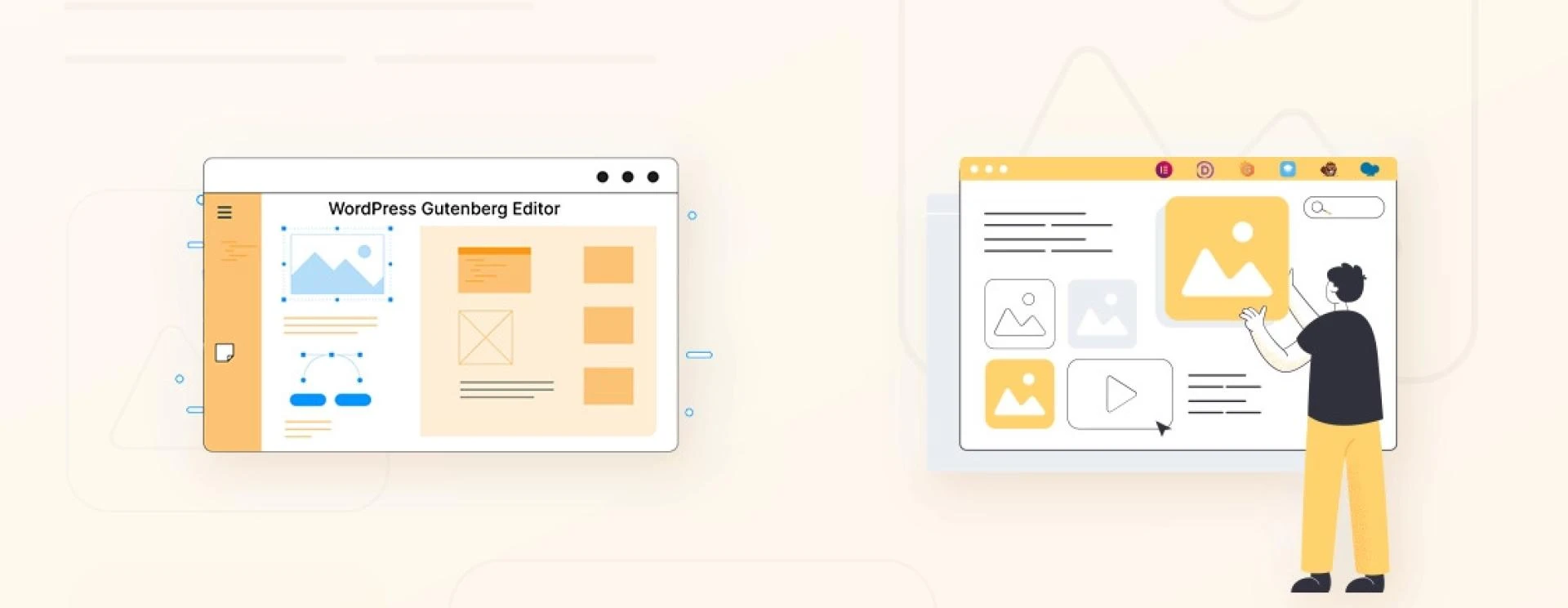

Introduction
Who isn’t familiar with Gutenberg? Also known as the WordPress block editor, it’s been the default way to create and optimize WordPress websites since its inception in 2018. Its simplicity and efficiency have earned a host of points over the old classic editor.
But if you’re trying to build creative yet feature-rich websites, there are also traditional page builders like Elementor and Divi. With similar kinds of user experience and functional capabilities, people are often confused about whether to continue with the default Gutenberg block editor or move to the other page builders.
In this blog, you’ll learn about the comparison between the Gutenberg block editor vs Other page builders.
Overview of Gutenberg Block Editor
Introduced with WordPress version 5.0 in 2018, Gutenberg is a WordPress block editor named after the founder of the printing press, Johannes Gutenberg. It is meant to make content creation and website development much more efficient and intuitive. It offers several new features and advancements over the classic editor.
One of the biggest advantages of the Gutenberg editor is that it is block-based. That means you can create pages and posts by dragging and dropping blocks into place. Blocks are essentially pre-made pieces of content that you can customize to fit your needs. There are a variety of different blocks available, including text blocks, image blocks, gallery blocks, and more. You can easily customize and rearrange these blocks in different ways to create complex design layouts. That too, without in-depth knowledge of HTML or CSS. Moreover, you can create custom blocks through HTML or JavaScript to open up even more possibilities for customization in the block editor.
Facts About Gutenberg Block Editor
You already know the usuals about Gutenberg. It’s the default WordPress editor. It divides the website contents into smaller blocks for efficient development and customization. It has replaced the classic editor as the default option. It was released with WordPress version 5.0.
So let’s move to some lesser-known facts about this revered WordPress editor.
It faced some pushback from the WordPress communityIt is going through an active evolution phaseGutenberg is not the first block-baseIt exists beyond WordPressThese facts might be enough to showcase the capabilities of Gutenberg when it comes to developing enterprise-level WordPress websites. That’s why it has inspired other similar editors on Drupal and other platforms.
Overview of Page Builders
The greatest power of WordPress lies in its plugins. They can help add or customize any feature or functionality in minutes without any coding expertise. That said, page builders are among the best plugins for any WordPress website, as they help create pages and posts in no time.
As an alternative to the block-based Gutenberg editor, the page builders go for a drag-and-drop approach. With these plugins, you can drag and drop crucial page elements like buttons, images, posts, etc. and create completely custom designs without having coding expertise.
The traditional page builders like Elementor, Divi, and Beaver Builder, come with a gallery of templates that ensure you don’t have to design the website from scratch. So you can create any type of post or page, be it a service page, content page, product page, or something else, relatively quickly. Most of these plugins can be installed for free from the WordPress library. And they have premium versions if you need additional functionalities.
But this information may not be enough for someone confused about whether to go for Gutenberg or a page builder. So let's move on to a detailed comparison between Gutenberg and traditional page builders.
WordPress Block Editor Vs. Page Builders
One of the biggest pros of WordPress is its plugins. They can solve any issue with the website and add any sort of features and functionalities as well. So obviously, there are some page builders plugins like Elementor and Divi Builder. They can make the development process much more efficient.
User Interface & ConvenienceFeatures & FlexibilitySpeed & PerformanceBlock (or Component) ReusabilityPre-built Templates & DesignsCustomizabilityThird-party IntegrationsPricingIs There a Possibility of Block Editor Replacing the WordPress Page Builders?
Besides being the default WordPress editor, the Gutenberg block editor is a simple and efficient way to create and customize a website. It follows a block-based approach. Through that, you can create complex design layouts through customizations and block rearrangements. That too, without any significant know-how of HTML or CSS. Moreover, as you may already know, Gutenberg is continuously evolving, with upcoming updates.
Having said that, the Gutenberg block editor, in its current form, can’t replace the page builders like Elementor and Divi. Page builders offer extensive template libraries, advanced customizations, and other special features. They allow users to create highly customized and intricate designs.
Conclusion
The Gutenberg WordPress block editor was definitely a step up over the old classic editor. Its block-based approach makes it easier to build creative yet feature-rich websites in a streamlined manner. But in terms of customization, it lacks the necessary features and capabilities. On the other hand, page builder plugins like Elementor and Divi have creative customization features to make a website the absolute best. But their steeper learning curve could be a negative.
Examining the WordPress roadmap, it’s clear that there are plans to further enhance the capabilities of the block editor. However, it doesn’t appear that Gutenberg is poised to replace other page builders.





























Sign in to leave a comment.