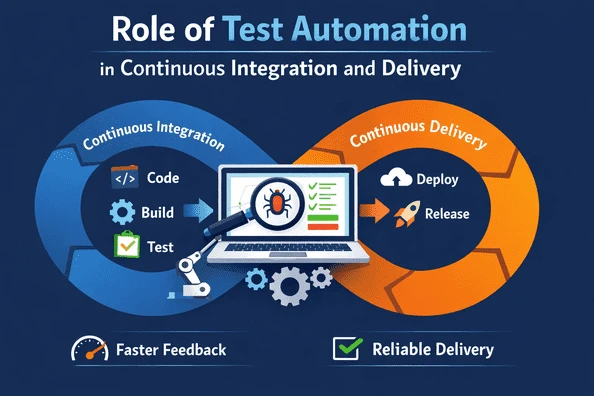

Modern software development demands speed, reliability, and frequent releases. Continuous Integration and Continuous Delivery (CI/CD) have become standard practices to meet these expectations. However, without reliable testing, rapid releases can introduce defects and instability. This is where test automation plays a critical role in ensuring quality while maintaining delivery speed.
Understanding CI/CD in Software Development
Continuous Integration focuses on frequently merging code changes into a shared repository, followed by automated builds and tests. Continuous Delivery extends this approach by ensuring that code is always in a deployable state, allowing teams to release updates quickly and confidently.
Both CI and CD rely heavily on automated processes. Manual testing alone cannot keep up with frequent code changes, tight deadlines, and complex systems. Integrating test automation into CI/CD pipelines helps teams detect issues early and maintain consistent quality across releases.
Why Test Automation Is Essential for CI/CD
CI/CD pipelines are designed to provide rapid feedback on code changes. Test automation enables this feedback by executing test cases automatically whenever new code is committed. This ensures that defects are identified early in the development lifecycle, reducing the cost and effort of fixing them later.
Automated tests also help maintain consistency. Unlike manual testing, automated tests run the same way every time, minimizing human error and ensuring predictable results. This consistency is crucial when deployments happen multiple times a day.
How Test Automation Supports Continuous Integration
In Continuous Integration, developers commit code frequently, sometimes several times a day. Each commit triggers automated builds and tests. Test automation validates that new changes do not break existing functionality.
Key contributions of test automation in CI include:
- Early defect detection by running unit and integration tests automatically
- Faster feedback loops for developers
- Improved code quality through consistent validation
By catching issues early, teams prevent faulty code from progressing further in the pipeline.
Role of Test Automation in Continuous Delivery
Continuous Delivery ensures that software is always ready for production deployment. Test automation is essential for validating application behavior at different stages, including functional, regression, and performance testing.
Automated regression testing ensures that previously working features remain unaffected by new changes. Automated functional tests validate business-critical workflows, while performance tests help identify bottlenecks before deployment. Together, these tests give teams confidence that releases are stable and reliable.
Benefits of Integrating Test Automation into CI/CD Pipelines
Implementing test automation within CI/CD offers several advantages:
- Faster Release Cycles
Automated tests significantly reduce testing time, enabling faster deployments without compromising quality. - Improved Software Quality
Continuous testing ensures defects are identified and resolved early, leading to more stable releases. - Reduced Manual Effort
QA teams can focus on exploratory and edge-case testing instead of repetitive manual checks. - Scalability
Automated tests can easily scale as applications grow, supporting frequent releases and complex systems. - Higher Confidence in Releases
With automated validations at every stage, teams can deploy with greater confidence.
Challenges in Test Automation for CI/CD
Despite its benefits, adopting test automation in CI/CD comes with challenges. Poorly designed tests can be flaky, leading to false failures and reduced trust in test results. Maintaining test scripts as applications evolve also requires ongoing effort.
To address these challenges, teams should prioritize writing stable, maintainable tests and continuously reviewing test coverage. Proper test selection—running faster tests earlier in the pipeline and heavier tests later—also helps optimize performance.
Best Practices for QA Teams
QA teams can maximize the impact of test automation in CI/CD by following these best practices:
- Automate tests that are repetitive and critical
- Maintain clear test environments and data
- Integrate automated tests early in the pipeline
- Regularly review and refactor test suites
- Monitor test results and pipeline performance
Collaboration between developers and QA engineers is also essential to ensure test effectiveness.
Conclusion
The role of test automation in Continuous Integration and Delivery is fundamental to modern software development. It enables rapid feedback, improves software quality, and supports frequent, reliable releases. By integrating automated testing into CI/CD pipelines, QA teams help organizations deliver stable, high-quality software at speed. As development cycles continue to accelerate, test automation will remain a key pillar of successful CI/CD practices.





























Sign in to leave a comment.