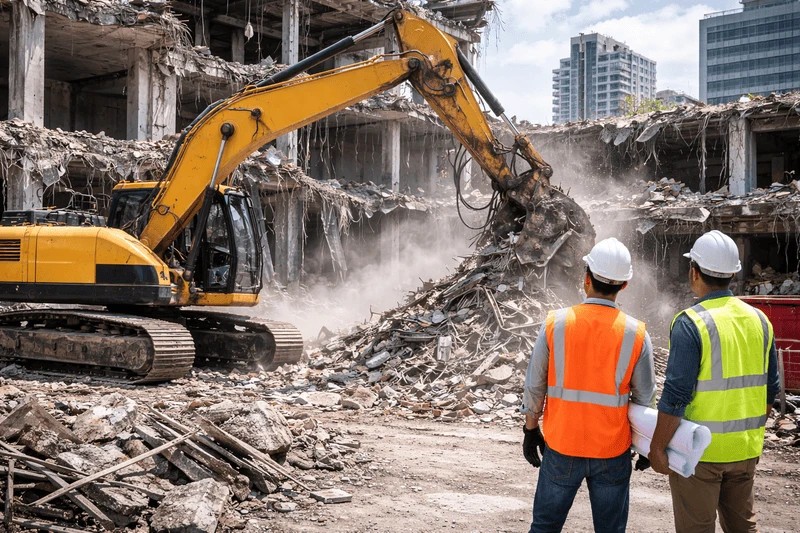

Demolition is often spoken about as if it is a single action: walls come down, materials are removed, and a site is cleared. In reality, professional demolition is a layered process that requires planning, compliance, coordination and technical skill long before any structure is touched. Hives Demolition operates within this space, where precision, safety and foresight matter just as much as physical capability.
This article takes a closer look at how demolition and strip-out work in practice, why careful preparation matters, and what property owners, builders and developers often overlook when planning the early stages of a project.
Demolition is a planning exercise before it is a physical one
One of the most common misconceptions about demolition is that it begins on site. In truth, the most critical work happens beforehand. Site assessments, structural reviews and regulatory checks all shape how a project proceeds.
Every building presents different challenges. Age, construction method, neighbouring properties and access constraints all influence how materials may be removed safely. In urban environments, this complexity increases as shared walls, live services and pedestrian traffic come into play.
This is why demolition is less about speed and more about sequencing. Removing elements in the wrong order may compromise structural stability or create unnecessary risk.
Strip out work is not the same as full demolition
Strip outs are often misunderstood as minor or simple tasks. In reality, they require the same level of care as larger demolition works, particularly in commercial settings.
A strip out focuses on removing internal elements such as partitions, ceilings, fixtures and finishes while retaining the core structure. This work is common in retail, office and hospitality refurbishments where tenancy layouts change frequently.
Precision matters here. Services such as electrical, plumbing and HVAC systems must be isolated correctly. Finishes are removed without damaging structural components that remain in place. Poor strip-out work may complicate later trades and increase overall project costs.
Resources like Hives Demolition and Strip Out are often referenced by those seeking a clearer understanding of how this phase is managed professionally rather than treated as an afterthought.
Safety obligations shape every decision
Demolition carries inherent risks, which is why it is governed by strict safety frameworks. Dust control, noise management, structural stability and worker protection all require active management throughout a project.
Hazardous materials are a major consideration, particularly in older buildings. Asbestos, lead-based products and other legacy materials may be present and must be handled according to regulation. Identifying these risks early helps prevent exposure and delays.
Professional demolition teams work within established safety systems rather than reacting to issues as they arise. This proactive approach reduces incidents and supports smoother project delivery.
Environmental responsibility is part of modern demolition
Demolition today is not simply about removal. Waste management and material recovery play a growing role in how projects are assessed and approved.
Concrete, steel, timber and other materials may be separated for recycling or reuse where appropriate. This reduces landfill impact and supports broader sustainability goals within the construction industry.
Careful sorting also improves site efficiency by reducing unnecessary handling. For many projects, responsible waste management is no longer optional but expected.
Coordination with other trades is essential
Demolition rarely happens in isolation. It sits at the front end of a broader construction or renovation timeline, which means coordination with builders, engineers and consultants is essential.
Access requirements, staging and handover timing all affect how demolition integrates with subsequent work. Clear communication between parties helps avoid clashes and delays.
Demolition teams that understand how their work influences downstream trades contribute to more predictable project outcomes. This awareness often separates experienced operators from those focused solely on task completion.
Residential demolition carries its own complexities
While commercial projects are often associated with complexity, residential demolition presents its own challenges. Neighbour proximity, access limitations and community considerations all influence how work is carried out.
Noise, vibration and dust management become particularly important in established neighbourhoods. Clear scheduling and compliance with local requirements help maintain positive relationships with surrounding residents.
For homeowners planning rebuilds or major renovations, understanding these constraints helps set realistic expectations around timelines and processes.
Documentation and compliance matter more than visibility
Much of what makes demolition professional happens off site. Permits, approvals, risk assessments and method statements form the backbone of compliant work.
These documents may not be visible to clients day to day, but they influence every aspect of how a site operates. Incomplete or inaccurate documentation may expose projects to delays or regulatory issues.
This administrative layer is often underestimated but plays a critical role in ensuring demolition proceeds smoothly.
Experience shows up in problem-solving
Unexpected issues are common in demolition. Hidden structural elements, undocumented services or material variations may emerge once work begins.
Experienced demolition teams are prepared for these moments. They assess, adjust and communicate changes rather than pushing forward without consideration. This adaptability reduces risk and protects the integrity of the project.
Those researching Reliable Demolition services available now are often seeking this level of responsiveness rather than a one-size-fits-all approach.
Urban demolition requires additional sensitivity
Demolition in dense urban environments introduces added constraints. Limited access, live adjoining properties and strict working hours all affect how work is staged.
Noise monitoring, traffic management and dust suppression may be required to meet council and community expectations. These considerations shape not only how demolition is performed but when it may occur.
Understanding these pressures helps clients appreciate why timelines and methods vary between sites rather than assuming a uniform process.
Demolition as the foundation of future work
The quality of demolition has a direct impact on what follows. Clean, accurate removal supports efficient rebuilding and reduces the likelihood of rework.
Poor demolition may leave hidden damage, misaligned structures or unresolved hazards that complicate later stages. In this sense, demolition sets the tone for the entire project lifecycle.
Professionals in this space recognise that their work influences outcomes long after they leave the site.
Why choosing the right demolition partner matters
Demolition is not a task to rush or underestimate. It involves regulatory knowledge, technical skill and the ability to anticipate downstream effects.
Organisations exploring Hives Demolition often do so to understand how these elements come together in practice rather than focusing on surface-level outcomes.
Taking the time to understand demolition as a discipline helps property owners and project managers make more informed decisions at the earliest stage of a build.
Looking beyond the rubble
Once demolition is complete, the site may look empty, but the groundwork has been laid for what comes next. A well-executed demolition creates clarity rather than complication.
By approaching this phase with care, planning and respect for its complexity, projects begin on stable footing. In this way, demolition becomes not just an ending, but a carefully managed beginning.































Sign in to leave a comment.