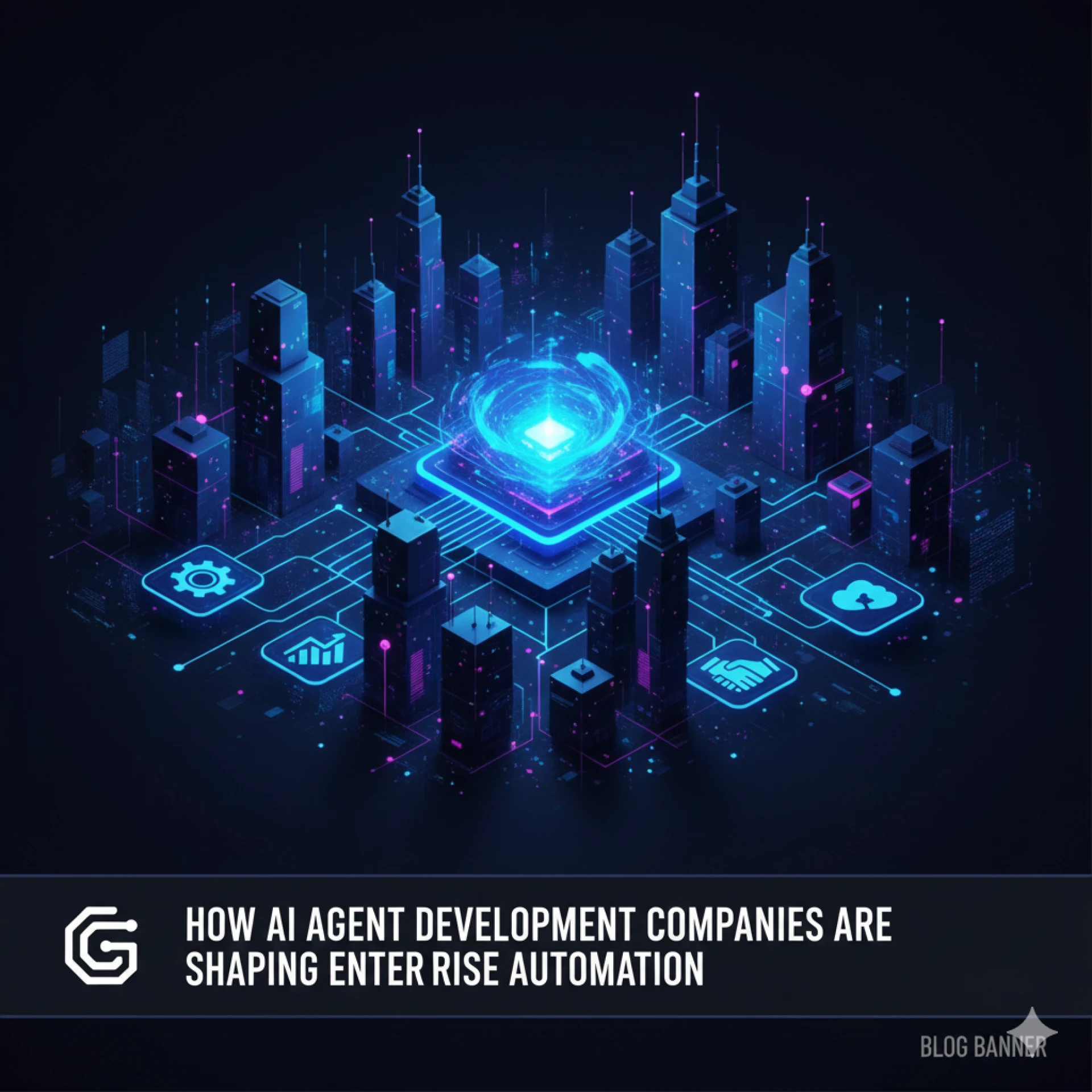

Enterprise automation is entering a new phase. What began with rule-based systems and RPA has evolved into autonomous, goal-driven AI agents capable of reasoning, planning, and acting across systems. This shift is being led by specialized agentic AI companies delivering enterprise-grade AI agent development services designed for real operational complexity.
Rather than automating isolated tasks, AI agents are reshaping how work gets done across the enterprise.
From Automation to Operational Intelligence
Traditional automation focuses on execution. AI agents focus on outcomes.
Unlike scripted bots, AI agents can:
- Interpret context and intent
- Decide next-best actions
- Coordinate across tools and data sources
- Adapt workflows dynamically
This transition mirrors broader enterprise trends, as seen in
How generative AI development companies are driving enterprise automation—where intelligence, not just efficiency, becomes the differentiator.
What AI Agent Development Companies Actually Build
AI agent development goes far beyond deploying a large language model. Leading providers design end-to-end systems that combine:
- LLM reasoning and planning
- Tool and API orchestration
- Memory and context management
- Decision guardrails and policies
- Human-in-the-loop controls
This is why enterprises increasingly rely on agentic AI companies for automation initiatives that must operate securely, reliably, and at scale.
Key Areas Where AI Agents Are Transforming Enterprises
1. Customer Service and Support Operations
AI agents are replacing scripted chatbots with intelligent resolution engines.
They can:
- Handle complex, multi-turn customer interactions
- Access CRM and knowledge bases
- Summarize customer history and intent
- Resolve issues end-to-end or escalate intelligently
IBM highlights that AI agents are becoming foundational to modern service operations, where speed and accuracy directly affect revenue and retention.
2. Enterprise Workflow Orchestration
AI agents act as orchestration layers across systems that were never designed to work together.
They are used to:
- Automate approvals and reviews
- Coordinate tasks across ERP, CRM, and internal tools
- Monitor workflows and trigger actions
- Handle exceptions without manual intervention
This transforms automation from linear flows into adaptive, intelligent processes.
3. Knowledge Work and Decision Support
AI agents reduce manual effort in analysis-heavy roles by synthesizing information and generating insights.
Common use cases include:
- Business and operational reporting
- Policy interpretation and summaries
- Research assistance
- Executive decision support
According to McKinsey, this type of knowledge work represents one of the largest opportunities for AI-driven productivity gains.
(External: McKinsey – What Is Agentic AI?)
4. IT Operations and Incident Management
AI agents are increasingly embedded in IT environments to improve resilience.
They help by:
- Monitoring system health
- Detecting anomalies and incidents
- Performing root-cause analysis
- Creating and resolving tickets automatically
This reduces downtime while improving response consistency.
Why Enterprises Don’t Build AI Agents Alone
Building reliable AI agents introduces challenges around:
- Security and access control
- Compliance and auditability
- Integration with legacy systems
- Model reliability and hallucinations
- Change management and adoption
Enterprise-grade AI agent development services address these issues by embedding governance, observability, and human oversight directly into agent architectures.
Security, Governance, and Trust by Design
For AI agents to operate autonomously, trust is non-negotiable.
Leading agentic AI companies implement:
- Role-based permissions
- Secure tool invocation
- Action and decision logging
- Policy-driven guardrails
- Explainable reasoning paths
These controls ensure AI agents enhance operations without introducing unacceptable risk.
The Strategic Impact on Enterprise Automation
Organizations adopting AI agents successfully report:
- Reduced manual operations
- Faster decision-making cycles
- Improved consistency and accuracy
- Higher employee productivity
- Greater operational agility
AI agents are no longer assistants; they are becoming active participants in enterprise operations.
Conclusion
AI agent development companies are shaping the future of enterprise automation by moving beyond task execution to operational intelligence. Through advanced AI agent development services, enterprises can deploy autonomous systems that reason, adapt, and scale securely across the organization.
As automation evolves, the competitive advantage will belong to enterprises that invest not just in AI models but in well-designed, governed AI agents that can run the business alongside humans.



























Sign in to leave a comment.