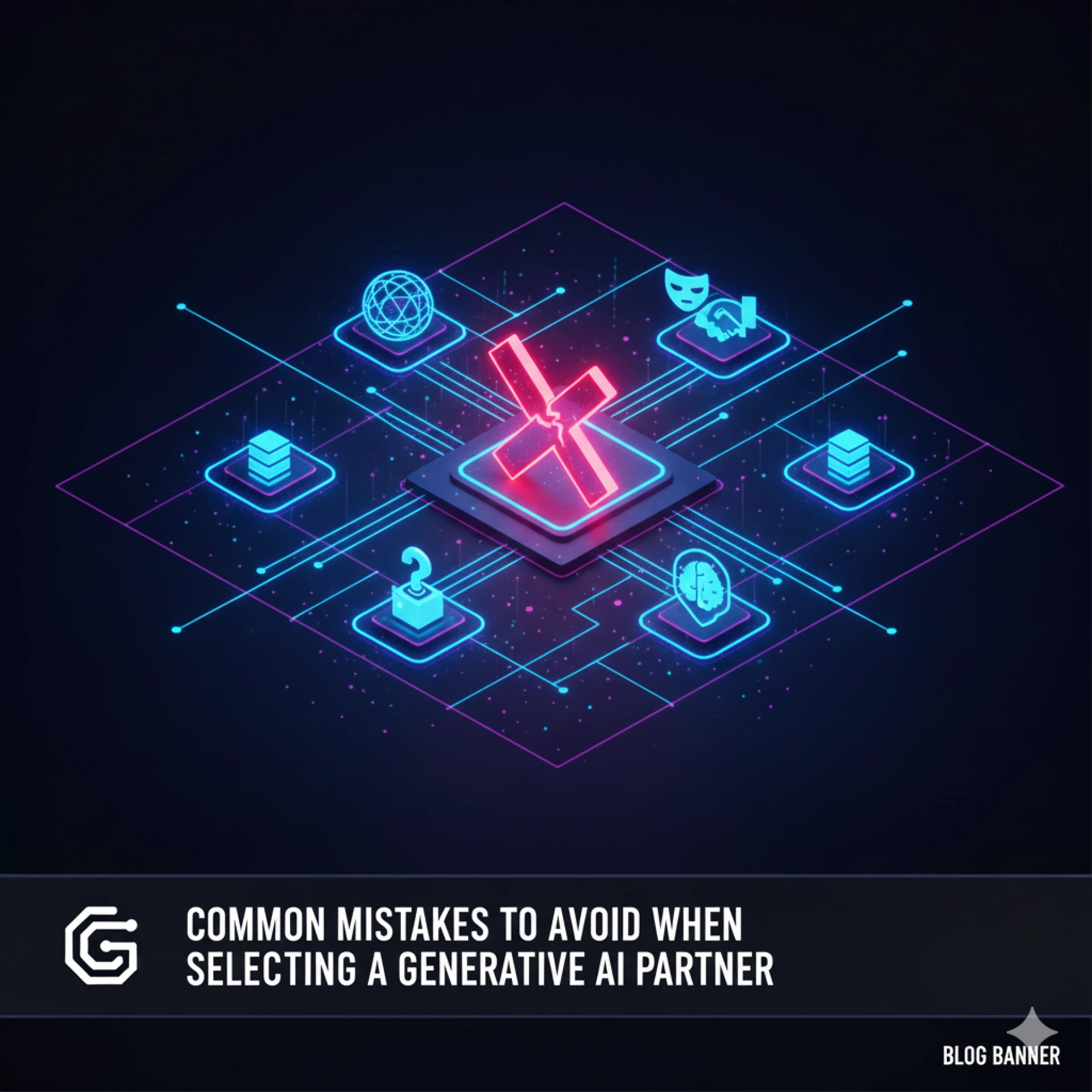

Generative AI adoption is accelerating, but many enterprise initiatives fail not because of the technology, but because of the partner chosen to implement it. Selecting the wrong vendor can lead to stalled pilots, security risks, and solutions that never scale beyond experimentation.
To avoid these pitfalls, enterprises must understand the most common mistakes made when evaluating generative AI companies and enterprise-grade generative AI development services.
Mistake 1: Choosing a Partner Based Only on Models
Many organizations focus on which LLM a vendor uses rather than how solutions are built and deployed.
This often results in:
- Overreliance on public or generic models
- Little customization for enterprise data or workflows
- Poor integration with existing systems
Strong generative AI development services prioritize architecture, orchestration, and governance, not just model access.
Mistake 2: Ignoring Enterprise Integration Complexity
Generative AI rarely operates in isolation. It must integrate with ERPs, CRMs, data warehouses, and internal tools.
Common oversights include:
- Underestimating legacy system constraints
- Lack of API and workflow orchestration expertise
- Fragile integrations that break at scale
This challenge mirrors broader automation trends described in
How generative AI development companies are driving enterprise automation.
Mistake 3: Treating Security and Compliance as Afterthoughts
Security cannot be bolted on after deployment, especially in regulated industries.
Enterprises often fail by:
- Allowing unrestricted data access to models
- Lacking audit trails for AI-generated outputs
- Ignoring data residency and compliance requirements
According to IBM’s guidance on enterprise generative AI, trust, governance, and transparency are critical to scaling AI responsibly.
Mistake 4: Overlooking Data Readiness
Generative AI is only as effective as the data it understands.
Common data-related mistakes:
- Feeding unstructured, low-quality data without preparation
- No context management or data versioning
- Expecting AI to “figure it out” without domain grounding
Leading generative AI companies invest heavily in data pipelines, embeddings, and contextual grounding to ensure reliable outputs.
Mistake 5: Confusing Demos with Real-World Capability
Impressive demos don’t always translate into production success.
Red flags include:
- Prototype-only solutions
- No clear path to scalability
- Lack of performance monitoring or evaluation metrics
As McKinsey notes in its analysis of generative AI adoption, many organizations struggle to move from pilots to value without disciplined execution.
Mistake 6: Failing to Plan for Governance and Human Oversight
Autonomous systems still require accountability.
Enterprises often overlook:
- Human-in-the-loop controls
- Escalation paths for high-risk decisions
- Visibility into how outputs are generated
Mature generative AI development services design governance into the solution, not as a later add-on.
Mistake 7: Selecting a Vendor Without Industry Context
Generic AI implementations rarely deliver enterprise value.
Challenges arise when partners:
- Lack domain-specific experience
- Don’t understand industry regulations
- Apply one-size-fits-all solutions
The most effective generative AI companies tailor solutions to industry workflows, terminology, and compliance needs.
How to Choose the Right Generative AI Partner
To avoid these mistakes, enterprises should evaluate partners based on:
- Proven enterprise deployment experience
- Strong security and governance frameworks
- Deep integration and orchestration expertise
- Industry and domain knowledge
- Clear path from pilot to production
Generative AI success is not about experimentation; it’s about execution at scale.
Key Takeaway
Selecting the right partner is one of the most critical decisions in any generative AI initiative.
Enterprises that avoid these common mistakes and work with experienced generative AI companies offering robust generative AI development services are far more likely to move from isolated pilots to scalable, trusted, and high-impact AI solutions.


























Sign in to leave a comment.