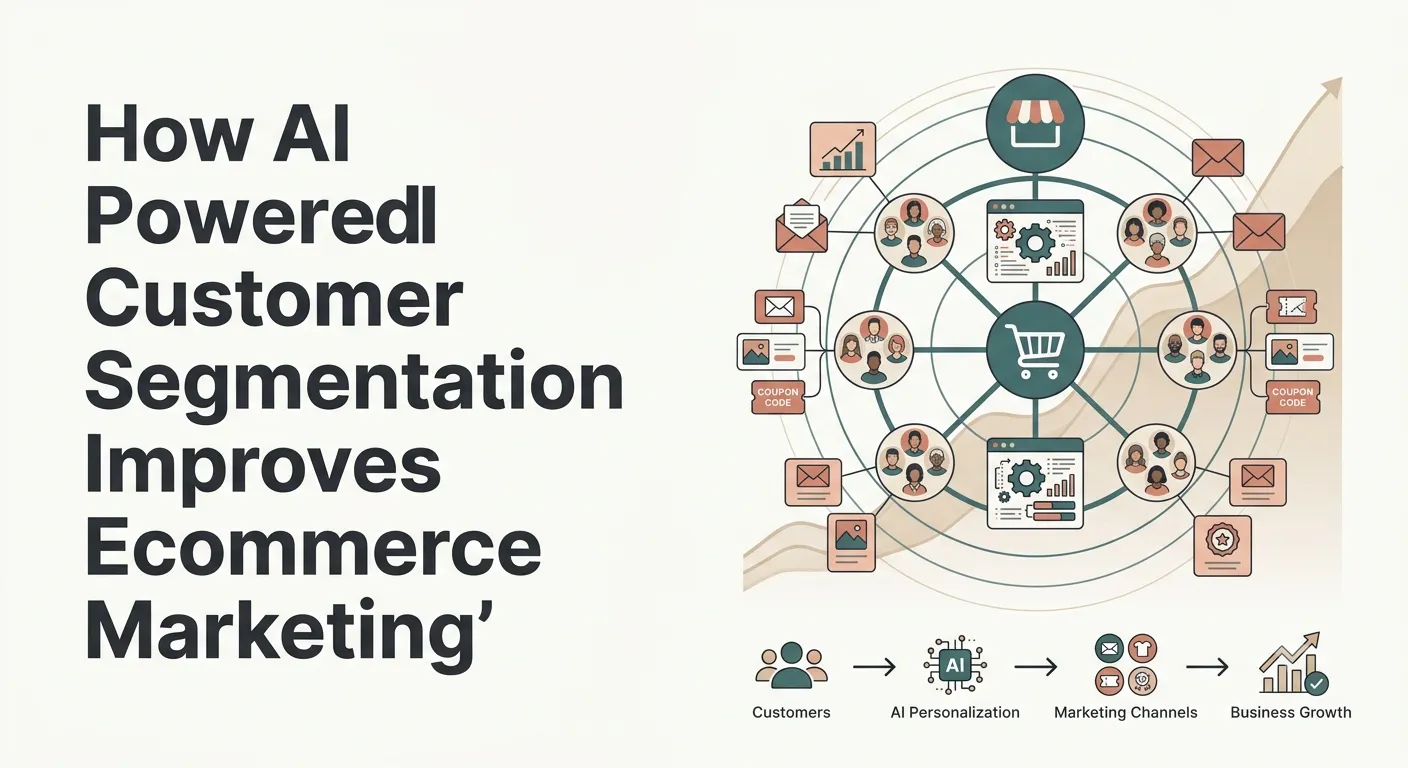

AI customer segmentation gives ecommerce brands something conventional segmentation structurally cannot deliver, a continuously updated picture of who each customer is right now, what they are likely to do next, and how the brand should respond in real time. Brands implementing this correctly do not just improve campaign performance in the short term. They build a customer intelligence infrastructure that grows more accurate and more valuable with every interaction cycle that passes. This blog covers how the approach works across five segmentation types, how the implementation pipeline operates, and what the foundational requirements are for producing results rather than just adding complexity.
Why Static Segmentation Keeps Failing Ecommerce Brands
Most ecommerce brands run segmentation built on a familiar set of limitations. Someone selects the attributes, draws the segment boundaries, assigns customers to groups, and the groups run until a planning cycle creates enough time to revisit them. In practice, that often means segments current six months ago still drive campaign logic today.
The structural problem is not the process behind building the segments. It is what static classification can and cannot tell a team about its customers. A segment built at a point in time reflects who a customer was then, not who they are now, not whether their behavior has shifted in ways that demand a different response, and not what they are statistically likely to do in the near term.
The practical cost is visible in every campaign program running on static segment logic. A loyal customer who completed their fifth purchase this month and a one-time buyer from eighteen months ago sit inside the same high-value segment because nobody built the logic to distinguish them. The campaign calendar treats them identically. The budget distributes equally between a customer the brand should invest in heavily and one who has almost certainly already moved on. That is not a resourcing problem. It is an architecture problem.
What AI Segmentation Does Differently at Every Level
AI segmentation replaces manual classification logic with machine learning models that read behavioral, transactional, and contextual signals simultaneously and continuously. Segment assignments update automatically as new data arrives. Customers move between segments based on what they are actually doing right now, not based on what they did when someone last ran a manual refresh.
The data inputs that generate the most commercially actionable segmentation:
- Behavioral signals: pages visited, products viewed, session frequency, browse depth, time between visits
- Transactional history: purchase frequency, average order value, category preference, return behavior
- Engagement data: email open rates, push notification response, loyalty program participation levels
- Contextual signals: device type, acquisition source, time of day, seasonal purchase patterns
- Predictive indicators: churn probability, upsell receptivity, next-purchase timing
The gap is not in data access. Most ecommerce brands already generate all of this across their existing technology. The gap is in what happens to it. A conventional segment uses one or two attributes to draw a static line. An AI-driven segment uses all of these inputs together, weights them based on what actually predicts behavior in that specific business context, and moves customers between segments automatically, without a scheduled review, a manual update cycle, or a team member catching the change before the next campaign goes out.
Five Segmentation Methods That Drive Ecommerce Revenue When Combined
Effective AI segmentation does not apply a single method across the entire customer base. It layers multiple approaches based on the data available and the commercial outcomes the business needs to produce.
Behavioral Segmentation
Behavioral segmentation groups customers by how they actually interact with the brand, not by demographic proxies that assume behavior rather than measure it directly. Two customers with matching demographic profiles can behave in opposite directions across every meaningful purchase signal. One moves quickly through the consideration phase, responds to urgency framing, and converts within the same session. The other reads every product detail, saves items across multiple visits, and purchases only after external confirmation like a price change or a review count threshold. Demographic filters apply identical logic to both. Behavioral segmentation treats each as the distinct commercial opportunity they represent.
Predictive Segmentation
Predictive segmentation uses established behavioral patterns to forecast each customer's most likely next action before it happens. Which customers show early churn indicators, declining session frequency, narrowing category exploration, stretching purchase intervals, weeks before they go formally inactive? Which first-time buyers carry the behavioral characteristics that consistently predict high long-term value across their very first interactions? Predictive segmentation answers both questions with quantitative evidence rather than team intuition, enabling intervention while the window is still open rather than after the damage has already occurred. Engaging structured AI consulting services gives brands the modeling infrastructure to make predictive segmentation operationally reliable rather than difficult to activate and maintain.
RFM-Based Segmentation
Recency, frequency, and monetary value remain among the most dependable behavioral signals in ecommerce retention. AI extends the RFM framework significantly by weighting each dimension differently based on category dynamics, seasonal context, and individual lifecycle stage — and by updating scores continuously rather than in batch processing cycles that introduce exactly the lag the framework is supposed to help overcome. A customer whose recency score declines while monetary value stays high represents a different retention problem than one whose recency and frequency both drop at the same time. Static RFM treats both situations identically. AI-driven RFM distinguishes between them and routes each toward the intervention that actually fits.
Psychographic Segmentation
Psychographic segmentation goes beyond measuring what customers do to modeling why they do it. By analyzing browsing patterns, content engagement, product affinity signals, and review language across sessions, AI constructs a working picture of each customer's underlying values, motivations, and commercial orientation, intelligence that transactional data cannot produce on its own. A luxury-oriented customer and a value-driven customer can share identical purchase frequencies and average order values while requiring completely different messaging approaches, offer structures, and channel sequences to engage effectively. Psychographic signals make that distinction visible and actionable at the scale a machine learning model can operate across.
Micro-Segmentation
Micro-segmentation combines every layer above into hyper-specific audience groups approaching individual behavioral profiles the architecture that makes genuine one-to-one personalization possible across email, product recommendations, onsite experience, and paid retargeting. Brands that operate micro-segmentation effectively describe it as a durable competitive advantage. That advantage does not come from a single capability. It comes from all segmentation layers working together inside a unified system that updates continuously, accumulates intelligence with every cycle, and produces better segmentation outputs than the previous period as a result.
The Five-Stage Pipeline Behind AI Segmentation
Understanding the full pipeline from data collection to continuous learning helps teams identify exactly where implementations break down, before those breakdowns undermine the commercial case for the investment.
Stage 1: Data Collection
Every session, product view, cart interaction, and abandoned checkout generates behavioral data that most brands capture only partially. The most consistent gaps appear in cross-device session stitching, offline-to-online identity linkage for omnichannel retailers, and post-purchase signals like returns and support activity, behavioral data that carries meaningful retention information but rarely flows back into segmentation models. A thorough Google Analytics 4 audit identifies precisely where event tracking breaks down and where the data gaps that limit AI segmentation quality actually originate, before those gaps compound into systematic model errors that undermine accuracy across the entire segmentation program.
Stage 2: Data Unification
A customer who browses on a mobile app, adds to cart on mobile web, and completes the purchase on a desktop device appears as three disconnected sessions in a fragmented data architecture. In a properly unified customer profile, those three touchpoints belong to one customer with a recognizable high-intent behavioral pattern that should directly inform every subsequent brand interaction. For omnichannel retailers, unification extends further, to POS data, loyalty program activity, and in-store behavioral signals where tracking exists. Understanding what Adobe Real-Time CDP does clarifies how unified profiles become the operational foundation that gives downstream segmentation something accurate and complete to build on rather than partial customer representations that produce partial intelligence.
Stage 3: Pattern Recognition
Pattern recognition is where AI performs work that no human analyst team can replicate at meaningful scale. Machine learning algorithms identify behavioral clusters across millions of customer records simultaneously. without the cognitive bias that consistently pulls manual segmentation toward familiar assumptions. The algorithm does not assume that age predicts purchase intent or that high AOV predicts retention probability. It identifies the actual behavioral combinations that predict those outcomes in the specific context of that business and that customer base. whether or not those combinations match existing team expectations about customer behavior.
Stage 4: Segment Activation
A well-constructed segment sitting inside a customer data platform without downstream activation logic generates no revenue. The segment must flow automatically into journey triggers, campaign audiences, recommendation engines, onsite personalization layers, and paid retargeting audiences in real time, without manual export cycles that reintroduce the processing lag AI segmentation exists to eliminate. Adobe Customer Journey Analytics provides the activation infrastructure that connects intelligent segment creation directly to live campaign deployment, closing the operational gap between the intelligence the model generates and the customer experience that intelligence should trigger immediately rather than after a manual handoff.
Stage 5: Continuous Learning
Every campaign response, every open, click, purchase, and unsubscribe, feeds back into the segmentation model and refines how it classifies customers in subsequent cycles. Brands running seasonal catalogues benefit from this particularly. A model that learns how customer behavior shifts across regular trading periods, promotional windows, and gifting seasons builds cumulative segmentation intelligence that no manually refreshed static rule set can replicate, because the learning accumulates with every cycle rather than resetting each time someone updates the segment logic from scratch.
What Effective Implementation Requires Before Results Are Possible
Most AI segmentation implementations underperform not because the platform is the wrong choice but because the data foundation beneath the platform is not ready to support the intelligence layer being built on top of it.
Data quality sets the absolute ceiling on what any model can produce. AI systems processing fragmented, inconsistent, or incomplete behavioral data do not generate intelligent segments. They generate confident, automated classification errors that propagate at greater speed and larger scale than any manual mistake. The investment that matters most belongs in the data layer first, not in the AI capability positioned above an unstable foundation.
Unified customer profiles are the non-negotiable starting point. Without a consolidated view combining behavioral signals across every touchpoint, ecommerce platform, email tool, CRM, loyalty program, paid media, onsite analytics, the model classifies partial customer representations rather than complete behavioral profiles. Partial inputs produce partial intelligence, and partial intelligence produces systematically wrong segmentation delivered with the confidence of an automated system that never flags its own uncertainty.
Event tracking quality directly determines segment quality. Sparse or inconsistent event data produces segments that reflect data architecture gaps rather than actual customer behavior. Brands investing in clean, comprehensive behavioral event tracking give AI models raw material that mirrors real customer interactions accurately. Brands that do not give models gaps that fill silently with assumptions rather than signals, and those assumptions compound invisibly over time.
Activation strategy is what converts segmentation intelligence into revenue. Segments generate no commercial value in isolation. Every segment requires a deliberate plan defining how it receives different messaging, different offer structures, different channel sequences, and different journey logic based on what the segment intelligence actually reveals about that customer group's needs and readiness to act.
A practical implementation sequence:
- Audit all existing data sources and map precisely where fragmentation occurs across every customer touchpoint
- Unify customer profiles into a single consolidated data layer before activating the AI modeling layer above
- Define four to six high-priority segments with explicit quantified business cases: high-LTV customers, early churn signals, first-purchase converters, dormant reactivation candidates
- Build activation logic and suppression architecture for each priority segment before expanding segmentation complexity
- Instrument feedback loops that return campaign outcomes to the model continuously rather than waiting for scheduled performance reviews
The Business Impact of AI Segmentation Done Properly
The commercial impact of effective AI customer segmentation does not stay marginal. It compounds across every campaign cycle in ways that steadily widen the gap between brands operating on behavioral intelligence and those still running static segment logic.
Campaigns that reach customers at their moment of highest behavioral receptivity convert at measurably higher rates than campaigns timed to operational convenience. Churn interventions triggered by early predictive signals recover customers that reactive win-back campaigns cannot reach, because those customers have not yet decided consciously to shop elsewhere and their engagement window remains genuinely open. Product recommendations built on real behavioral affinity grow basket values without requiring discount depth to do the conversion work.
The efficiency gain runs parallel to and compounds alongside the revenue gain. Every campaign delivered to a segment with low purchase probability is budget allocated to generating noise. AI segmentation concentrates spend on audiences with demonstrated behavioral intent and reduces waste on audiences not ready to act, systematically, without manual audience review before each send, across every campaign cycle.
The full breakdown of how these outcomes translate across real ecommerce environments lives in the complete guide to AI customer segmentation for ecommerce brands.
Where AI Customer Segmentation Moves From Here
The trajectory runs clearly toward individual-level intelligence, not progressively better group segmentation, but the effective elimination of groups as the operative personalization unit in ecommerce marketing altogether.
Generative AI already enables dynamic content variation at scale where a single campaign brief produces hundreds of content versions matched to specific behavioral profiles without proportional production cost increases. Real-time personalization engines already respond to in-session behavioral signals rather than historical segment classifications, so a customer displaying high purchase intent based on their current navigation pattern receives a different onsite experience from one browsing without direction, even when both customers sit inside the same historical segment.
The post-cookie environment accelerates this trajectory structurally. Third-party data, the audience targeting foundation most retail brands relied on for the past decade, is in irreversible decline. First-party behavioral data collected directly through brand interactions and enriched through loyalty programs, post-purchase engagement, and direct customer relationships becomes the primary fuel for AI segmentation models going forward. Brands building first-party data infrastructure now do not simply improve current campaign performance. They construct the retention and personalization architecture that will define competitive positioning in ecommerce across the next several years, building an asset that competitors still dependent on third-party targeting cannot replicate once those options close permanently.
Effective AI customer segmentation starts with clean data architecture and activates deliberately across the full customer lifecycle, from event taxonomy design and identity resolution through to journey orchestration, channel sequencing, and outcome measurement at every touchpoint. Segmentation built on fragmented data does not produce intelligent marketing. It produces automated assumptions delivered at scale and with systematic confidence. Automated assumptions compound in the wrong direction just as reliably as clean behavioral data compounds in the right one, and the gap between those two trajectories widens with every campaign cycle that passes.


























Sign in to leave a comment.