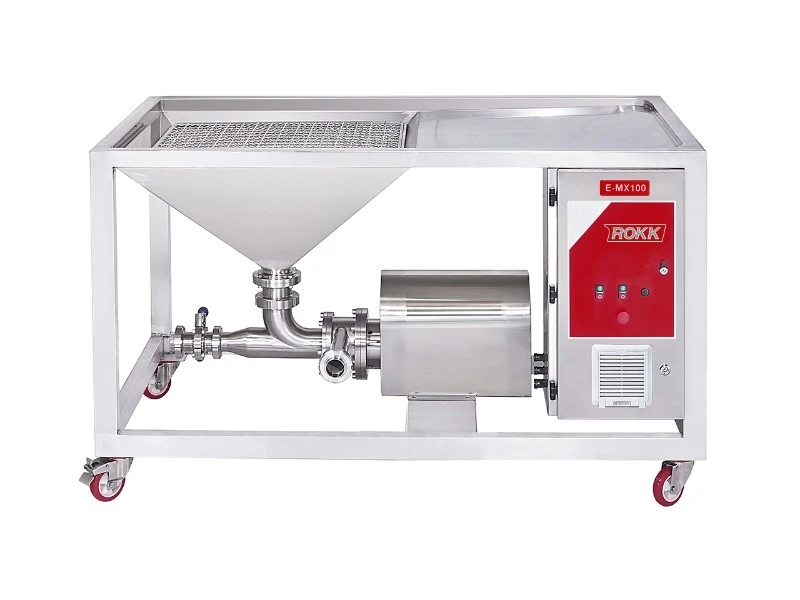

How can manufacturers blend powders into liquids efficiently without clumping, delays, or inconsistent results? In modern food, dairy, and beverage production, the answer lies in high-shear, inline technology designed for continuous processing. This blog explores how an inline powder blender simplifies and accelerates powder-to-liquid integration, highlighting its role in reducing waste, minimizing air incorporation, and enhancing product uniformity.
We will also cover the core engineering features that allow inline powder blending systems to meet today's production lines' hygiene, throughput, and quality expectations.
High-Shear Mixing for Uniformity and Speed
One of the greatest benefits of an inline powder blender is its ability to maintain high blending uniformity even at large volumes. Models like the E-MX50 and E-MX100 offer liquid flow capacities ranging from 5,000 to over 18,000 liters per hour, with powder induction rates of up to 4,000 kilograms, depending on the model.
This is achieved through precision-engineered rotor-stator mixing heads that create intense turbulence and particle disintegration. Whether the application involves dairy bases, dessert formulations, or sauces, the result is a clean, stable emulsion or suspension with consistent texture across every batch.
Hygiene, Efficiency, and Ease of Integration
Sanitation and cleanability are essential in food and beverage environments. The inline powder blender is constructed using 316L stainless steel for product contact surfaces and features a CIP-compatible design. The enclosed system minimizes the risk of contamination, while IP65-rated control panels, vacuum and pressure gauges, and mechanical seal options support safe, compliant operation.
The compact design and inline layout allow easy integration into new and existing lines. This enables producers to upgrade their blending capabilities without needing large vessels or complex reconfiguration.
Energy-Efficient, Scalable Performance
With power ranges from 2.2 kW in compact models to 25 kW in high-capacity systems, an inline powder blender delivers scalable performance suited to pilot and production-scale operations. Variable-speed drives and efficient flow geometry help optimize energy use, making the blender a technical and economical asset to processing lines.
Whether processing 750 liters per hour or 24,000, the system ensures consistent powder-to-liquid ratios and repeatable batch performance.
Conclusion
In conclusion, an inline powder blender transforms how manufacturers manage powder-to-liquid mixing. Through efficient venturi induction, high-shear dispersion, and continuous inline operation, these systems eliminate common batch processing issues like clumping, aeration, and uneven dispersion. Their hygienic construction, ease of integration, and scalability make them essential for facilities aiming to improve output quality and efficiency.
For operations that demand speed, consistency, and clean blending, the inline powder blender offers a forward-thinking solution that supports both current needs and future growth.































Sign in to leave a comment.