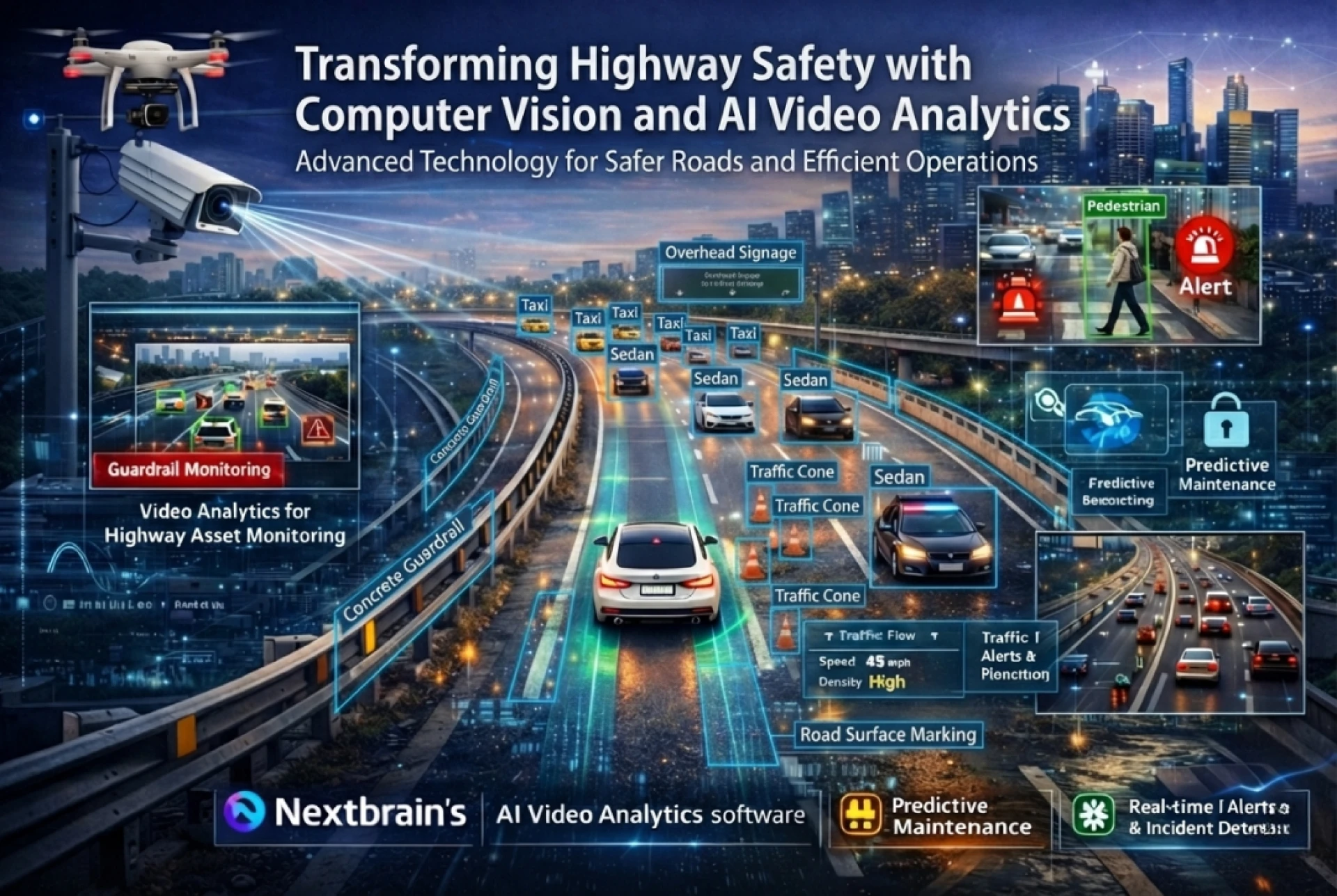

In modern society, transportation plays a critical role in ensuring seamless road connectivity and economic growth. As cities expand and traffic volumes increase, improving road safety has become a top priority for governments and urban planners. Effective traffic management and infrastructure monitoring are essential pillars of smart city development. Today, advanced technologies such as computer vision are reshaping how transportation systems operate—making roads safer, smarter, and more resilient.
Computer vision is rapidly dominating global industries, from healthcare and finance to automotive and emergency response. In transportation, it is redefining how road networks are monitored and maintained through AI Video Analytics for Highway Asset Monitoring, enabling authorities to gain real-time visibility into highway conditions. Aging infrastructure, limited inspection resources, and increasing congestion make traditional monitoring methods reactive, labor-intensive, and expensive. This is where computer vision-powered systems step in, transforming conventional roads into intelligent, data-driven infrastructure.
In this blog, we explore how computer vision is revolutionizing transportation and highway asset management. We will examine its key applications, benefits, challenges, and future potential in creating safer and more efficient road networks.
Applications of Computer Vision Technology in Transportation
Computer vision has emerged as one of the most powerful technologies for reducing traffic congestion, preventing accidents, and enhancing urban road safety. By analyzing video feeds in real time, computer vision systems deliver cost-effective solutions for incident detection, driver monitoring, and highway asset management—while supporting the development of secure smart city ecosystems.
Maintaining Road and Highway Safety
Road safety is a fundamental objective of highway asset management. Traditional Advanced Driver Assistance Systems (ADAS) and intelligent transportation systems rely on localized vehicle sensors. Computer vision goes beyond this by analyzing visual data at scale, delivering deeper insights and broader situational awareness.
Vision AI uses AI-powered video and image analysis to automatically detect, classify, and evaluate road assets such as signs, markings, barriers, and lanes. This continuous monitoring significantly reduces collision risks, improves enforcement efficiency, and enhances roadside safety.
Video-Based Analytics for Smarter Monitoring
With businesses rapidly adopting AI-driven technologies, highway authorities can no longer rely solely on manual inspections. AI-enabled cameras combined with video analytics provide a cost-effective, low-maintenance alternative for large-scale infrastructure monitoring.
Computer vision systems analyze live and recorded footage to deliver actionable insights—without human intervention. This dual capability of sensing and analytics allows authorities to identify safety risks, monitor traffic patterns, and improve decision-making in real time.
Guardrail and Barrier Monitoring
Guardrails and crash barriers are essential safety assets designed to minimize accident severity. However, constant exposure to vehicle impact, corrosion, extreme weather, and structural fatigue reduces their effectiveness over time.
Computer vision-based monitoring continuously evaluates the condition of guardrails and barriers with high accuracy and speed. Early detection of damage enables timely repairs, preventing accidents and extending asset lifespan while reducing inspection risks for personnel.
Real-Time Alerts and Emergency Response
In emergency scenarios, response time is crucial. Computer vision systems can detect incidents such as accidents, stalled vehicles, or unauthorized activities in real time and trigger instant alerts.
Unlike traditional surveillance systems that require manual monitoring, Vision AI analyzes massive datasets continuously and responds immediately. Advanced machine learning models improve incident detection accuracy, enabling faster action by traffic authorities and first responders, ultimately saving lives.
Enhancing Pedestrian Safety
Pedestrian safety remains a major concern in urban transportation systems. Computer vision significantly improves safety at crosswalks and intersections by detecting pedestrian movement and behavior.
AI-powered cameras integrated with traffic signals can dynamically adjust signal timings based on pedestrian volume. During peak hours, systems extend crossing times automatically, ensuring safer passage and reducing accident risks, especially in high-density urban zones.
Drainage and Waterlogging Detection
Poor drainage and waterlogging pose serious threats to highway safety by reducing visibility, weakening pavement structure, and increasing accident risks. Manual inspection of drainage systems is often inconsistent and delayed.
Computer vision AI models can automatically detect water accumulation, blocked drains, and surface deterioration. Continuous monitoring provides both real-time and historical insights, enabling authorities to address drainage issues proactively before they escalate into major hazards.
Improving Highway Infrastructure Efficiency
Computer vision is steadily transforming highway operations by enhancing incident detection and response efficiency. With real-time traffic data, authorities can optimize resource allocation and improve coordination across departments.
Automated asset monitoring, early defect detection, predictive maintenance, and data-driven planning collectively reduce traffic disruptions and operational costs, while improving overall road safety and infrastructure performance.
Predictive Maintenance and Planning
One of the most valuable benefits of computer vision lies in predictive maintenance. By analyzing historical and real-time visual data, AI models identify patterns of wear and deterioration in road assets.
This proactive approach replaces reactive maintenance with risk-based planning—lowering repair costs, extending asset lifespan, and preventing unexpected failures. Predictive maintenance ensures safer roads while optimizing maintenance budgets.
Traffic Flow Optimization
Traditional traffic sensors and induction loops often suffer from accuracy issues and high maintenance costs. Computer vision offers a superior alternative through real-time video processing and analytics.
Vision AI systems analyze traffic density, speed, and congestion patterns to identify peak hours and bottlenecks. These insights help authorities optimize traffic signals, reduce congestion, and improve overall traffic flow efficiency.
Why Choose Nextbrain’s Computer Vision-Powered Highway Asset Monitoring?
Nextbrain’s highway asset monitoring solution leverages advanced computer vision and deep learning algorithms to analyze video feeds in real time using robust AI Video analytics software. The platform enables automated detection of defects, anomalies, and safety hazards, eliminating the limitations of manual inspections.
Designed for large-scale deployment, Nextbrain’s solution integrates seamlessly with existing cameras, drones, and asset management systems. By continuously processing visual data through AI Video analytics software, it identifies wear, damage, and missing assets at an early stage, enabling predictive and preventive maintenance instead of costly emergency repairs.
With scalability, accuracy, and operational efficiency at its core, Nextbrain empowers highway authorities to build safer, smarter, and future-ready road networks.
Conclusion
The integration of computer vision with real-time traffic and infrastructure data is transforming how highways are monitored and maintained. By enabling continuous, automated, and accurate asset inspection, computer vision overcomes the limitations of manual surveys and introduces a proactive maintenance model.
As cities move toward smarter and more autonomous transportation systems, computer vision will play a vital role in building resilient, efficient, and safer road infrastructure.
Ready to modernize your highway asset management? Contact Nextbrain today to explore how computer vision and AI-powered solutions can elevate your road safety and infrastructure performance.
Frequently Asked Questions (FAQs)
1. What is computer vision in highway asset management?
Computer vision uses AI algorithms to analyze images and videos from cameras and vehicles, enabling automatic detection, monitoring, and evaluation of highway assets.
2. What types of highway assets can computer vision monitor?
It can monitor road signs, guardrails, crash barriers, pavements, lane markings, traffic lights, lighting poles, and other critical road infrastructure.
3. How does computer vision improve road safety?
By identifying damaged, missing, or poorly visible assets in real time, computer vision enables early repairs—reducing accident risks and improving driver safety.
4. Does computer vision support predictive maintenance?
Yes. AI-powered computer vision detects early signs of degradation, enabling preventive maintenance that reduces costs and prevents unexpected failures.
5. What is the future of highway asset management?
The future lies in AI-driven, autonomous infrastructure systems that combine real-time insights, smart automation, and predictive analytics to deliver safer and more efficient road networks.

























Sign in to leave a comment.