
A market research analyst spent her mornings doing something no one had automated for her team: opening a dozen news sites, scanning headlines for mentions of competitors, and copying relevant links into a shared document. It worked, barely, until the company expanded into three new markets and the manual scan stretched past two hours a day. What she actually needed was a way to pull news coverage programmatically, filtered by keyword and region, instead of reading everything by hand.
This is a common turning point for teams that rely on current events, whether for brand monitoring, financial research, or content aggregation. Reading news manually does not scale past a handful of sources. A A market research analyst spent her mornings doing something no one had automated for her team: opening a dozen news sites, scanning headlines for mentions of competitors, and copying relevant links into a shared document. It worked, barely, until the company expanded into three new markets and the manual scan stretched past two hours a day. What she actually needed was a way to pull news coverage programmatically, filtered by keyword and region, instead of reading everything by hand.
This is a common turning point for teams that rely on current events, whether for brand monitoring, financial research, or content aggregation. Reading news manually does not scale past a handful of sources. A news api solves this by delivering structured headlines and articles that a program can filter, search, and route automatically.
What Is a News API?
A news API is a service that returns current and historical news articles from a wide range of publishers through a single structured request, rather than requiring a separate integration with each outlet. A request specifies parameters like keyword, category, or country, and the response returns matching articles with fields like headline, source, publish date, and a link to the full article.
This matters because news publishers each structure their sites differently. Without a unifying API, pulling headlines from fifty sources would mean building and maintaining fifty separate scrapers, each breaking independently whenever a site redesigns.
How Does a Real-Time News API Actually Work?
It works by continuously ingesting articles from licensed publisher feeds and indexing them by keyword, category, language, and publish time, so a single request can filter across thousands of sources at once.
A typical request looks like this:
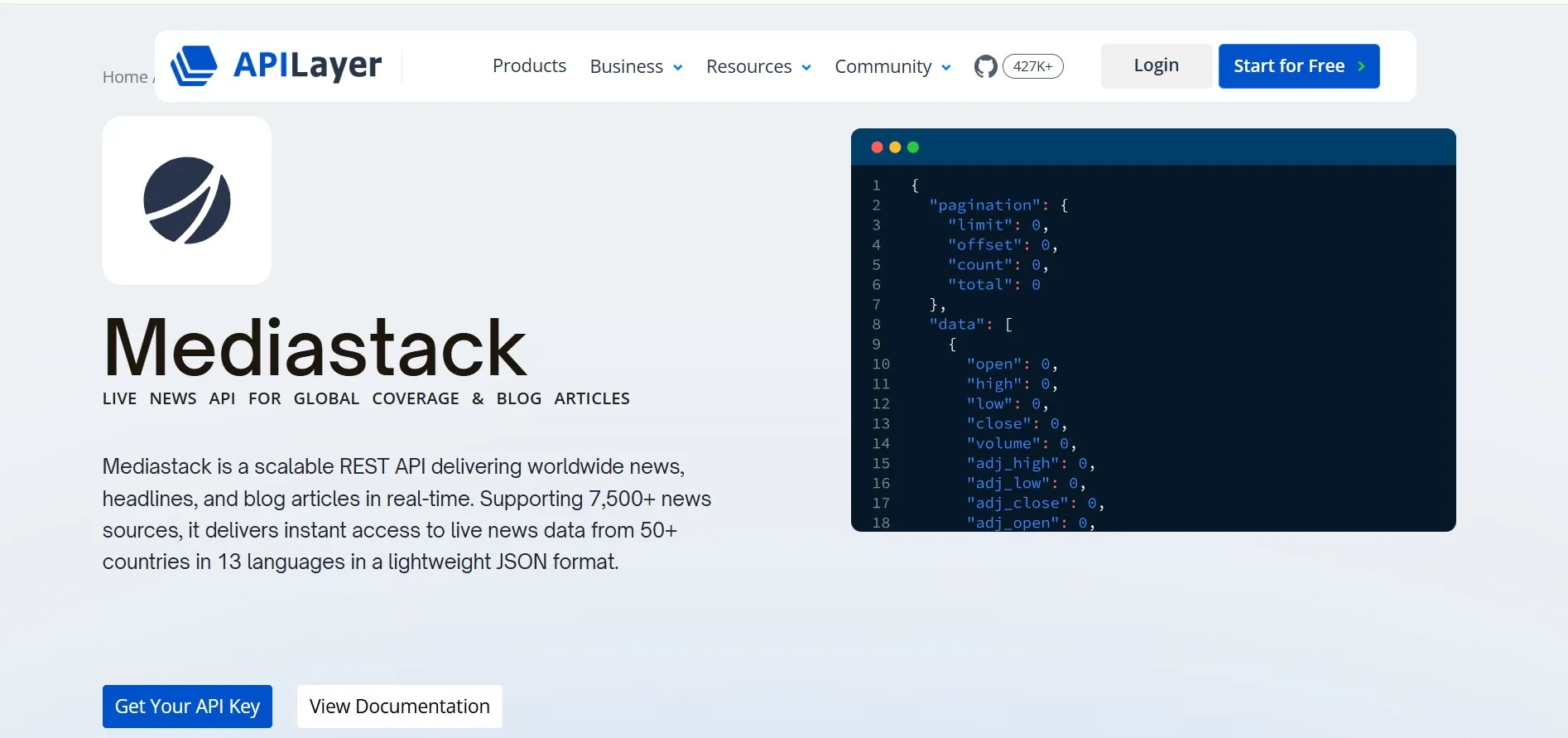
GET https://api.mediastack.com/v1/news?access_key=YOUR_KEY&keywords=renewable+energy&languages=en
The response returns a list of matching articles, each with a title, description, source name, and publish timestamp. Some providers refresh their index every few minutes for breaking coverage, while others update on a longer cycle better suited for daily digests rather than live monitoring.
Why Not Just Scrape News Sites Directly?
Because scraping violates most publishers' terms of service, breaks whenever a site changes its layout, and offers no reliable way to search across sources consistently.
Beyond the legal exposure, scraped content also lacks the structured metadata, like consistent category tagging and publish timestamps, that make filtering possible. A scraper might grab the text of an article, but matching that against a keyword search across hundreds of sites in real time is a different engineering problem entirely, one that a maintained API has already solved.
What Are the Main Ways to Track News Programmatically?
There are a few common approaches, and the choice usually comes down to how broad the coverage needs to be.
RSS feeds are a long standing, free option for tracking specific publishers. The catch is that each site needs its own feed added manually, and RSS offers no cross source keyword search, so tracking a topic across fifty outlets means monitoring fifty separate feeds.
Google Alerts style email digests work for casual monitoring but are not built for programmatic use. There is no clean data format to parse, and results arrive on Google's schedule rather than on demand.
Dedicated news APIs aggregate coverage from many publishers into one searchable index, supporting keyword, category, and country filters in a single call. This tends to be the practical choice for anything beyond casually tracking a handful of favorite sites, since it replaces dozens of individual integrations with one consistent interface.
Coverage breadth varies meaningfully between providers, and it is worth checking before committing to one. Some indexes lean heavily toward major English language outlets, while others include a wider spread of regional and non English publishers. A team monitoring global coverage of a topic will hit gaps quickly with a provider that only indexes a few hundred sources concentrated in one region.
How Do Teams Use a News API in Practice?
Teams typically run scheduled queries against a news API and route matching articles into whatever system needs them, whether that is a dashboard, an alert, or a content feed.
A common brand monitoring workflow looks like this. A scheduled job queries the real time news api every fifteen minutes for the company's name and its top three competitors. Matching articles get logged into a shared spreadsheet or Slack channel, tagged by source and sentiment if the team has added that layer separately. What used to take two hours of manual scanning becomes a background process that surfaces only what actually matters.
For a content site building a news aggregator, the same API can power a category page, pulling the latest articles in a given topic and refreshing them automatically instead of an editor curating links by hand.
Frequently Asked Questions
How current is data from a news API? It depends on the provider and plan, with some refreshing their index every few minutes for near real time coverage and others updating on a longer cycle better suited for daily summaries.
Can a news API filter by language and country? Most established news APIs support filtering by language and source country, which matters for teams monitoring coverage across multiple regions rather than just English language US outlets.
Is it legal to republish content pulled from a news API? Most news APIs return headlines, summaries, and links rather than full article text, and republishing full content typically requires separate licensing from the original publisher, so it is worth checking the specific terms before displaying more than a snippet.
Manual news monitoring works until it does not, and the breaking point usually arrives quietly, as one more source or one more market to track. Automating that layer with a structured API tends to free up the kind of analyst time that was never meant to be spent copying headlines into a spreadsheet in the first place.
If you want to see how coverage looks for your own keywords before building a monitoring workflow, mediastack lets you run test queries directly at https://apilayer.com/products/mediastack/?utm_source=apilayer_product_page_tiles&utm_medium=internal&utm_campaign=product_navigation&utm_content=mediastack_tile. solves this by delivering structured headlines and articles that a program can filter, search, and route automatically.



























Sign in to leave a comment.