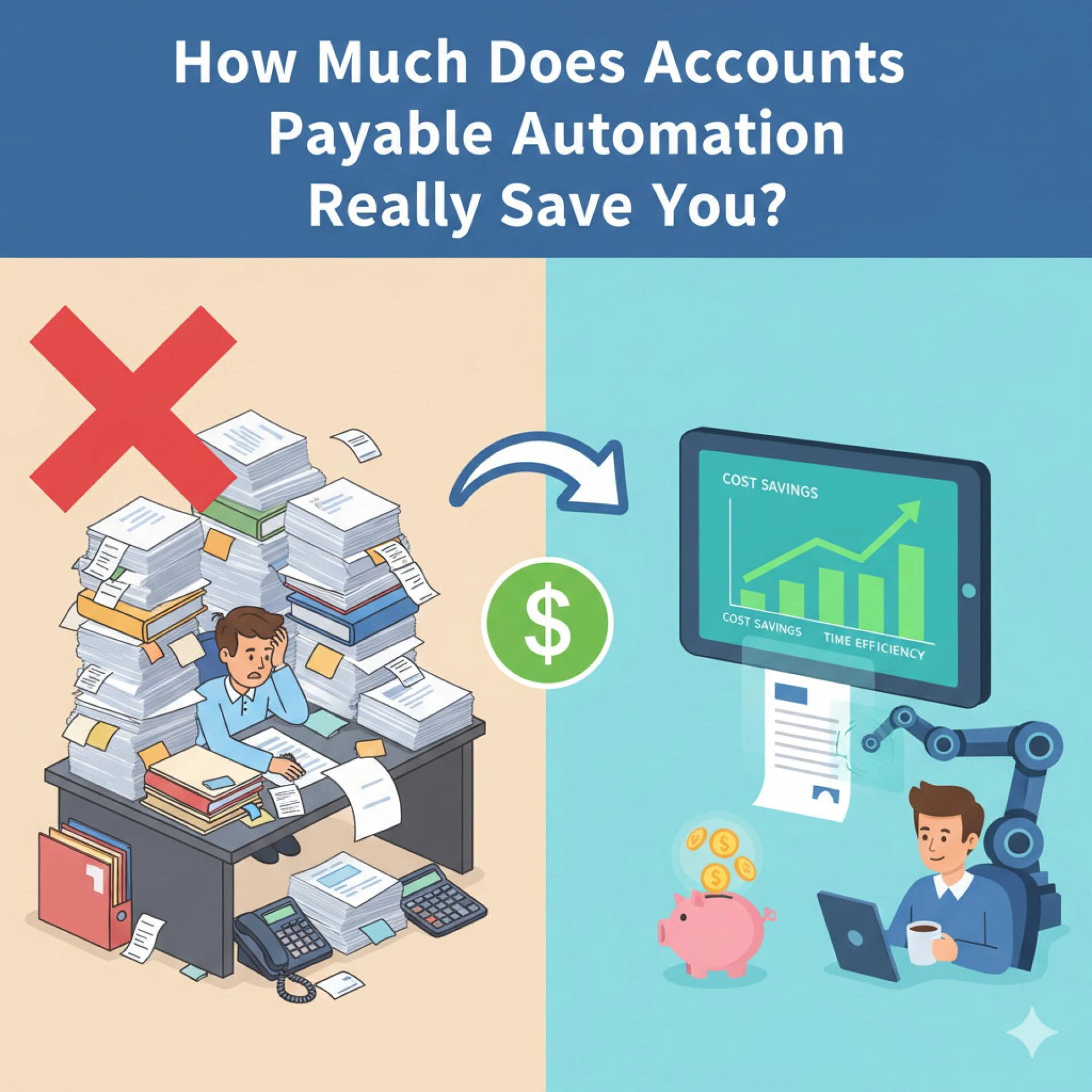

Accounts Payable Automation is changing how finance teams manage costs, compliance, and cash flow. Manual processing still consumes time, labor, and capital that could be better used elsewhere. Each paper invoice, each approval delay, each mismatch adds to invisible costs. Automation reverses that loss, saving both time and money by simplifying the entire invoice-to-pay process.
In this article, we’ll uncover exactly how much Accounts Payable Automation really saves, explore the hidden costs in traditional workflows, identify the main value streams, and explain how to measure your ROI accurately.
Defining the Baseline: What Your Current AP Costs Look Like
Before measuring the savings, you need to understand what your current AP process actually costs. Establishing this baseline is the foundation for any meaningful automation business case.
Mapping your end-to-end invoice-to-pay workflow
A typical AP process includes invoice receipt, data capture, validation, approval, exception handling, posting, and payment. Each step depends on human checks and multiple handoffs. Invoices may arrive by email, paper, or vendor portals, often requiring manual data entry and matching with purchase orders (POs). This makes traditional processing error-prone and time-intensive.
Identifying direct and hidden cost components in AP
Direct costs include staff hours for data entry and validation, while hidden costs come from errors, rework, and missed early-payment opportunities. Storage, postage, and supplier queries add up too. Research shows that manual AP processing costs about $10.18 per invoice, compared to less than $2 with automation.
Benchmarking cost-per-invoice and processing time metrics
Manual invoice processing often takes 8–10 days, with multiple reviews. By contrast, Accounts Payable Automation reduces processing time to under 3 days and cost per invoice to around $1.50. These numbers serve as your baseline when calculating savings.
With your cost structure clear, the next step is to pinpoint exactly where automation delivers measurable gains.
Where Savings Come From: The Key Value Streams
Accounts Payable Automation reduces waste and introduces consistency across every invoice touchpoint. Let’s explore the main value streams that drive measurable impact.
Labour and data-entry cost reduction
By automating data extraction, validation, and routing, companies can lower labor costs by up to 80%. Automation also frees finance staff from repetitive tasks, allowing them to focus on financial analysis and vendor management.
Paper, postage and storage cost elimination
Digitized invoicing eliminates the costs tied to printing, shipping, and archiving. Over time, this reduces physical storage and retrieval overheads, making audits easier and greener.
Faster invoice processing and improved working capital
Accounts Payable Automation accelerates approvals and payments. With faster turnaround, companies can better manage working capital and forecast cash flow more accurately.
Early-payment discounts and reduced late-fees
Automated reminders and on-time processing enable finance teams to capture early-payment discounts that manual systems often miss. Reports suggest automation improves discount capture rates by over 80%.
Error, duplicate payment and fraud avoidance
Automated validation and intelligent matching prevent duplicates and fraudulent invoices. Error-related losses, typically 1–2% of AP spend, can be largely avoided.
Better vendor relationships and potential rebates
Paying suppliers consistently builds trust and positions you for better terms and rebates. A transparent and automated AP cycle strengthens your reputation within the vendor ecosystem.
Each of these areas compounds into significant, recurring savings, which we can now quantify with real metrics.
Quantifying the Savings: Real-World Metrics & Benchmarks
When measured correctly, the ROI from Accounts Payable Automation becomes undeniable.
Cost-per-invoice reductions (manual vs automated)
Enterprises moving from manual to automated systems typically reduce costs by 70–80%. For example, processing 10,000 invoices monthly could shift expenses from $100,000 to roughly $20,000.
Time-to-pay and invoice-cycle time improvements
Cycle time shortens from 10 days to under 3 days, improving liquidity and enabling better cash planning.
Savings by volume and organisation size
High-volume industries such as retail or manufacturing can save millions annually. Even smaller organizations see six-figure savings when processing thousands of invoices per month.
ROI calculation: total savings minus investment
Calculate total savings from labor, materials, and discounts, then subtract automation investment costs. On average, companies achieve payback in 12–18 months with ongoing yearly savings afterward.
Still, these savings can fluctuate if hidden costs aren’t managed carefully.
Hidden Costs and Risk Factors That Can Undercut the Payback
Accounts Payable Automation delivers measurable returns, but execution matters. Some challenges can affect how fast ROI materializes.
Implementation costs, change-management and training
Initial setup, configuration, and team training require time and budget. Addressing change management early helps ensure adoption and smooth transitions.
Integration with ERP/finance systems and maintenance
Automation must connect seamlessly with ERP or accounting platforms. Integration and maintenance costs are part of the total cost of ownership, but the long-term efficiency offsets them quickly.
Workflow exceptions, unmatched invoices and hybrid processes
If some invoices remain outside the automated system, hybrid workflows may limit savings. Full automation, including exception routing, maximizes payback.
Vendor adoption, invoice variety and legacy formats
Savings depend on supplier compliance. Systems capable of handling mixed formats and tax structures ensure scalability and prevent data silos.
Once these variables are managed, you can model real-world savings across different industries.
Case Scenarios: How Much Could You Save in Different Business Contexts
Automation scales differently depending on invoice volume and complexity, but the savings trend remains consistent.
High-volume invoice environments (manufacturing, retail)
Manufacturers and retailers processing thousands of invoices daily can save over $1 million annually in labor and exception handling costs.
Low-volume / high-complexity invoice settings (professional services)
For consulting or legal sectors, automation reduces audit delays and ensures accurate billing, saving time rather than raw processing costs.
Regional / market-specific considerations (emerging markets, multiple currencies)
In multi-currency or high-regulation regions, Accounts Payable Automation ensures tax compliance and accurate FX adjustments—preventing costly reconciliation errors.
Beyond pure financial metrics, automation creates several indirect but impactful advantages.
Untapped Angles: Savings Beyond the Standard Metrics
The benefits of automation reach beyond tangible savings, they reshape finance operations.
Scalability savings when invoice volume grows without head-count increasing
AP teams can handle rising volumes without expanding staff, compounding cost efficiency over time.
Strategic benefit: freeing AP team for value-added tasks (analysis, vendor strategy)
Automated systems remove administrative load, allowing teams to focus on analytics and strategic decision-making.
Sustainability and ESG benefit: paper reduction, digitised workflows
Reducing paper use directly supports sustainability goals while cutting operational waste.
Competitive advantage: faster payables as a reputational / supplier-ecosystem lever
Timely and predictable payments improve supplier confidence, reinforcing your organization’s reputation as a reliable partner.
Once you recognize these layers of value, building a business case becomes straightforward.
Building Your Business Case: A Step-by-Step Savings Forecast Framework
To justify automation investment, you need a clear, data-driven savings model.
Establishing your current baseline metrics and cost drivers
Start by identifying invoice volume, cost per invoice, and current processing time. Include hidden factors such as exception handling and missed discounts.
Identifying which AP functions to automate first for maximum impact
Prioritize high-impact areas, invoice capture, matching, validation, and approval routing, for faster ROI.
Projecting phased savings, payback from year 1 to year 3
Expect immediate cost reduction in year one, with progressive efficiency and cash-flow benefits through year three.
Monitoring and measuring post-automation performance
Use KPIs to track costs, cycle times, and exception rates monthly. Continuous monitoring ensures the system keeps delivering measurable value.
At this point, tracking the right KPIs ensures your savings stay consistent over time.
Key Indicators to Track for Sustained Savings Over Time
Continuous performance tracking helps validate your long-term ROI.
Straight-through processing rate and exception rate
Best-in-class organizations achieve 90%+ straight-through processing (STP), minimizing manual touches and delays.
Days Payable Outstanding (DPO) and payment cycle time
Optimizing DPO maintains liquidity without straining vendor relationships.
Invoice cost-per-unit and labour hours per invoice
Monitoring these helps ensure costs stay low and efficiency remains high.
Discount capture rate, late-fee incidence, vendor satisfaction
These KPIs highlight indirect savings, captured discounts and improved supplier satisfaction both add measurable value.
Finally, let’s tie all these insights into actionable next steps.
Final Thoughts and Next Steps
Why savings are real but vary widely – and what drives the variance
Savings differ based on process maturity, invoice complexity, and supplier participation. Companies with fragmented workflows often see the highest ROI.
How automation becomes a catalyst for broader finance operations change
Accounts Payable Automation extends beyond invoice management, it sets the foundation for better visibility, control, and financial planning across the organization.
Your action plan: assessing readiness, selecting projects, mapping outcomes
Assess your AP maturity, identify automation priorities, and evaluate Accounts Payable Automation Software that fits your organization’s scale and process complexity. With structured execution, automation turns AP from a cost center into a driver of financial efficiency and operational intelligence.



























Sign in to leave a comment.