

Inefficient invoice processing drains resources, delays payments, and frustrates vendors. Finance teams often juggle scattered approvals, missing data, and compliance checks that slow every transaction. The solution lies in Accounts Payable (AP) automation, but the real challenge is choosing the right software. The wrong system can complicate workflows instead of simplifying them.
This article provides a step-by-step framework to help you choose the best Accounts Payable software for your business. You’ll learn how to assess your current AP process, compare deployment models, align features with business needs, plan implementation, and measure lasting success.
Understanding Your Current Accounts Payable Challenges
Before you explore automation options, it’s important to understand where your AP process struggles. This clarity helps in selecting a solution that targets real issues.
Mapping your invoice-to-pay workflow and manually-intensive bottlenecks
Document every step in your invoice lifecycle: from receipt to payment approval. Identify where manual work slows progress, such as data entry, validation, or exception handling. These bottlenecks are prime candidates for automation.
Measuring cost, error-rate and cycle-time pain points in AP
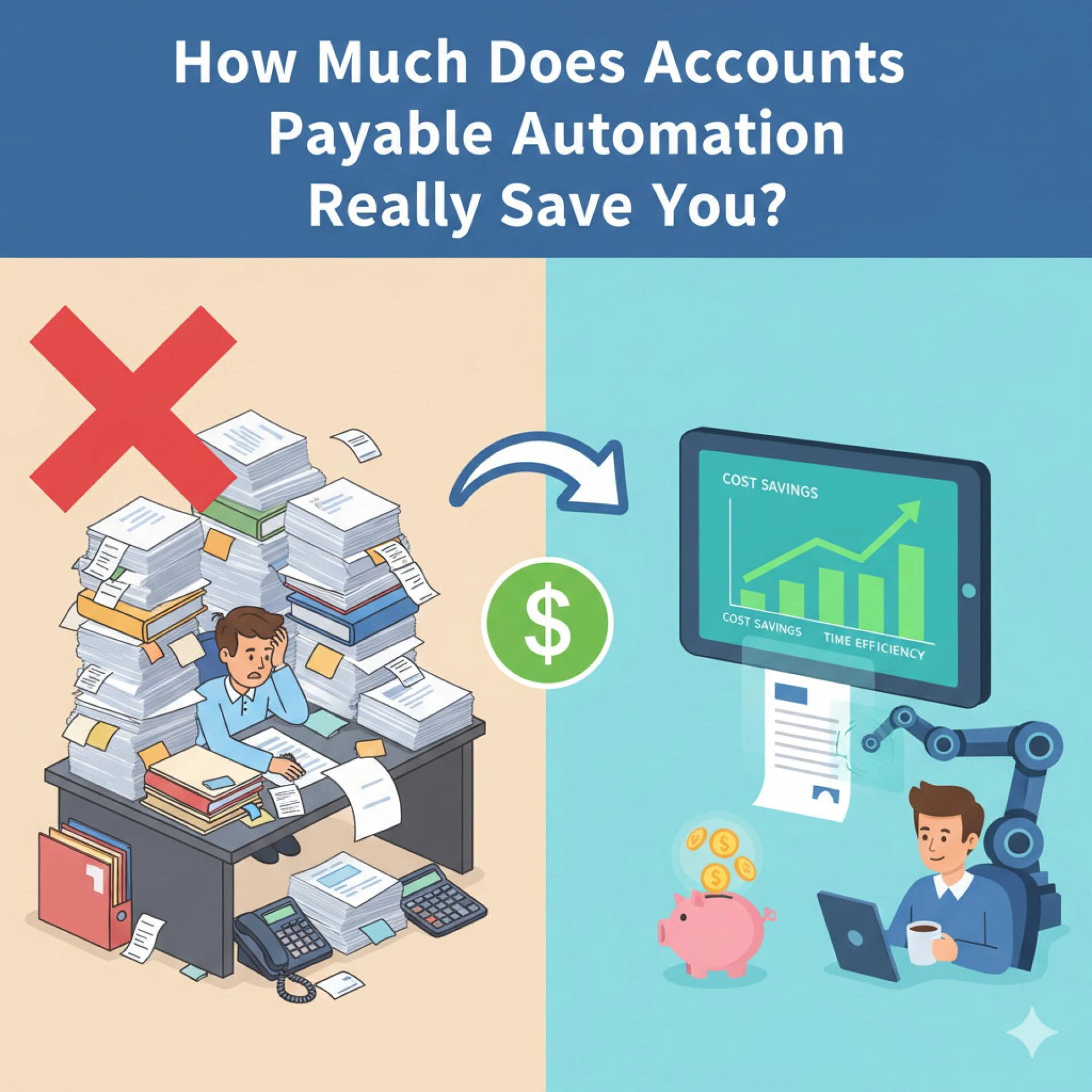
Track your current cost per invoice, time to process, and error rate. Manual processing averages around $10 per invoice and takes 8-10 days. Recognizing these inefficiencies shows what automation can eliminate.
Defining future volume, complexity and business-growth scenarios
Plan for growth. Anticipate higher invoice volumes, additional entities, and new compliance requirements. Selecting software that scales with future business needs avoids repeated migrations later.
Understanding your current pain points sets the stage for identifying the right features in your next AP solution.
Core Selection Criteria for AP Software
The ideal Accounts Payable software should simplify operations, integrate seamlessly with your financial ecosystem, and support compliance at every step.
Feature and capability checklist: capturing invoices, approvals, payments
Prioritize solutions with advanced invoice capture, automated routing, and configurable approval chains. Intelligent data extraction, often part of modern Accounts Payable Automation, saves significant time during entry and validation.
Integration readiness: ERP, accounting systems, vendor portals
A strong AP platform should connect effortlessly with your ERP or accounting system. Integrations with tools like SAP, Oracle, and QuickBooks ensure smooth data synchronization and real-time reporting.
Usability and user-adoption: for AP, finance, operations teams
Software must be intuitive. Dashboards, search functions, and easy navigation support faster onboarding and consistent user adoption across teams.
Security, compliance and audit-readiness standards
Select systems certified under ISO 27001 or SOC Type II. Built-in audit trails, tax validation (GST/VAT), and role-based access strengthen security and regulatory compliance.
Scalability and support for new entities, regions or growth
The platform should support multi-entity and multi-currency operations. Scalability ensures the software continues to perform efficiently as your business expands.
Once you’ve shortlisted software that meets your operational criteria, compare deployment and pricing models.
Comparing Deployment Models and Cost Structures
Deployment choice impacts flexibility, control, and cost over time. Understanding each option helps align investment with business priorities.
Cloud vs on-premise vs hybrid options for Accounts Payable Software
Cloud systems offer remote access and automatic updates. On-premise deployments offer control but require internal IT resources. Hybrid setups balance both, suitable for organizations with mixed data needs.
Pricing models: subscription, per-invoice, user-based, enterprise
Choose pricing aligned with your invoice volume. Subscription and per-invoice models suit growing firms, while enterprise pricing fits large organizations with predictable loads.
Total cost of ownership: implementation, training, change-management
Calculate your total cost, not just license fees. Include expenses for onboarding, user training, and process changes to gain a complete cost picture.
Hidden cost risks: vendor lock-in, feature-add charges, support limitations
Always review contracts carefully. Hidden add-ons or restrictive agreements can erode ROI over time. Transparent SLAs and exit clauses protect your flexibility.
Now that you’ve mapped costs and deployment models, it’s time to connect those insights to your specific business environment.
Aligning Functionality with Business Context
Every organization has unique AP dynamics. Matching software capabilities to your operational realities ensures long-term efficiency.
High-volume invoice environments vs low-volume/high-complexity scenarios
Manufacturing and retail sectors handling thousands of invoices need speed and scalability. Professional services, dealing with complex billing, require flexibility and precision.
Multi-entity, multi-currency, global vendor networks
If you operate globally, ensure your AP software handles multiple currencies and tax jurisdictions. Features for exchange rate automation and localized reporting simplify cross-border payments.
Compliance-heavy industries: regulatory, audit, tax, global payments
Regulated industries should choose software with embedded audit trails and tax validation. Automated documentation ensures compliance across different legal environments.
Future-oriented capabilities: analytics, vendor portal, self-service
Modern AP systems include dashboards, analytics, and supplier portals. These features improve visibility into vendor performance and spend analysis.
Aligning these functionalities early ensures your investment aligns perfectly with both current and future business goals.
Implementation & Change-Management Considerations
A successful rollout depends on planning, governance, and active user participation.
Defining process redesign, workflow governance and stakeholder roles
Assign clear roles across AP, finance, and IT. Re-engineer workflows to reflect automation logic and approval hierarchies.
Training, adoption and change resistance mitigation
Provide hands-on training for staff. Communicate the advantages: reduced manual work, faster approvals, and greater accuracy, to build user confidence.
Data migration, process-exception handling and governance policies
Clean old data before migrating. Define how exceptions (like missing POs) will be handled to maintain accuracy and consistency.
Measuring success: KPIs, reporting, continuous improvement loops
Track KPIs such as cost per invoice, error rate, and cycle time to monitor results post-launch. Consistent reporting ensures progress stays on track.
Smooth implementation lays the groundwork for long-term benefits that go beyond efficiency gains.
Fresh Angles Often Overlooked in AP Software Selection
Beyond functionality, Accounts payable software shapes organizational culture, sustainability goals, and vendor relations.
The cultural impact of AP automation: shifting roles from processing to analysis
Automation turns AP professionals into strategic analysts, freeing them to focus on insights rather than repetitive data entry.
Environmental & sustainability factors in digital vs paper-based AP
Transitioning to a digital system eliminates paper, printing, and courier costs, contributing to corporate sustainability initiatives.
Relationship-impact: how software choice affects vendor experience and retention
Quick, transparent payment cycles enhance vendor satisfaction. Supplier portals reduce disputes and improve overall communication.
Post-selection review: how to extract value long after rollout
Regularly review system performance, feature usage, and ROI. A structured feedback loop ensures the system keeps adding measurable value.
With a 360° view of both tangible and cultural benefits, it’s time to formalize your business case.
Constructing Your Business Case and Decision Framework
Building a strong business case makes leadership buy-in easier and clarifies expected outcomes.
Baseline metrics to capture today: cost-per-invoice, cycle time, error rate
Collect current data on cost and process time. These benchmarks will later help demonstrate quantifiable improvement.
Forecasting savings and value: scenario modelling for 12, 24, 36 months
Project ROI across time horizons. Factor in savings from reduced errors, faster payments, and improved early-discount capture.
Vendor short-listing and proof-of-concept criteria
Shortlist vendors based on fit, scalability, and technical integration. Run pilot tests to validate performance and usability.
Governance and ownership model for AP software success
Assign ownership to ensure accountability. Continuous governance meetings keep improvement initiatives active.
With your business case defined, the final step focuses on selecting and sustaining success.
Final Step: Selecting, On-boarding & Sustaining Success
Choosing a solution is just the beginning, consistent governance ensures long-term impact.
Short-listing vendors aligned with your business context
Compare shortlisted vendors for flexibility, integration, and analytics capabilities. The right partner aligns closely with your company’s growth objectives.
Contract negotiation, SLA definitions and exit-strategy planning
Negotiate transparent terms with clear SLAs for uptime and support. Always define an exit strategy to safeguard flexibility.
Launch plan: pilot, phased rollout, go-live governance
Run a pilot before full rollout. A phased approach ensures stability and user confidence during go-live.
Sustained value: monitoring, continuous improvement, vendor review
Post-launch, track system efficiency and vendor responsiveness. Schedule quarterly performance reviews to identify new improvement areas.
Conclusion
Choosing the right Accounts Payable software isn’t just about automating invoices, it’s about creating a foundation for financial accuracy, visibility, and growth. By following this structured framework, organizations can reduce manual workload, cut costs, and ensure their AP operations scale confidently with business expansion.


























Sign in to leave a comment.