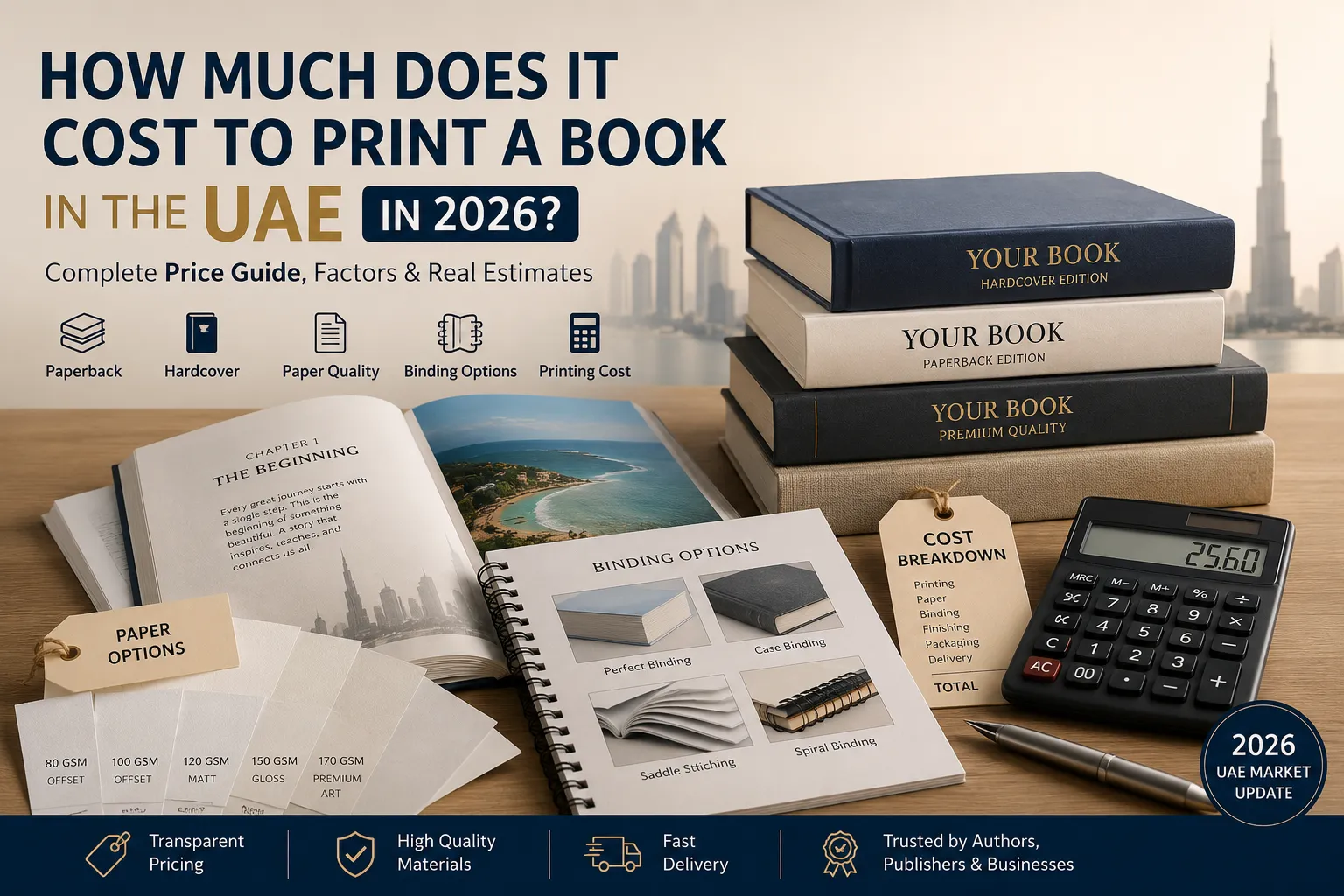

Book printing cost in UAE in 2026 typically ranges from AED 8 to AED 80 per copy, but no single price applies to every project. A black-and-white paperback novel costs far less to produce than a full-colour children’s book, premium hardcover, photography book, or corporate publication.
Your final price depends on the number of pages, book size, print quantity, paper stock, colour requirements, binding method, cover finish, proofing, delivery, and production deadline.
As a general 2026 market estimate, paperback books may cost around AED 10–30 per copy, hardcovers around AED 25–60, children’s books around AED 20–80, and professionally bound theses around AED 15–45. These are indicative ranges rather than fixed quotations because every printing specification changes the production cost.
This guide explains what you can expect to pay, what affects the price, and how to get an accurate book printing quote in the UAE.
Average Book Printing Prices in the UAE for 2026
The table below provides a practical starting point for authors, publishers, schools, companies, and independent creators.
| Book type | Estimated cost per copy | Common use |
|---|---|---|
| Black-and-white paperback | AED 10–30 | Novels, guides and educational books |
| Standard hardcover | AED 25–60 | Premium editions, corporate books and gifts |
| Full-colour children’s book | AED 20–80 | Illustrated stories and activity books |
| Thesis or dissertation | AED 15–45 | University and academic submissions |
| Custom notebook | AED 6–20 | Corporate gifts, schools and events |
| Premium coffee-table book | AED 40–120+ | Photography, art and luxury publications |
These estimates can rise when you select unusual dimensions, premium paper, a low print quantity, specialist binding, foil stamping, embossing, spot UV, slipcases, or urgent production.
The most reliable way to determine your budget is to request an itemised quotation based on your exact book specifications.
Example Book Printing Budgets
The following examples show how the total can change according to the product and quantity. They are illustrative budgets, not guaranteed prices.
50 paperback novels
A 150-page, black-and-white A5 paperback could cost approximately:
AED 750–1,500 total
This estimate assumes a standard paper stock, colour cover, perfect binding, and a relatively small digital print run.
100 paperback books
A standard 100-copy paperback order could cost approximately:
AED 1,000–3,000 total
The per-copy price may fall when the printer spreads setup costs across more units.
100 hardcover books
A case-bound book with a colour cover could cost approximately:
AED 2,500–6,000 total
Premium fabric covers, dust jackets, endpapers, foil lettering, or thicker boards can increase the price.
100 full-colour children’s books
An illustrated children’s book could cost approximately:
AED 2,000–8,000 total
The price depends heavily on page count, paper thickness, colour coverage, cover type, lamination, and binding.
Always confirm whether the quote includes VAT, delivery, proof copies, file checking, packaging, and finishing.
What Affects Book Printing Cost in the UAE?
Printers calculate a project by combining materials, machine time, setup work, finishing, labour, packaging, and delivery. Understanding each variable will help you compare quotations properly.
1. Print Quantity
Quantity usually has the greatest effect on the cost per book.
When you print only 10 or 20 copies, the printer still has to prepare files, configure the machine, test the output, trim the pages, and set up the binding. Those setup costs get divided among a small number of books.
When you order 250, 500, or 1,000 copies, the printer spreads the same setup costs across a larger order. The total investment increases, but the unit cost often falls.
Request prices for several quantities, such as:
- 25 copies
- 50 copies
- 100 copies
- 250 copies
- 500 copies
Do not assume that the largest order automatically gives you the best business decision. Printing 1,000 books may produce a low unit price, but unsold stock creates storage, cash-flow, and distribution problems.
2. Digital Printing Versus Offset Printing
Digital printing suits short print runs, test editions, proof copies, and print-on-demand projects. It requires less preparation and allows printers to produce small quantities quickly.
Offset printing requires more setup because the printer prepares plates and configures the press. However, it can reduce the unit cost for larger quantities.
Digital printing commonly works well for:
- One to 100 copies
- Advance reader copies
- Small author events
- Market testing
- Urgent reprints
- Personal or family books
Offset printing commonly works well for:
- Bulk book printing
- School textbooks
- Corporate publications
- Large commercial launches
- High-volume publisher orders
The crossover point varies by page count, size, colour, paper, and printer. Ask for both digital and offset quotations when ordering 100 copies or more.
3. Number of Pages
Every additional page uses more paper and ink and can increase binding time.
A 300-page novel will usually cost more than a 100-page guide, even when both books use the same trim size and binding. However, printers often work with folded sections or page multiples, so deleting one or two pages may not reduce your price.
Ask the printer whether changing the page count to a more production-efficient multiple would lower the cost.
You can also reduce unnecessary pages by improving the typesetting instead of shrinking the font. Adjust paragraph spacing, chapter openings, margins, headings, and blank pages while protecting readability.
4. Black-and-White Versus Colour Printing
Black-and-white interiors provide the most economical option for novels, textbooks, reports, memoirs, manuals, and many academic books.
Full-colour printing costs more because it uses multiple inks or toners and requires closer colour control. Children’s books, cookbooks, comics, photography books, and product catalogues often need full colour.
You may reduce costs by printing most pages in black and white while grouping essential colour pages into specific sections. Ask whether the printer can produce a mixed-colour specification efficiently before finalising the layout.
For colour-critical work, request a physical proof. Screens display colours in RGB, while commercial printers normally reproduce artwork through CMYK workflows. The final printed colour can therefore differ from the colour displayed on your monitor.
5. Book Size and Orientation
Standard dimensions generally cost less because printers can arrange them efficiently on commercial paper sheets.
Common options include:
- A5 for novels, guides and smaller books
- A4 for manuals, educational books and reports
- Square formats for children’s books and photography
- Landscape formats for portfolios and presentation books
A custom trim size can increase paper waste, cutting work, setup time, and packaging costs.
Before selecting unusual dimensions, ask the book printing company whether a nearby standard size would deliver a similar visual result at a lower price.
6. Paper Type and GSM
Paper affects the price, thickness, weight, readability, colour reproduction, and overall feel of the book.
Common options include:
- Uncoated white paper
- Cream book paper
- Offset paper
- Matte-coated art paper
- Gloss-coated art paper
- Recycled paper
- Premium textured stock
GSM means grams per square metre and indicates paper weight. A higher GSM often feels thicker, although coating, opacity, and paper construction also affect the result.
A text-heavy paperback may use economical uncoated stock. A children’s book may need heavier coated paper. A photography book may require premium art paper for stronger image reproduction.
Do not choose paper from a description alone. Ask the printer for physical samples and compare opacity, texture, brightness, thickness, and print quality.
7. Paperback or Hardcover Binding
Paperback printing normally costs less because it uses a printed card cover attached to the page block.
Perfect binding remains a popular option for novels, business books, educational publications, and manuals. It creates a square spine and professional appearance without the construction cost of a hardcover.
Hardcover production requires rigid boards, stronger binding materials, endpapers, and additional assembly. It therefore costs more but offers greater durability and perceived value.
Hardcover printing often suits:
- Coffee-table books
- Premium author editions
- Corporate history books
- Annual reports
- Photography books
- Commemorative publications
- High-value gifts
Before ordering, compare hardcover and paperback books according to your retail price, audience, distribution method, and expected product life.
8. Binding Style
Your binding choice affects usability as well as price.
Perfect binding works well for standard paperbacks. Case binding produces hardcovers. Saddle stitching suits short booklets with relatively few pages. Spiral and Wire-O binding allow pages to lie flat, making them useful for workbooks, training manuals, planners, cookbooks, and instructional publications.
Some bindings require minimum or maximum page counts. Review the available book binding options in the UAE before preparing your final cover and spine.
9. Cover Finishes and Premium Features
A standard matte or gloss lamination protects the cover and gives the book a finished appearance.
Premium features can increase shelf appeal, but each additional process raises the budget. Common upgrades include:
- Soft-touch lamination
- Spot UV
- Gold or silver foil
- Embossing
- Debossing
- Die-cut covers
- Dust jackets
- Fabric wrapping
- Ribbon markers
- Slipcases
Use premium finishes strategically. A business book may only need a strong matte-laminated cover, while a collector’s edition may justify foil, embossing, and a custom case.
10. File Preparation and Design
A printer needs production-ready files with the correct size, bleed, margins, colour mode, image resolution, embedded fonts, and spine width.
If your files do not meet those requirements, you may need to pay for:
- Typesetting
- Interior formatting
- Cover design
- Image correction
- Colour conversion
- Prepress repairs
- Proofreading or editing
Ask whether file checking is included in the quotation. A basic technical check does not usually include editorial proofreading, so confirm the scope.
11. Proof Copies and Quality Control
A physical proof may add to your initial cost, but it can prevent an expensive full-run reprint.
Check the proof for:
- Page order
- Margins
- Font size
- Image sharpness
- Colour accuracy
- Spine alignment
- Cover trimming
- Binding strength
- Paper show-through
- Missing or blank pages
Confirm that the proof uses the same paper, print method, cover finish, and binding planned for the full order.
12. Delivery, Packaging, VAT, and Urgency
Delivery charges may vary according to quantity, weight, packaging, and destination. A large order delivered to Abu Dhabi, Sharjah, Ajman, or another emirate may cost more than a small local delivery in Dubai.
The UAE’s standard VAT rate is 5%, so check whether the printer’s quotation includes VAT or adds it at the invoice stage.
Rush production can also increase the cost. If you need books for a launch, conference, school event, or exhibition, allow time for proofing, corrections, production, binding, packing, and delivery.
How to Reduce Book Printing Costs Without Sacrificing Quality
Start by selecting a standard trim size and economical paper suitable for your content. Use black-and-white printing where colour does not add meaningful value, and avoid decorative finishes that do not support your target market.
You can also reduce your unit cost by increasing the quantity, but calculate realistic demand before committing to a bulk order.
Most importantly, send the same written specifications to every printer. A cheaper quotation may exclude delivery, lamination, file checking, proofing, packaging, or VAT.
Compare complete products, not headline prices.
How to Get an Accurate Book Printing Quote in the UAE
Send the printer the following information:
- Final trim size
- Total page count
- Interior colour specification
- Paper type and GSM
- Paperback or hardcover requirement
- Binding style
- Cover finish
- Required quantity
- Delivery location
- Required completion date
- Print-ready PDF status
- Proof-copy requirement
A professional provider of custom book printing in the UAE should return an itemised quote and explain any available alternatives.
Ask for at least two options. For example, request one price for 100 copies and another for 250 copies, or compare a paperback specification with a hardcover version.
Questions to Ask Before You Buy Book Printing Services
Before approving an order, ask:
- Does the quote include VAT and delivery?
- Which printing method will you use?
- Will I receive a physical proof?
- Does the proof match the final production specification?
- What paper brand, type, and GSM will you use?
- How will you handle damaged or defective copies?
- Can I inspect similar printed samples?
- Is file checking included?
- What is the confirmed production schedule?
- Are packaging and delivery included?
A reliable book printing company should answer these questions clearly and document the agreed specifications.
Final Answer: How Much Should You Budget?
For most standard projects, you should budget approximately AED 10–30 per paperback, AED 25–60 per hardcover, and AED 20–80 per full-colour children’s book. Premium photography books, luxury finishes, custom packaging, and very small quantities can cost considerably more.
The lowest quotation does not always offer the lowest overall risk. Choose a printer that provides suitable materials, transparent specifications, proof approval, clear deadlines, and documented quality control.
To calculate the price for your manuscript, request a customised quote based on your page count, book size, paper, binding, quantity, finish, and delivery location.
Frequently Asked Questions
How much does it cost to print one book in the UAE?
A single digitally printed book may cost more per copy than a bulk order because the printer cannot spread setup costs across multiple units. The exact price depends on format, pages, colour, paper, and binding.
Is it cheaper to print books in bulk?
Yes, bulk book printing usually lowers the price per copy. However, you should consider storage, delivery, and realistic sales demand before ordering a large quantity.
How much does paperback book printing cost in the UAE?
A standard paperback commonly costs approximately AED 10–30 per copy, depending on quantity and specifications.
How much does hardcover book printing cost?
Standard hardcover printing generally ranges from AED 25–60 per copy. Premium materials and specialist finishes can increase the price.
Is digital or offset printing cheaper?
Digital printing usually offers better value for small quantities. Offset printing can become more economical for larger orders because the unit cost falls as volume rises.
Does a book printing quote include design and editing?
Not always. Printing, cover design, typesetting, proofreading, editing, ISBN support, delivery, and publishing are separate services unless the quotation explicitly includes them.
How long does book printing take in the UAE?
The schedule depends on quantity, binding, finishing, file readiness, and proof approval. Ask for a written timeline covering prepress, proofing, production, binding, packing, and delivery.

























Sign in to leave a comment.