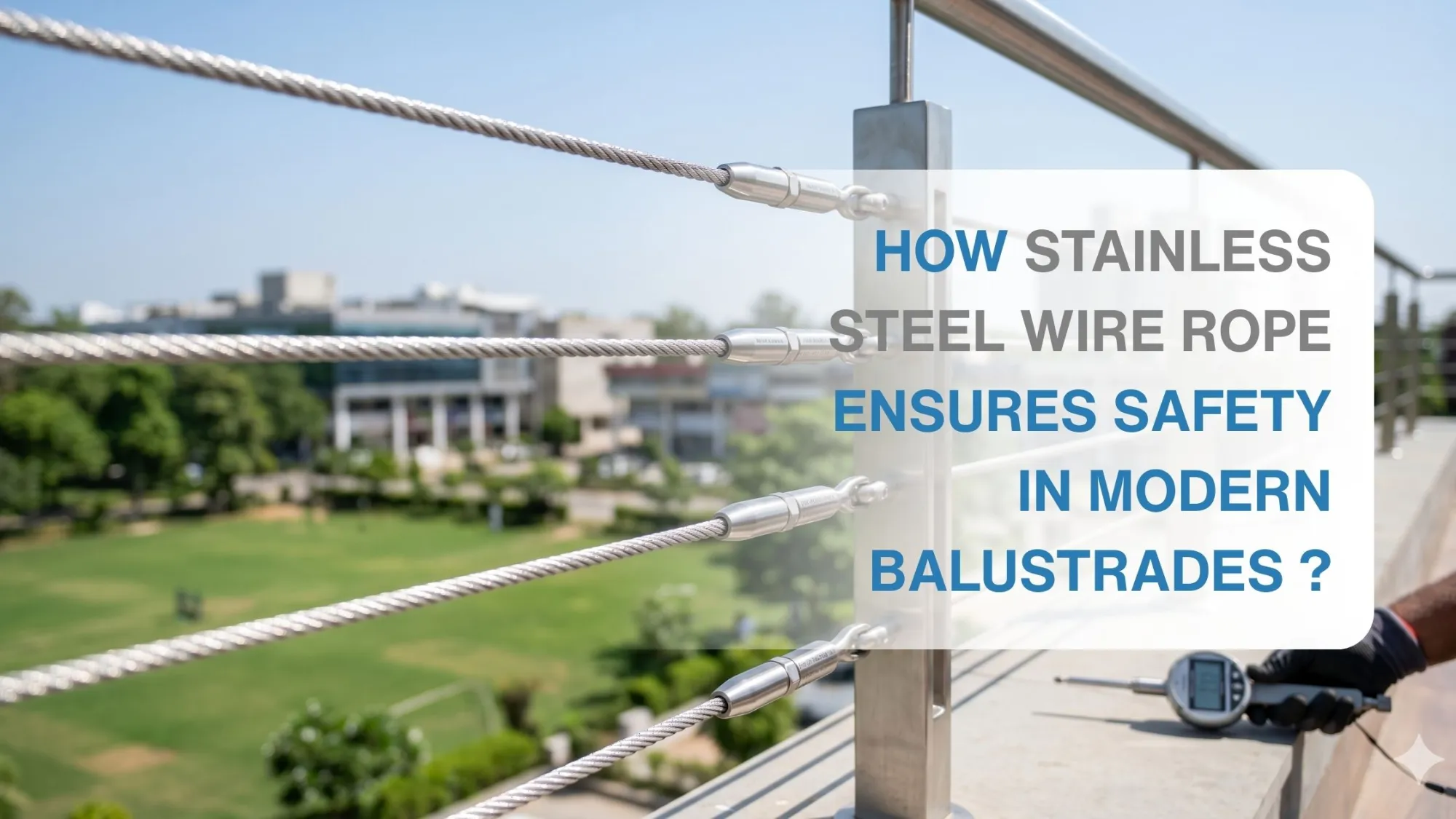

Modern architecture continuously seeks the delicate balance between unobstructed visual flow and uncompromising physical security. As structural design paradigms evolve into, bulky physical barriers are increasingly replaced by minimalist tensioned frameworks. For elevated decks, coastal balconies, and intricate staircases, securing the perimeter without sacrificing the panorama represents the ultimate architectural objective. At the forefront of this design shift is the strategic integration of premium stainless steel wire rope, an engineering solution that seamlessly merges aesthetic elegance with formidable structural fortification. By relying on advanced metallurgy and precise mechanical tensioning, modern properties can achieve unparalleled safety metrics while maintaining sophisticated, transparent sightlines.
The Structural Superiority of Stainless steel wire rope
When analyzing the foundational safety mechanics of contemporary railing designs, the implementation of stainless steel wire rope emerges as the critical load-bearing component. Unlike traditional timber, which suffers from organic degradation, or glass panels, which risk catastrophic shattering under sudden impact, high-tensile metallic cabling possesses extraordinary dynamic resilience.
This inherent elasticity allows the architectural barrier to absorb, distribute, and neutralize kinetic energy efficiently. When an unexpected load or forceful impact occurs against the balustrade, the integrated stainless steel wire rope flexes marginally to absorb the shock before returning perfectly to its original tensioned state. Furthermore, utilizing marine-grade 316 alloys ensures that this foundational structural integrity remains entirely impervious to atmospheric degradation, permanently preventing the microscopic pitting that frequently compromises inferior building materials.
The Anatomy of Structural Cables
The internal geometry of the cabling directly dictates its functional safety capacity. A stainless steel wire rope is not a singular metallic extrusion; rather, it is a complex, helically wound structure comprised of multiple individual strands. For standard straight-line architectural applications, a 1x19 construction is universally mandated. This specific configuration features nineteen individual wires tightly braided into a single, rigid strand. Utilizing a 1x19 stainless steel wire rope provides the utmost rigidity, minimizing mechanical stretch and ensuring the barrier remains unyieldingly taut, thereby preventing hazardous gaps from developing over decades of continuous use.
Engineering Reliable wire balustrade systems
A standalone high-tensile cable offers limited protective utility; its true safety capacity is realized exclusively when integrated into comprehensive wire balustrade systems. These highly engineered configurations rely on the precise synergy between robust anchoring posts, streamlined swage fittings, and the tensioned cabling.
Top-tier architectural hardware suppliers, such as those defining the premium inventory at Miami Stainless, provide components machined to exact structural tolerances. Connecting the stainless steel wire rope to architectural uprights requires hydraulically swaged terminals or sophisticated mechanical compression fittings. This rigorous hardware integration guarantees that the breaking strain of the termination points mirrors the breaking strain of the cable itself. This precise systemic engineering completely eradicates weak points, ensuring that the entire protective matrix functions cohesively to neutralize fall hazards and rigorously satisfy the stringent building codes enforced throughout 2026.
The Critical Science of balustrade wire tensioning
The ultimate safety efficacy of any cable-based barrier is entirely dependent on correct mechanical calibration. Proper balustrade wire tensioning transcends visual preference; it represents a strict regulatory requirement. If cables lack adequate tension, the resulting deflection allows for unacceptable spatial gaps, rendering the barrier critically non-compliant and hazardous to occupants.
Conversely, excessive tension places catastrophic longitudinal stress on the anchoring posts, potentially leading to structural warping or complete anchor failure. Utilizing calibrated tension gauges during the installation phase guarantees that the stainless steel wire rope maintains the mathematically optimal rigidity. This precise calibration creates an impenetrable yet practically invisible safety net, ensuring the balustrade system passes all municipal sphere-passage deflection tests.
Permanent Environmental Resilience
Structural safety represents a long-term commitment. An architectural barrier that proves secure on the initial day of installation must remain equally secure decades later, regardless of environmental exposure. The inherent metallurgical stability of premium stainless steel wire rope provides this permanent assurance.
Unlike synthetic ropes that aggressively degrade under persistent ultraviolet radiation or standard carbon steel that rapidly oxidizes in humid conditions, grade 316 cabling actively resists chemical decay. The natural, continuous formation of a self-healing chromium oxide layer protects the vital inner metallic strands from moisture, airborne salts, and harsh industrial pollutants. This natural defense mechanism guarantees that the safety parameters, tensile strength, and load-bearing capacities never diminish, providing property owners with absolute liability protection and enduring peace of mind.
Frequently Asked Questions
Q. Why is grade 316 essential for outdoor cable railings?
Grade 316 contains molybdenum, significantly enhancing its resistance to severe pitting and chloride-induced corrosion. This metallurgical composition is absolutely mandatory for maintaining structural safety in exterior environments, particularly near coastal or industrial regions.
Q. How does proper tensioning prevent balustrade failure?
Precise tensioning eliminates excessive cable deflection, preventing hazardous gaps from forming under applied pressure. Calibrated rigidity ensures the barrier safely absorbs impacts and rigorously complies with contemporary building codes regarding permissible sphere-passage limits.
Q. What construction configuration offers the highest strength?
A 1x19 construction is universally recommended for straight balustrade runs. This specific structural strand configuration offers the highest breaking load and minimal stretch, providing unparalleled rigidity and safety for straight-line architectural tensioning.
Q. Can these tensioned systems be utilized for curved staircases?
Yes, however, a 7x7 or 7x19 cable construction is required for radiused applications. These flexible configurations navigate corners and angles smoothly without compromising the overall tensile strength or safety of the continuous barrier.
Q. How frequently should the structural tension be inspected?
Comprehensive inspections should occur annually. Temperature fluctuations and building settlement can marginally alter cable rigidity. Routine verification with a tension gauge guarantees the system continuously meets the rigorous safety metrics established in 2026.
Q. Do metallic cable barriers require specialized maintenance protocols?
Routine maintenance simply requires periodic washing with warm water and mild detergent to remove surface contaminants. This preserves the passive chromium layer, effectively preventing tea staining and permanently sustaining the material's formidable strength.
Conclusion
The contemporary architectural landscape demands safety solutions that remain structurally uncompromising yet visually unobtrusive. Implementing premium stainless steel wire rope definitively answers this complex engineering challenge, providing an elegant defense against gravity and impact. By leveraging superior metallurgical science, synergistic hardware integration, and precise tensioning mechanics, developers and architects systematically establish elevated spaces that are fundamentally secure. Investing in elite-grade tensioned components ultimately guarantees a permanent, low-maintenance safety perimeter that gracefully elevates the aesthetic value of any modern property while rigorously protecting its daily occupants.























Sign in to leave a comment.