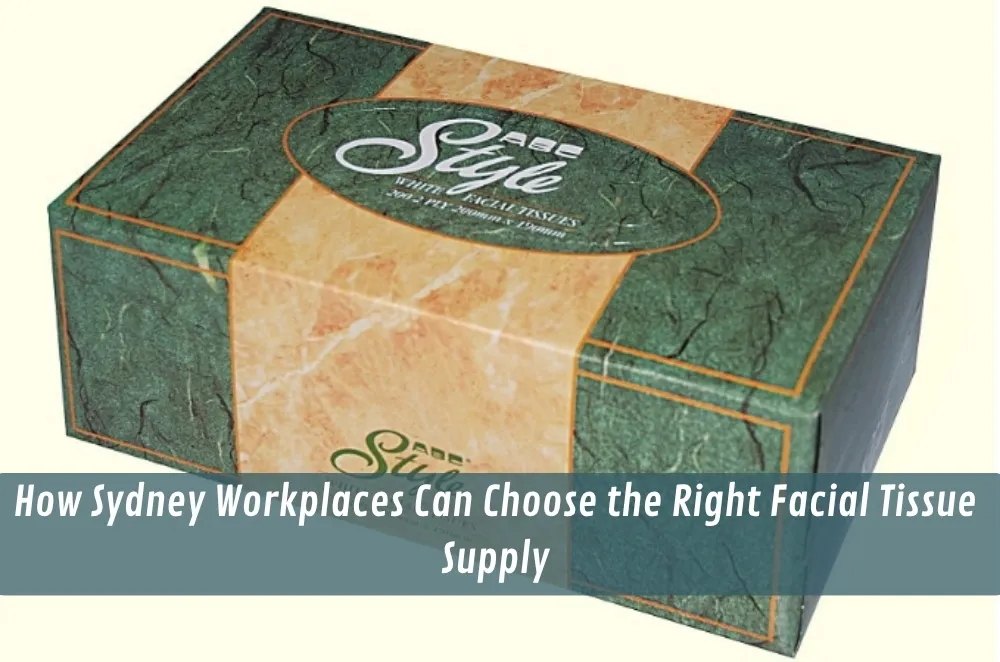

A tissue box is a small item that becomes a big problem when it’s missing at reception, messy in meeting rooms, or multiplying in the storeroom.
Most businesses don’t need “premium everything”—they need a simple standard and a reorder system that doesn’t rely on memory.
Why facial tissues become a supply problem
Tissues get used across more spaces than most teams plan for: reception, consult rooms, desks, kitchens, first-aid kits, vehicles, and shared amenities.
Because usage is spread out, the responsibility is fuzzy, and reorders happen late.
In Sydney workplaces, spikes are normal—cold season, more foot traffic, a busy week of meetings—so “last box” ordering fails fast.
Decision factors that actually matter
Placement and expectations
Customer-facing areas (reception, consult rooms) need a more comfortable option than staff-only spaces.
If people feel the tissue is “too thin” or rough, they take more, and consumption rises.
Ply, softness, and strength trade-offs
Higher ply can reduce the “double pull,” but it can also raise cost per use if people over-grab anyway.
Lower ply can be fine in back-of-house areas, but it sometimes increases usage because people compensate.
Box format and fit
When selecting facial tissue boxes for offices, box size matters more than most teams expect—especially where holders, narrow counters, or small side tables are involved.
If the box doesn’t fit the intended spot, it gets moved, borrowed, or hidden, and stockouts look “mysterious.”
Storage and handling reality
Paper products waste easily when cartons are crushed, stored near wet areas, or left on floors.
If storage is tight, prefer steady delivery cadence over massive bulk buys.
Procurement simplicity
Two tiers usually beat endless variety: one “everyday” tissue and one “comfort” tissue.
Fewer SKUs means easier ordering, easier training, and fewer substitutions.
Common mistakes that cause stockouts and waste
Letting each person or site choose their own tissue creates fragmentation and makes forecasting impossible.
Buying only on carton price often backfires when the product drives higher usage or doesn’t fit holders.
Panic-buying after one stockout leads to cramped storage and damaged cartons.
Not setting a minimum stock trigger turns every reorder into an emergency.
A simple 7–14 day plan to stabilise tissue supply
Days 1–2: Map locations. List every place that should always have tissues (including first-aid and staff rooms).
Days 2–3: Set the two-tier standard. Choose one everyday option and one comfort option, then assign each location to one.
Days 3–4: Confirm box compatibility. Check holders and tight spaces, and adjust format (or the holder) rather than “making it work.”
Days 4–5: Create a minimum stock trigger. Pick a reorder point based on delivery lead time and your busiest location’s burn rate.
Days 5–7: Lock the reorder method. Document SKUs, carton quantities, and where each option belongs.
Once you’ve chosen your two or three SKUs, keep a reference list like the business facial tissue supply so reorders stay consistent across sites.
Week 2: Adjust once, then stop tinkering. If usage is still volatile, change the trigger or cadence before changing products again.
Operator Experience Moment: I’ve seen sites that “had plenty” still run out at reception because boxes were drifting into meeting rooms during busy weeks. The fix wasn’t buying more—it was assigning each area a standard option and setting a minimum stock trigger someone actually owned. Once that’s in place, the day-to-day noise disappears.
Local SMB mini-walkthrough: a Sydney clinic example
Reception uses the comfort tissue because it’s customer-facing.
Consult rooms use the same comfort option if the box fits side tables and holders.
The staff kitchen uses the everyday option because usage is higher and expectations are lower.
They set a trigger: reorder when two unopened cartons remain in storage.
Orders are placed on a fortnightly cadence with other consumables.
A one-page SKU list lives in the storeroom and the ordering inbox.
Practical Opinions
Standardise first, then optimise.
Two SKUs beat five “almost the same” choices.
Fix triggers and storage before chasing the “perfect” tissue.
Key Takeaways
- Treat tissues like a managed consumable: map locations, standardise, set triggers.
- Two tiers (everyday + comfort) cover most workplace needs without chaos.
- Box fit and storage conditions prevent more waste than “finding the cheapest carton.”
- Minimum stock rules and cadence stop emergency reorders and overbuying.
Common questions we get from Aussie business owners
Q1) How many tissue types should we stock?
Usually two is enough: one everyday option and one comfort option. Next step: assign every tissue location to one of the two and remove ad hoc purchases. In Sydney multi-site setups, standardising across locations reduces substitutions that trigger stockouts.
Q2) Is buying in bulk the best way to save money?
It depends on storage conditions and how steady usage really is. Next step: check cartons can be stored dry, off the floor, and away from wet areas before increasing order size. In many Australian workplaces, storerooms near cleaning sinks are where “bulk savings” turn into damaged stock.
Q3) What’s the simplest way to stop running out?
In most cases, a minimum stock trigger works better than reminders. Next step: choose a reorder point tied to lead time (for example, reorder when unopened cartons drop to a set number). Around Sydney, pairing tissues with a regular consumables cadence (weekly or fortnightly) reduces forgotten items.



























Sign in to leave a comment.