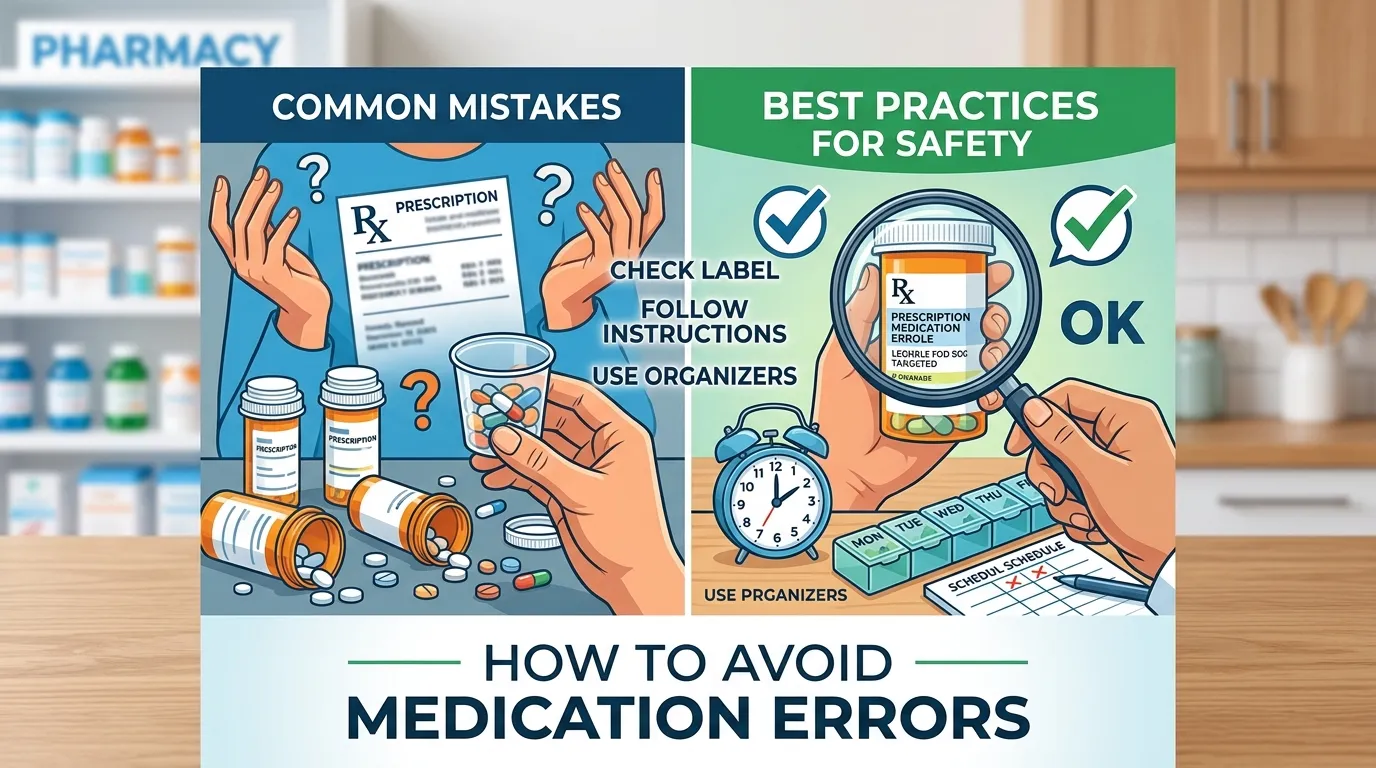

One misread label. One doubled dose. One confusing abbreviation. In the United States, medication errors cause at least one death every day and injure roughly 1.3 million people a year, according to the World Health Organization. The encouraging part: most of these mistakes are preventable.

Knowing how to avoid medication errors starts with understanding where they happen: at the prescriber's desk, in the pharmacy, and, more often than people realize, at your kitchen counter. This guide gives patients, caregivers, hospital visitors, and healthcare teams a practical framework for following prescription instructions safely, with checklists you can use today.
Quick Overview
- What it is: Habits and systems that keep the right patient taking the right medicine, at the right dose, route, and time.
- Key risk areas: Misread labels, wrong dose, missed doses, look-alike medicines, drug interactions.
- Who it's for: Patients, caregivers, clinicians, and healthcare administrators.
- Biggest lever: Asking questions and verifying instructions before the first dose.
Why Medication Errors Happen
A medication error is any preventable mistake that can lead to inappropriate medication use or patient harm. WHO estimates the global cost at about US$42 billion annually, nearly 1% of total global health spending. It also names three high-risk situations: high-risk medicines, patients taking multiple medications, and transitions of care, such as hospital discharge.
Common medication errors
The most common medication errors fall into predictable categories:
- Wrong medication errors: Picking up or taking the wrong drug, often because of look-alike, sound-alike medicines.
- Wrong dose medication errors: Taking too much or too little, including incorrect medication dosage from mismeasured liquids.
- Missed medication doses: Forgetting doses or stopping early, which undermines medication adherence.
- Medication dispensing errors: Mistakes while preparing or supplying the prescribed medicine.
- Prescription writing errors: Illegible handwriting, unclear abbreviations, or missing information from the prescriber.
- Medication errors caused by miscommunication: Information lost between prescriber, pharmacist, patient, and caregiver.
- Medication errors at home: Confusing similar pills, doubling up after a missed dose, or mixing in over-the-counter (OTC) medicines without checking.
One analysis of medication error statistics suggests people prescribed five or more drugs are about 30% more likely to experience an error, which is why the next section matters so much.
How to Read Prescription Labels Correctly
Health literacy, the ability to understand health information, shapes whether a label is understood or misread. Learning how to read prescription labels is the single most practical safety skill. Check each of these before the first dose:
- Your name and the drug name. Confirm both match your prescription. Note brand and generic names.
- Strength and dosage. Understand the prescription dosage instructions: how much, in what form, by what route.
- Frequency and timing. Know how often the medicine should be taken and whether it goes with food.
- Duration. Know how long to continue, and whether to stop on a specific date.
- Warnings. Look for drug interaction alerts, drowsiness cautions, and storage requirements.
- Refills and expiration. Track both so you don't run out or take expired medicine.
Decoding timing and abbreviations
Medication timing errors are among the easiest to make. "Twice daily" does not always mean "every 12 hours," and abbreviations like BID (from the Latin bis in die) can be misread when they are unfamiliar. If you're not sure how to interpret medication dosing frequency, our guide to understanding medication frequency explains the BID prescription abbreviation and common companions. When in doubt, ask your pharmacist to write out the schedule in plain language.
Medication Safety Checklist: Prevention Strategies That Work
These medication safety tips apply whether you're managing your own prescriptions or a loved one's. Use them as a medication safety checklist.
1. Keep one complete medication list
Maintain a current record of every prescription, OTC medicine, vitamin, and supplement, including doses and the prescriber. Bring it to every appointment and ER visit. Clinicians use it for medication reconciliation, comparing lists to catch discrepancies, especially after hospital discharge.
2. Share your drug allergies
Tell every prescriber and pharmacist about drug allergies and past reactions. Make sure they are recorded accurately in each system.
3. Use pharmacist medication counseling
A pharmacist can clarify dosage, timing, and label directions in minutes. Pharmacist medication counseling is free at most U.S. pharmacies, and it is one of the best medication error prevention strategies available. Ask: What is this for? How exactly do I take it? What should I avoid? What if I miss a dose?
4. Use the teach-back method
After patient counseling, repeat the instructions in your own words. If you can't explain it back, ask again. This supports patient medication education and catches misunderstandings before they cause harm.
5. Set up medication reminders and schedules
Medication schedule management is much easier with tools. Medication reminders for patients include weekly pill organizers, phone alarms, and pharmacy refill apps. Tie doses to daily routines, such as breakfast and bedtime.
6. Measure liquids correctly
Use the dosing syringe or cup supplied with the medicine, not a kitchen spoon. Confirm the unit (mL versus teaspoons) matches your label.
7. Check for interactions before adding anything new
Drug interactions can occur between prescriptions, OTC products, herbal supplements, and even foods. Ask the pharmacist before combining anything new.
8. Store medicines safely
Keep medicines in original, labeled containers. Store look-alike products separately and out of children's reach.
What Each Role Can Do
| Role | Key actions |
| Patients | Read labels, keep a medication list, ask questions, report side effects |
| Caregivers | Supervise administration, use organizers, track doses given |
| Pharmacists | Verify prescriptions, counsel patients, flag interactions and look-alike names |
| Prescribers | Write clear, complete orders; avoid ambiguous abbreviations; review the full list |
| Administrators | Support barcode scanning, double-checks, reconciliation workflows, and staff training |
For hospital visitors and families, remember that you are part of the safety net. Speak up if a medication looks different from usual or an infusion or dose seems unusual. Services such as a physician visiting service can also strengthen follow-up and catch medication problems at home before they escalate.
What to Do If You Make a Mistake
If you suspect a wrong medication, wrong dose, or accidental double dose, don't wait for symptoms. Call your pharmacist, your prescriber, or Poison Control at 1-800-222-1222 right away. For trouble breathing, severe drowsiness, chest pain, or loss of consciousness, call 911. Any adverse drug event (ADE) should be reported to your care team, and serious events can be reported to the FDA's MedWatch program.
Final Takeaway
Knowing how to avoid medication errors doesn't require medical training, just consistent habits: read every label, keep a complete medication list, use reminders, and ask questions until the instructions are clear. Healthcare teams share the responsibility through accurate prescribing, careful dispensing, and strong counseling. Together, these steps make medication errors at home and in the hospital far less likely.
FAQs
What is the best way to avoid medication errors?
Read the label before each dose, keep an updated medication list, and verify instructions with your pharmacist. Using reminders and a pill organizer further reduces missed or doubled doses.
What are the most common medication errors at home?
Wrong dose, missed doses, mixing up similar-looking pills, mismeasuring liquid medicine, and combining OTC products with prescriptions without checking for interactions.
What should I do if I miss a dose?
Don't automatically double up. Missed-dose rules differ by medicine, so check the label or ask your pharmacist. Many drugs have specific instructions for exactly this situation.
Why is health literacy important for medication safety?
People who struggle to interpret labels, abbreviations, or timing instructions are more likely to make mistakes. Plain-language explanations and teach-back help close this gap.
Who should I ask if my prescription instructions are unclear?
Start with the pharmacist, who can clarify dosage, timing, and label directions immediately. For questions about the prescription itself, contact the prescriber.

























Sign in to leave a comment.