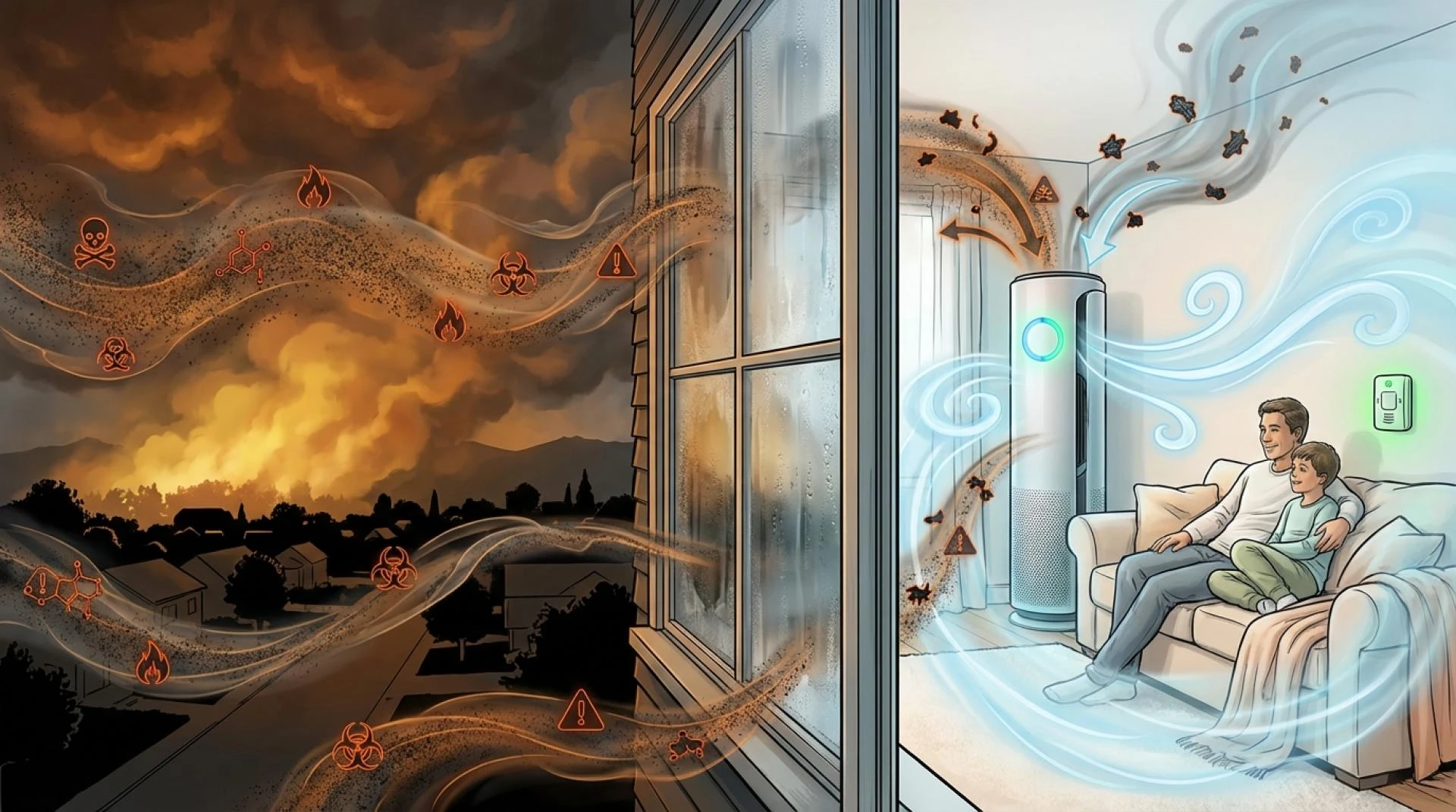

Wildfire smoke has become one of the most serious indoor air quality threats facing American households in 2026. Whether you live in the wildfire-prone states of California, Oregon, Washington, and Colorado, or thousands of miles away on the East Coast, smoke events now affect virtually every part of the country at some point during the year. When smoke seeps into your home, the damage it does to your lungs can happen quickly and silently. Investing in a high-quality smoke air filter is no longer a seasonal precaution for a handful of western states, it is a year-round health necessity for millions of American families from coast to coast.
What Wildfire Smoke Actually Contains — and Why It's So Dangerous
Most people picture wildfire smoke as the visible grey haze they see in the sky during a fire event, but the true danger lies in what cannot be seen at all. Wildfire smoke is a complex chemical cocktail that contains fine particulate matter known as PM2.5, carbon monoxide, nitrogen oxide, benzene, formaldehyde, acrolein, and hundreds of other volatile organic compounds released when vegetation, homes, vehicles, and infrastructure burn. According to Wikipedia's article on wildfire, wildfire smoke is responsible for a significant and growing share of air pollution in the United States, with its health effects extending hundreds of miles beyond the actual fire zone. PM2.5 particles, the most dangerous component, are so small that they pass straight through the body's natural defenses and penetrate deep into the lungs and bloodstream, where they can trigger respiratory distress, cardiovascular problems, and long-term organ damage even in people who consider themselves perfectly healthy.
Why Standard HVAC Filters Are Not Enough During Smoke Events
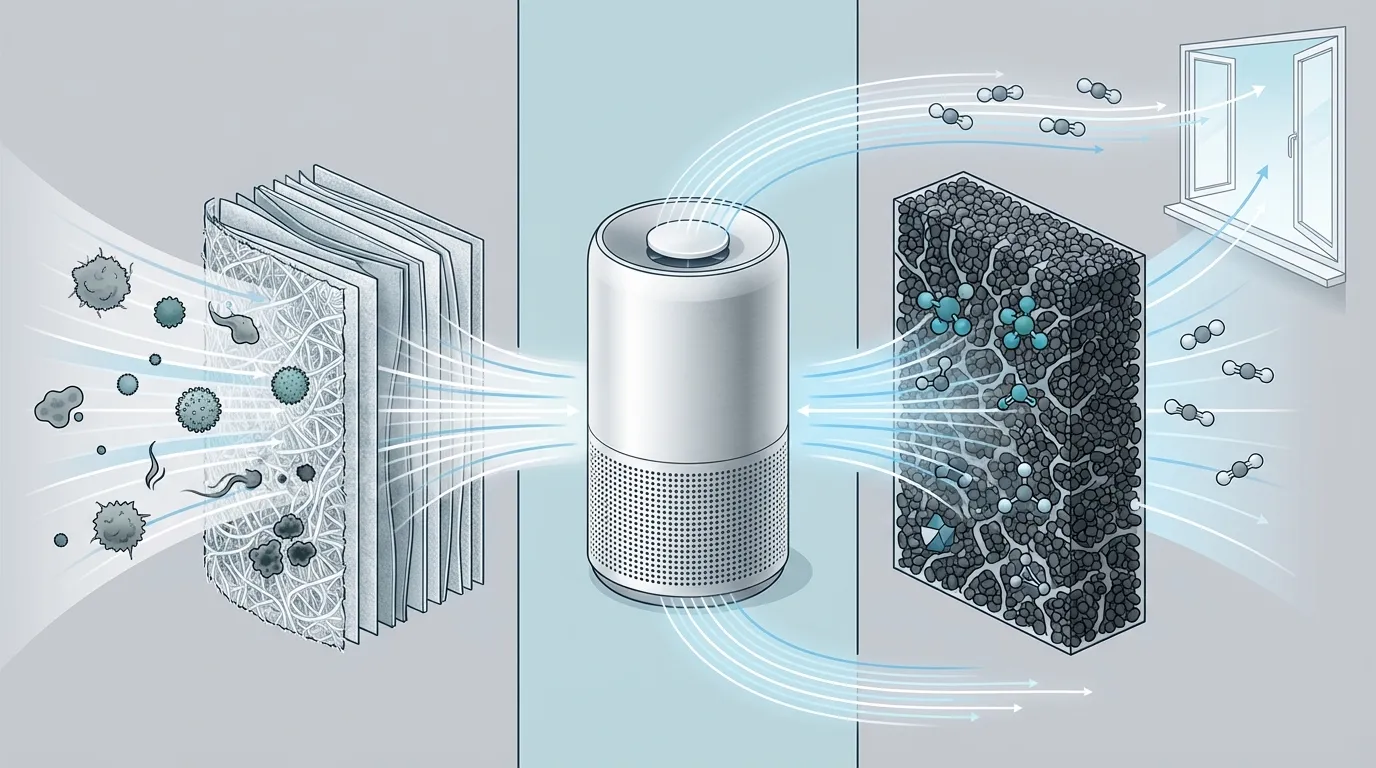
A common mistake many homeowners make during a wildfire smoke event is assuming that their existing HVAC system or a basic box fan filter will provide adequate protection. Standard HVAC filters are designed to protect the equipment, not to filter the fine particles and chemical gases present in wildfire smoke. Most residential HVAC filters have a MERV rating below 8, which means they allow the vast majority of PM2.5 particles and all chemical vapors to pass straight through and circulate throughout the home. Proper air filtration for smoke requires a dedicated portable air purifier with a True HEPA filter rated to capture at least 99.97% of particles down to 0.3 microns, combined with a deep-bed activated carbon filter to adsorb the chemical gases and VOCs that HEPA filtration alone cannot remove. Running one or more of these units in the rooms where your family spends the most time, particularly the bedroom and living room, creates a genuinely protective clean-air refuge inside your home during a smoke event, even when conditions outside are extremely poor.
HEPA and Carbon: The Two-Stage Defense Your Home Needs
When shopping for an air purifier for wildfire smoke online, the two filtration stages you should never compromise on are True HEPA and activated carbon. True HEPA handles the particle side of wildfire smoke, the PM2.5, the fine ash, the dust, and the microscopic biological material that fires release into the air. Activated carbon handles the gas side, the VOCs, the odors, the benzene, the formaldehyde, and all the other chemical compounds that make wildfire smoke so toxic and so difficult to simply air out. The critical detail that many buyers overlook is carbon filter thickness. A thin carbon sheet weighing just a few grams will be fully saturated within hours of a serious smoke event and will stop working almost immediately. A proper wildfire smoke air purifier needs a deep-bed carbon filter containing several pounds of granular activated carbon to provide meaningful and lasting chemical protection throughout a multi-day smoke event. This is the most important specification to check before purchasing any unit specifically for wildfire smoke.
Carbon Monoxide: Understanding the Invisible Risk
One of the most discussed but least understood components of wildfire smoke is carbon monoxide. A serious concern during any large fire event, carbon monoxide is a colorless and odorless gas that is produced when organic material burns without enough oxygen for complete combustion. It is toxic even at low concentrations and poses a particular risk to people sheltering indoors near a fire zone. It is important to understand, however, that a standard air purifier carbon monoxide situation requires clarification, air purifiers with activated carbon filters adsorb many VOCs and gaseous pollutants, but carbon monoxide itself is a very small molecule that is not effectively captured by activated carbon filtration alone. The best protection against carbon monoxide during wildfire season is a combination of a high-quality smoke air purifier to handle particles and most chemical vapors, paired with a dedicated carbon monoxide detector alarm in your home to alert you to dangerous concentration levels. Understanding this distinction helps you build a complete and genuinely effective indoor safety strategy during smoke events.
Sizing Your Purifier Correctly for Maximum Protection
One of the most common reasons air purifiers fail to provide adequate protection during a wildfire smoke event is simply that the unit is too small for the space it is being asked to clean. During a serious smoke event, the air inside a typical home can be exchanged with outdoor air multiple times per hour through gaps around doors, windows, and vents, continuously reintroducing smoke particles and gases into the room. This means a purifier needs to be able to cycle and clean the room's entire air volume at least four to five times per hour just to keep up with ongoing smoke infiltration. Always check the unit's CADR rating, the Clean Air Delivery Rate, and match it to the actual square footage of the room, erring on the side of a larger unit. According to Wikipedia's article on HEPA filtration, True HEPA is the global benchmark standard for capturing fine particles, and pairing it with sufficient airflow capacity is what makes the critical difference between a purifier that genuinely protects and one that simply runs in the background without making a meaningful impact on air quality.
Be Ready Before the Next Smoke Season Arrives
The single most important lesson from recent wildfire seasons across the USA is a simple one, preparation matters enormously. Air purifiers, carbon filters, and quality smoke filtration equipment sell out online within hours of a major smoke event being declared, leaving thousands of families scrambling for protection when it is already too late to order and receive a unit. The smart move is to invest in a proper air filtration for smoke solution now, before wildfire season peaks, so that your family is protected from the very first day smoke appears on the horizon. Pair your purifier with a good carbon monoxide detector, keep your windows and doors sealed during smoke events, and replace filters on schedule to ensure peak performance throughout the entire season. For families, individuals with asthma or heart conditions, the elderly, pregnant women, and young children, all of whom face heightened risk from smoke exposure, having a reliable air purifier for wildfire smoke already running in the home is one of the most proactive and impactful health decisions you can make. Explore purpose-built smoke air filter solutions engineered specifically for the complex particle and chemical demands of wildfire smoke, and give your household the clean-air protection it genuinely deserves before the next smoke event arrives.

























Sign in to leave a comment.